(303) 999-8864

Sedalia, Colorado · Douglas County · Established 2003
Luxury Residential Painting
in Sedalia, CO
A serious residential painting and finishing contractor for significant homes, custom residences, and architecturally detailed properties in Sedalia and surrounding Douglas County.
DAECO in Sedalia
A Residential Painting Contractor Built for Properties That Require It
Sedalia sits at the edge of Douglas County's open landscape, where the Front Range spreads into broader acreage and deliberate custom residential development. Properties here tend toward scale—larger footprints, longer site lines, architectural detail that reflects careful choices by the people who built or bought them. Many Sedalia homes carry mixed exterior materials, detailed interior millwork, or cabinetry investments that a production-painting model was not designed to handle well. The substrate conditions, the environmental exposure, and the finishing expectations on high-value residential properties in this area all call for a different level of technical judgment.
DAECO Painting Company has served luxury residential properties across the Front Range since 2003. More than two decades of residential work—custom homes with complex interiors, demanding exterior substrates, Fine Paints of Europe applications, and detailed cabinetry and millwork finishing—shapes how we evaluate every property we assess. That experience changes the questions we ask during a site visit, the specificity of what we propose, and the standard we hold the finished work to.
Sedalia is not a geography we've recently discovered. It's a market we understand, both in the character of its custom residential properties and in the environmental conditions that determine how coatings perform on Front Range properties over time.
Why Sedalia Requires a Specialized Approach
What Makes Luxury Residential Painting in Sedalia Different?
The direct answer: the properties themselves, the environmental conditions, and the finishing expectations all require more than a simplified commodity approach can provide.
Sedalia's residential market includes a meaningful share of larger custom homes, acreage properties, and residences with mixed architectural materials—siding types that change across elevations, extensive exterior wood, detailed interior millwork, and cabinetry that represents a significant craftsmanship investment. These conditions require a thorough in-person assessment before a proposal is written. Assumptions based on photographs, rough square-footage estimates, or brief driveway observations are not an adequate foundation for a serious project proposal.
Colorado's Front Range environment adds technical complexity. UV exposure at elevation is measurably more intense than at sea level—a factor that affects how exterior coating films degrade over time. The air is consistently dry, with humidity conditions that influence how certain coatings perform during application and cure, and how wood substrates behave through seasonal cycles. Temperature differentials between day and night, and across the seasons, test coating adhesion and film integrity on every exterior surface. South and west exposures on larger open-site properties experience conditions that erode coating systems more aggressively than a shaded suburban face on the same block.
None of this makes painting a Sedalia home difficult. It makes precise assessment and sound specification essential.
Property Character & Site Conditions
Sedalia's Residential Environment
Sedalia sits at the edge of Douglas County's open landscape, where the Front Range spreads into broader acreage and deliberate custom residential development. Properties here tend toward scale—larger footprints, longer site lines, architectural detail that reflects careful choices by the people who built or bought them. Many Sedalia homes carry mixed exterior materials, detailed interior millwork, or cabinetry investments that a production-painting model was not designed to handle well. The substrate conditions, the environmental exposure, and the finishing expectations on high-value residential properties in this area all call for a different level of technical judgment.
DAECO Painting Company has served luxury residential properties across the Front Range since 2003. More than two decades of residential work—custom homes with complex interiors, demanding exterior substrates, Fine Paints of Europe applications, and detailed cabinetry and millwork finishing—shapes how we evaluate every property we assess. That experience changes the questions we ask during a site visit, the specificity of what we propose, and the standard we hold the finished work to.
Sedalia is not a geography we've recently discovered. It's a market we understand, both in the character of its custom residential properties and in the environmental conditions that determine how coatings perform on Front Range properties over time.
Ready to Transform Your Denver Home?
Free consultation · $0 down up to $20K · 22+ years experience
What the Evaluation Covers
What a Serious Luxury Painting Assessment Includes
Before a meaningful proposal can be written for an architecturally detailed home, the property needs to be evaluated in person—carefully, and with specific questions in mind.
On the exterior, a thorough assessment examines the current coating condition on each substrate type, identifies adhesion failures and surface deterioration, evaluates caulk condition, inspects wood for evidence of moisture infiltration or UV degradation, and establishes the repair scope required before any coating work begins. On the interior, the assessment means understanding the finish expectations for each space: whether a room calls for standard wall painting, smooth-wall preparation with high-visibility finishing, or fine finish work on architectural millwork that will be examined at close range under directional light.
A homeowner evaluating contractors should take note of what a contractor actually examines during a site visit. A contractor who arrives, takes a quick walk around the exterior, and produces a number within minutes has not conducted the kind of assessment that a substantial residential project requires. Substrate conditions, preparation requirements, and the appropriate coating system for each surface are not things that can be accurately determined from the driveway.
DAECO visits Sedalia properties to conduct a thorough evaluation before a proposal is written. What we find during that assessment directly informs what we propose—and that specificity is part of the value a homeowner is contracting for.
The Foundation of Every Fine Finish
Preparation Is the Specification
Every residential painting contractor will tell you that preparation matters. The more useful question is what preparation actually means in practice—because the answer changes substantially based on the substrate, the surface condition, and the finish being pursued.
On a standard interior, preparation means patching nail holes, cleaning surfaces, and applying primer. On a high-visibility surface where walls will receive a smooth finish and be inspected under directional light, preparation means surface leveling, raking-light inspection between coats, careful joint treatment, priming, sanding, and re-inspection before the topcoat is applied. The standard that defines "prepared" is set by the finish that follows. On a custom home with sophisticated interior expectations, that standard is considerably higher than on a conventional repaint.

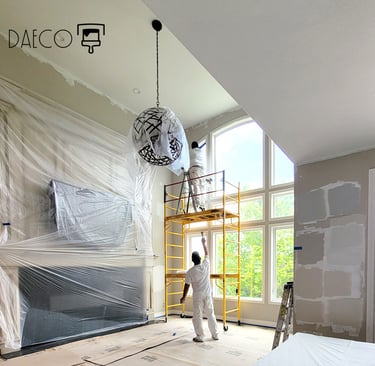
This is especially true with higher-sheen finishes, Fine Paints of Europe systems, and any architectural surface—millwork, cabinetry, doors, built-ins—that receives close-range examination under varied light. Preparation is not a line item to minimize in the interest of a lower estimate. On a luxury residential project, it is the specification.
A premium topcoat cannot conceal inadequate preparation under close inspection and raking light. The quality of what's underneath is always present in the finished surface.
Technical Understanding
Coating Systems vs. Paint Products
There is a persistent misconception in residential painting: that the product determines the result. In practice, the coating system determines the result—and a coating system is considerably more than a can of paint.
A complete coating system for a given substrate and exposure includes the substrate in its current condition, the preparation that brings it to an appropriate standard, any necessary repairs, the primer specified for adhesion and topcoat compatibility, intermediate coats where the application calls for them, the topcoat selected for that surface and exposure, the application method chosen for the surface and product, the environmental conditions during application, and the cure conditions that follow. Change any one of these variables and the outcome changes with it.
A high-quality topcoat on a substrate that hasn't been properly prepared will underperform. A sound primer on the wrong substrate can create adhesion failures. An otherwise excellent product applied outside its rated temperature range may degrade prematurely regardless of its laboratory performance. The product alone cannot overcome the system surrounding it.
DAECO Pro System™— Substrate-specific coating specification for each surface and exposure
DAECO's approach—what we call the DAECO Pro System™—is built around a single discipline: the system is specified for the substrate and the exposure in front of it, not applied uniformly across every surface on the property. A contractor with the experience to make those distinctions produces a materially different result than one who applies a single product everywhere because it carries a recognizable label.
This distinction matters particularly on Sedalia custom homes, where different substrates on the same property—wood siding, previously painted composite materials, cedar trim, stucco, masonry, drywall, cabinetry, and architectural millwork—may each require a different evaluation before a coating approach is selected.
DAECO Pro System™ — What a Complete Coating System Includes
01
Substrate Evaluation
Material type, condition, adhesion history, and repair needs before any coating is selected
02
Surface Preparation
Cleaning, sanding, repairs, filling, and deglossing specific to each surface type
03
Primer Selection
Specified for the substrate and the topcoat it must support—not chosen from habit
04
Application Method
Brush, roller, spray, or combination based on the surface type and product characteristics
05
Topcoat Selection
Matched to substrate, exposure, sheen requirement, and long-term performance needs
06
Conditions & Cure
Temperature, humidity, and time managed during and after application for proper film formation
Interior Painting
Interior Painting for Custom Homes
High-end residential interior painting is not primarily a product question. It is a preparation and application question—and the requirements change substantially based on the surfaces involved and the finish expectations in each space.
In an architecturally detailed home, interior surfaces are not uniform. Entry spaces and great rooms may carry high ceilings, architectural millwork, and wall finishes intended to hold up under close-range inspection and directional light. Hallways and utility spaces can tolerate a different standard. Cabinetry and built-ins represent a finishing discipline separate from wall painting. Trim and door profiles may require a level of smoothness and film consistency distinct from adjacent wall surfaces.
When sunlight rakes across a wall at a low angle, or when an interior light throws at an acute angle across a door panel or built-in, inadequate substrate preparation becomes visible in the finished surface. There is no topcoat that conceals poor preparation from a knowledgeable observer with appropriate light.
DAECO approaches high-end residential interiors with a raking-light inspection standard. Surfaces are evaluated under varied light conditions during preparation—not only at the end of the project. Color transitions, sheen differentials between trim and wall surfaces, and the consistency of spray-applied fine finishes are monitored throughout the work, not assessed in a final walk-through after the fact.
Our residential interior painting service covers the full range of interior work we provide, from standard residential refinishing to fine architectural finishing on high-visibility surfaces.


Ready to Transform Your Denver Home?
Free consultation · $0 down up to $20K · 22+ years experience
Cabinetry & Millwork
Cabinetry, Millwork & Architectural Details
Cabinetry and architectural millwork are among the most visible, most handled, and most scrutinized surfaces in a home. They should not be approached as an extension of interior wall painting—they are a distinct finishing discipline that requires different materials, different preparation methods, and different application practices.
The process begins at assessment. The existing surface needs to be evaluated for condition, adhesion history, material composition, and what it will need to properly accept and hold a fine topcoat over time. Where existing finishes have sound adhesion, preparation focuses on careful scuff-sanding, deglossing, and priming for compatibility with the intended topcoat. Where existing finishes have failed or the surface is being brought to a substantially higher standard, the preparation requirement is more significant.
Primer selection for cabinetry differs from primer selection for drywall. The products need to bond to different surfaces, support different topcoats, and resist the specific stresses that cabinetry faces: frequent handling, moisture exposure in kitchen and bath environments, and the thermal cycling that causes wood to expand and contract through Colorado's seasons.
Fine finishes on cabinetry and millwork are typically spray-applied where conditions allow. Spray application produces a surface consistency that brush work cannot match on flat panel surfaces. It requires careful masking and protection of surrounding areas, precise product preparation, appropriate application conditions, and adequate cure time before the surface is handled, closed, or reinstalled.
The objective is a surface that holds up to bright kitchen lighting, close-range examination from any angle, and years of normal residential use. Our cabinetry and millwork finishing service page covers this work in more detail.
Exterior Painting & Colorado Exposure
Exterior Painting & Colorado's Environmental Reality
Colorado's exterior environment places specific demands on coating systems—demands worth understanding before a coating specification is written for a Sedalia property.
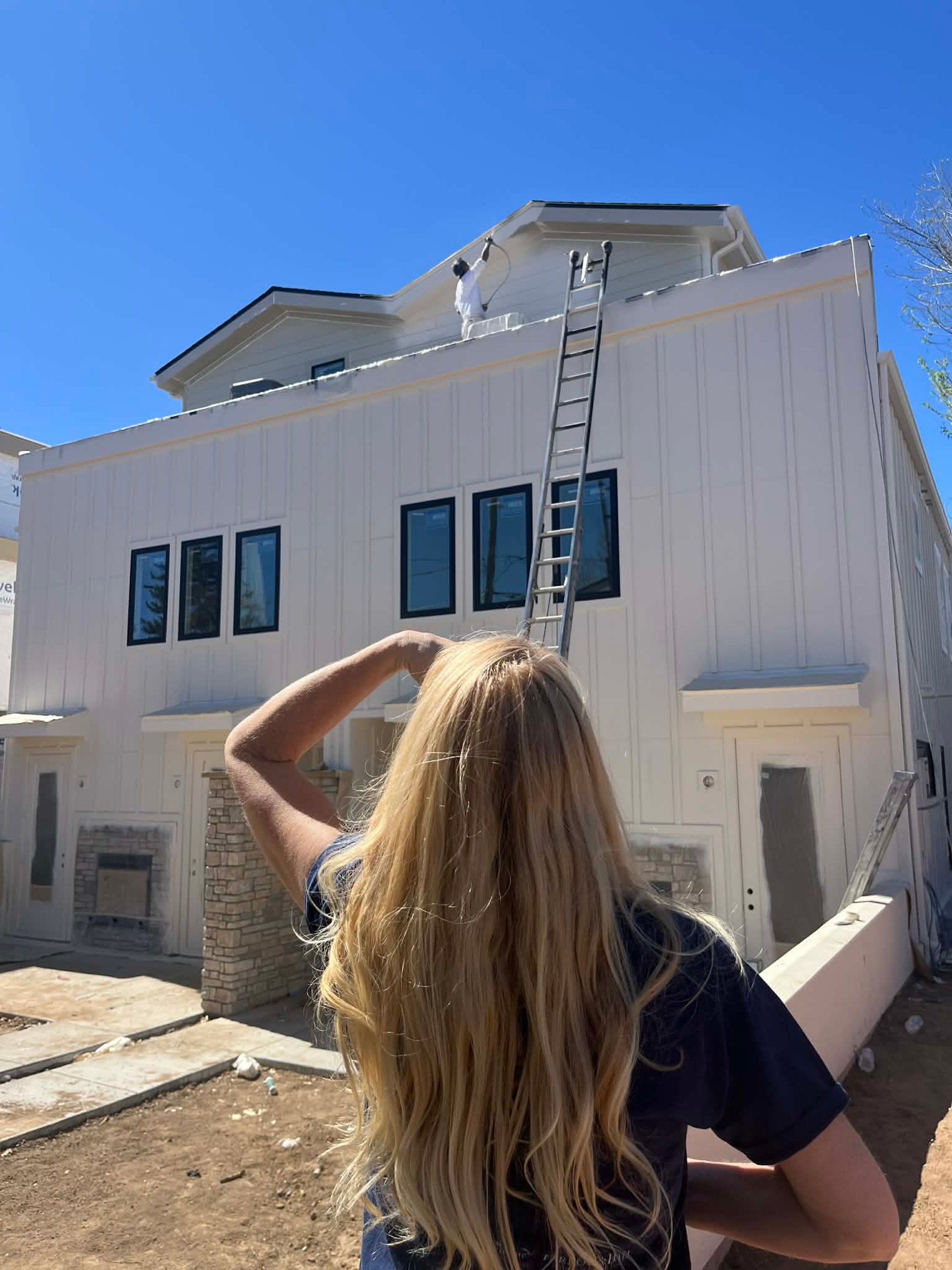
UV exposure at Front Range elevation is more intense than at sea level, a factor that directly affects how exterior coating films break down over time. The air is consistently dry; low humidity affects how certain film-forming products perform during application and cure, and how wood substrates respond to moisture cycling through the seasons. Temperature differentials between day and night can be substantial even in mild months, and the seasonal transition from Colorado summers to winters tests coating adhesion and film integrity on every exposed surface.
South and west exposures tend to bear the most demanding conditions: maximum direct sun, maximum UV load, and the greatest temperature swings. On a larger Sedalia property with significant exterior elevations, a south-facing façade may experience conditions materially different from a north-facing one. DAECO's Climate Protocol™ evaluates each elevation's specific orientation before a product recommendation is made—because applying the same exterior system to every face of a custom home, regardless of aspect, doesn't reflect how Colorado's environment actually behaves.
Exterior wood deserves particular attention in this environment. Wood moves—it expands with moisture and contracts in dry conditions, and it is susceptible to UV degradation and moisture infiltration if coating protection fails or cracks. A coating system on exterior wood needs appropriate film flexibility, UV resistance, and moisture management characteristics. The preparation—cleaning, sanding, spot priming, and full prime application—directly determines how the topcoat performs through the seasons that follow.
How long will an exterior coating last on a Sedalia property? The honest answer depends on the substrate condition at the time of application, the preparation conducted, the coating system selected, the specific exposure of that elevation, the application conditions, and whether the property receives any maintenance attention between major repaints. Preparation quality and the appropriateness of the coating system for the specific exposure are consistently the strongest determinants of performance. Our exterior painting service covers the full scope of exterior work we undertake, including exterior wood preservation and finishing for properties with significant wood exposure.
DAECO Pro System™— Substrate-specific coating specification for each surface and exposure
Fine Paints of Europe & Specialty Interior Finishes
Fine Paints of Europe & Specialty Architectural Coatings
Application discipline is equally important. The Hollandlac system has specific working characteristics, thinning requirements, and environmental conditions under which it performs as specified. Cure conditions—temperature, air movement, and the time allowed before a surface is handled—affect the final result in ways that cannot be recovered after the fact. The DAECO FPE System™ is the framework we use to ensure substrate preparation, application conditions, and cure management all align before this work proceeds on any interior architectural surface.
DAECO's familiarity with Fine Paints of Europe comes from working with these products on significant interior projects over many years—informed by direct experience with how these systems respond to different substrates and application conditions. For clients in the Sedalia and Castle Rock area considering Fine Paints of Europe for an interior architectural application, our Fine Paints of Europe service page provides additional context.


DAECO has extensive working experience with Fine Paints of Europe products, including the Hollandlac system, for high-end interior architectural applications. These products are appropriate in specific situations: fine millwork, high-visibility architectural surfaces, cabinetry and doors where the objective is a lacquer-like depth and consistency of finish that standard residential products are not designed to produce. Our experience with these systems is specifically in interior architectural contexts—cabinetry, millwork, built-ins, and other surfaces where preparation quality and application discipline directly define the result.
DAECO FPE System™— Fine Paints of Europe interior specification: preparation, application conditions, and cure management
What makes Fine Paints of Europe systems perform as intended is the substrate preparation that precedes application. These finishes amplify surface conditions rather than concealing them—every variation in substrate smoothness, every inadequately filled imperfection, becomes more visible under the reflective sheen of a fine architectural topcoat. The preparation standard required is higher than most residential painting demands, and it must be inspected at close range under directional light before the finish coat is applied.
Acreage & Rural Property Planning
Acreage Property Logistics, Protection & Sequencing
Not every Sedalia property presents the site considerations that come with rural or acreage character. But on certain properties in this area, site conditions introduce planning factors that don't arise on a standard suburban lot—and they matter as much as product selection.
On properties with unpaved approaches or rural driveways, normal vehicle movement can generate dust conditions incompatible with exterior coating work. Particles settling on a freshly applied surface before it has set create quality issues that have nothing to do with the product chosen or the application technique used. On properties where equestrian or agricultural activity is normal, coordinating site timing becomes part of managing the project correctly—not a logistical nicety.
Wind is a persistent factor on certain Front Range open-site properties, particularly on elevated or exposed acreage. Coating application in excessive wind creates overspray risk and can cause premature solvent evaporation that compromises film formation. Timing exterior coating work to appropriate weather windows—and understanding a specific site's prevailing conditions—is part of responsible project planning.
Landscaping protection on larger properties requires a different level of planning than on a standard suburban lot. Established plantings, mature trees, lawn areas, and natural ground cover all require careful drop-cloth and masking procedures when spray application is involved. The time required to protect them properly should be reflected in how a project is scoped, not discovered mid-project.
Sequencing on substantial exterior projects matters in its own right. On a property with multiple substrates requiring different products and drying windows, and where scaffolding or equipment may be needed to access upper elevations, the order of operations affects both quality and efficiency. We discuss site conditions, access, timing, and sequencing during the initial evaluation of any Sedalia project where these factors are relevant.
Professional Documentation
What a Professional Proposal Should Document
A painting proposal for a high-value residential property should be specific enough that a homeowner can understand exactly what is being proposed—and compare it meaningfully against other proposals received.
"Paint exterior, prep as needed" is not a meaningful specification for a luxury residential project. It tells the homeowner almost nothing about what will actually happen on their property.
That language doesn't define which substrates will be addressed, what preparation the contractor considers adequate, what coating system will be applied, or how much of the project scope is subject to the contractor's discretion after work begins. It also makes it nearly impossible to compare proposals from multiple contractors, because one contractor's "prep as needed" may mean something entirely different from another's—and neither party is accountable to anything specific.
A professional proposal for a custom home or acreage property should address:
A homeowner who receives two proposals—one detailed and one vague—should not assume the detailed one will be more expensive. They should recognize that the detailed one is more honest about what the work actually involves. That honesty protects both parties when field conditions reveal themselves during the project.
Substrate Conditions
What was observed during the assessment, and what those conditions require
Defined Scope
Which surfaces, elements, and areas are included—and which are explicitly excluded
Preparation
What preparation will be performed for each surface type, and to what standard
Coating Systems
Specific product lines for each substrate or surface category—not a generic reference to "exterior paint"
Protection Measures
How non-painted areas—flooring, furnishings, landscaping—will be protected
Access & Equipment
How upper elevations or difficult areas will be reached and what equipment is required
Sequencing
Order of operations for complex multi-substrate or multi-area projects
Schedule Estimate
Realistic timeframe for the defined scope under normal site and weather conditions
Change Conditions
When and how scope changes will be identified, priced, and approved
Ready to Transform Your Denver Home?
Free consultation · $0 down up to $20K · 22+ years experience
Evaluating Proposals Intelligently
How to Compare Luxury Painting Bids
When comparing proposals for a custom or acreage property, scope comparison is more useful than price comparison—particularly when the proposals haven't been confirmed to address the same work.
Start with scope alignment. Is each proposal addressing the same surfaces, the same preparation, and an equivalent coating system? If one contractor has identified substrate conditions requiring repair before painting and another has not mentioned those conditions, they are not bidding the same project—regardless of whether the price reflects it.
Evaluate coating-system specificity. A proposal that names specific product lines for each substrate type is proposing something materially different from one that references generic "exterior paint." Ask which products are being proposed and why, and what preparation those products require on each surface type.
Ask directly about preparation. A contractor who can explain specifically what preparation means on your property—what they observed during the site visit, what it requires, and how they'll address it—has actually evaluated the project. Vague general answers about "thorough preparation" suggest the contractor is working from assumptions rather than from assessment.
Understand change-order practices before work begins. Conditions that are hidden until work starts—substrate deterioration below the existing coating, repairs more extensive than initially visible—are a normal part of residential painting work. How a contractor handles those conditions once the project has started is worth understanding in advance.
Verify insurance. Any contractor working on an established residential property should carry appropriate general liability coverage and workers' compensation for their crew. Requesting a certificate of insurance before work begins is standard professional practice—not an unusual or aggressive request.
Understanding the Distinction
What Separates Luxury Residential Painting from Production Painting?
Luxury Residential Approach
Designed for homes with specific substrate and finish requirements
Assessment before scope — substrate drives the specification
Preparation defined by the finish and surface condition
Coating system specified per substrate and exposure
Architectural sensitivity in application and protection
Sequencing, inspection, and communication throughout
Formal documentation and accountability at every stage
Production residential painting serves a real market. Properties that need a clean, serviceable repaint—priced for value and completed efficiently—benefit from a production model built around speed, standardized scope, and systemized application. Those are genuine strengths for what the model is designed to do.
Luxury residential painting is a different discipline. The distinction isn't about which paint brand is specified—it's about how a project is evaluated, specified, executed, and inspected.
Production Approach
Optimized for efficient delivery on standard residential work
Scope based primarily on square footage
Standardized preparation regardless of substrate
Minimal differentiation between surface types
Speed and volume as key performance metrics
Systemized application methods across all surfaces
On a property with fine woodwork, architectural millwork, detailed cabinetry, mixed exterior substrates, and interior surfaces inspected at close range, the first approach produces inadequate results for that property. The second is what the property requires. This distinction is worth understanding clearly before choosing a contractor for a Sedalia home with real architectural detail.
DAECO Painting Company
DAECO's Approach to Sedalia Residential Paint Projects
DAECO has been a residential-focused painting and finishing contractor since 2003. More than two decades of work on custom homes across the Front Range—properties with complex interiors, demanding exterior conditions, detailed architectural elements, and owners with clear expectations about finish quality—has shaped the standards we apply to every project we take on in Sedalia and across Douglas County.
Our painters are in-house employees. We don't use subcontractor crews for core painting work. The people conducting preparation are the same people executing the application, accountable to the same standards throughout the project. When a DAECO project manager evaluates a property and writes a specification, the crew executing that specification has the experience to understand what it requires—because this is the level of work they've done, consistently, over a long career in residential painting and finishing.
DAECO does not take on commercial work. We don't compete for high-volume production residential contracts. The residential focus is deliberate, and it shapes everything about how we operate—who we hire, how we conduct assessments, what we specify, and how we manage the work in progress. Our reputation in this market comes primarily from referrals, which means the quality of completed work is what drives the next project.
Sedalia is within the geographic range we've served throughout our company's history. The properties there are the kind of work our company was built for: architecturally detailed homes, high finishing expectations, and owners who understand the difference between a contractor who has genuinely evaluated a property and one who hasn't.
For significant homes in Sedalia, the process begins with a site evaluation—not a price call. We need to understand a property before we can honestly propose work on it.
What We Do in Sedalia
Prodessional Residential Painting & Finishing Services in Sedalia
The following services represent the work DAECO performs on Sedalia residential properties. Each is approached through the DAECO Pro System™—substrate evaluation first, coating specification second, with preparation standards appropriate to the surface and the finish expectation in front of it.
Interior Painting
Residential Interior Painting & Fine Finishing
From standard residential refinishing to smooth-wall preparation and raking-light inspection on high-visibility surfaces. Our interior work accounts for surface type, sheen requirements, color transitions, and the consistency expected at close range under varied light. Interior painting details.
Exterior Painting
Exterior Coating & Surface Preparation
Exterior work specified by substrate and exposure orientation—not applied uniformly across all surfaces. Includes assessment of existing coating condition, repair scope, primer selection, and topcoat specification under the DAECO Climate Protocol™ for Colorado environmental conditions. Exterior painting details.
Residential Wallcoverings
Wallpaper & Interior Finishing
Wallcovering installation begins long before the first panel is hung. DAECO evaluates the wall surface, existing texture, repairs, porosity, primer requirements, seams, pattern alignment, and the conditions that can affect how a wallcovering ultimately looks and performs. Our work includes wallpaper and specialty wallcoverings for refined residential interiors, with careful attention to smooth-wall preparation, transitions, corners, ceilings, architectural detail, and high-visibility areas. Interior painting and wallcovering are often coordinated as part of the same finishing sequence so each surface meets the same level of preparation and precision. Wallpaper & wallcovering installation details.
Cabinetry & Millwork
Cabinetry, Built-ins & Architectural Millwork
A distinct finishing discipline—not an extension of wall painting. Proper surface preparation, appropriate primer selection, spray application where conditions allow, and cure management for surfaces that receive daily handling and close-range visual scrutiny. Cabinetry and millwork finishing.
Fine Paints of Europe
Fine Paints of Europe — Interior Architectural Applications
Applied through the DAECO FPE System™ on appropriate interior surfaces: high-end millwork, cabinetry, doors, and architectural elements where depth and film consistency are the objective. Preparation, application conditions, and cure management are all specified before the work begins. Fine Paints of Europe information.
Exterior Wood
Exterior Wood Preservation & Finishing
Wood is among the most maintenance-sensitive substrates on Colorado Front Range properties. Our exterior wood work includes cleaning, sanding, spot treatment, appropriate primer application, and topcoat selection suited to Colorado UV exposure and seasonal moisture cycling. The DAECO Wood Preservation Approach™ guides substrate assessment through final coating specification. Exterior wood preservation.
Specialty Coatings
Specialty Architectural Coatings
For surfaces that require something beyond conventional residential products—architectural finishes, specialty sheens, and coatings specified for performance on demanding substrates. Application technique, environmental conditions, and cure management are part of how specialty coatings are executed correctly on custom homes.
Custom & Acreage Properties
Custom Residences & Acreage Properties
Larger properties and custom-built homes in Sedalia require planning that goes beyond product selection: site assessment, sequencing across multiple substrates and elevations, access planning, landscaping protection, and coordination of application timing with Colorado's environmental conditions. DAECO approaches these properties through a full pre-project site evaluation—the specificity of that evaluation is reflected directly in the proposal that follows. Our residential painting overview covers the full range of projects we take on across the Front Range.
Further Reading · Sedalia Residential Painting
"If You Own a Significant Home in Sedalia, Here's What to Expect From a Serious Luxury Residential Painting Contractor"
A detailed look at what a serious residential painting process should look like—from initial assessment through proposal review, execution, and final inspection—for owners of custom and acreage properties in Sedalia.
Geographic Service Area
Sedalia and Surrounding Douglas County
Sedalia, CO
Douglas County
Castle Rock
Castle Pines Village
Denver Metro
Front Range Corridor
DAECO serves luxury residential properties throughout the Front Range corridor. Sedalia's location within Douglas County places it within a geography we've worked in consistently since our founding—a region that includes some of the most architecturally detailed custom residential properties along the Front Range.
Our work in the communities surrounding Sedalia—Castle Rock, Castle Pines and Castle Pines Village, and the broader Denver metro area—reflects the same technical standards and residential focus we bring to every Sedalia project. The environmental conditions, the architectural character, and the finishing expectations across this geography are closely connected. A client in Castle Rock and a client in Sedalia are dealing with the same Colorado UV exposure, the same dry-air substrate dynamics, and many of the same mixed-material construction realities. The geographic relationship matters not as marketing language, but because the same coating system knowledge and preparation standards transfer across it.
Guide to Hollandlac & When It's Appropriate
Exterior Wood Preservation & Finishing
Castle Rock Luxury Residential Painting
Castle Pines & Castle Pines Village Painting
What to Expect From a Serious Sedalia Painting Contractor
Related Services & Resources
DAECO Residential Painting — Service Overview
Residential Interior Painting
Exterior Painting Services
Cabinetry & Millwork Finishing
Fine Paints of Europe Applications
Common Questions
Questions Sedalia Homeowners Ask About Luxury Residential Painting
Whatshould I look for in a luxury residentail painter in Sedalia?
Start with the site evaluation process. A contractor serving an architecturally detailed property should arrive, examine it carefully—substrates, existing coating condition, repair scope, finish expectations for each area—and produce a proposal that reflects what they actually found. A contractor who produces a number without a thorough on-site assessment has not done the work required to propose accurately.
Beyond that, ask about coating-system specificity: can they name which products they're proposing for which surfaces, and why? Ask about preparation standards and what they mean in practice on your specific substrates. Ask whether their painters are in-house employees or subcontracted. Request a certificate of insurance. And ask how they handle scope changes if conditions reveal themselves during the work. A contractor who answers those questions clearly and specifically has the experience to execute the project correctly.
Why is painting an acreage property different from painting a suburban home?
Several factors combine to create a different planning environment. Larger properties have greater exterior square footage and often more mixed substrates—materials that change across elevations and require different preparation and coating approaches for each. Access for equipment, crew sequencing, landscaping protection, and management of environmental conditions on the days of application all become meaningful planning considerations that simply don't arise on a standard suburban lot.
On certain Sedalia acreage properties, site-specific factors matter further: unpaved approaches can generate dust incompatible with exterior coating work, wind exposure on open sites affects application windows, and equestrian or agricultural activity may need to be coordinated around project timing. Sequencing and site management can be as important to the final result as product selection—and they need to be planned for in the proposal, not addressed as surprises on the first day of work.
Does expensive paint guarantee a better result?
No—and understanding this is one of the most useful things a homeowner can take into a contractor evaluation. A premium topcoat applied over inadequate preparation will not produce a fine result. The preparation is what makes the finish possible. The product delivers on that foundation, not despite its absence.
The quality of a coating result depends on the substrate condition at the time of application, the preparation conducted, the appropriateness of the coating system for that specific substrate and exposure, the application conditions, and the experience of the people executing the work. A high-quality product is one component of a well-specified system. It does not compensate for the other components when they're missing or inadequate. A contractor who leads with product brand rather than preparation specifics has their priorities inverted.
How should exterior coatings be selected for Colorado conditions?
Colorado's exterior environment places specific demands on coating systems: intense UV exposure at Front Range elevation, consistently dry air, significant temperature swings, and—on exposed south and west elevations—conditions that degrade coating films more aggressively than many national coating averages assume.
Coating selection for Colorado exteriors should account for UV resistance appropriate for high-altitude exposure, film flexibility suited to wood substrates moving through seasonal humidity cycles, and adhesion characteristics suited to each specific substrate. The DAECO Climate Protocol™ evaluates each elevation's specific orientation before a product recommendation is made. A south-facing wall and a north-facing wall on the same property may warrant different approaches—and a contractor who specifies the same product universally across all exposures hasn't engaged with these variables.
What makes a painting proposal appropriate for a high-value home?
Specificity and completeness. A proposal for a custom home or acreage property should document the defined scope, the substrate conditions observed during assessment, the preparation that will be performed for each surface type, the coating systems proposed, protection measures, access and sequencing where relevant, an estimated schedule, and how scope changes will be handled if field conditions differ from what was initially visible.
A vague proposal protects the contractor, not the homeowner. "Paint exterior, prep as needed" tells you nothing about what will actually happen on your property—and it makes it essentially impossible to hold the contractor accountable to a specific standard, or to compare the proposal meaningfully against alternatives. Specificity is how both parties understand what is being agreed to before work begins.
Who handles Fine Paints Of Europe in the Sedalia and Castle Rock area?
DAECO has worked with Fine Paints of Europe products, including Hollandlac, on significant residential projects throughout the Front Range over many years. Our experience with these systems is specifically in interior architectural contexts—fine millwork, cabinetry, doors, and high-visibility surfaces where depth and film consistency are the objective. The DAECO FPE System™ is the framework we use to ensure preparation, application conditions, and cure management align before this work proceeds.
If you're considering Fine Paints of Europe for a Sedalia, Castle Rock, or Castle Pines property, we're able to evaluate whether these systems are appropriate for the specific surfaces involved and what preparation they'll require to perform as intended. Not every interior application warrants an FPE system, and we'll say so directly if a standard architectural coating is the right choice for the surface in question.
A Serious Project Begins with an Evaluation of the Property
We don't produce estimates based solely on square footage. We visit Sedalia properties, assess what's there—substrates, conditions, finish expectations, site considerations—and propose what the project actually requires. If you own a custom home or acreage property in Sedalia or the surrounding Douglas County area and are considering a serious painting or finishing project, we'd welcome the opportunity to evaluate it.
DAECO Painting Company · Denver & Boulder · Serving the Front Range Since 2003
303-999-8864
DAECO PAINTING COMPANY© 2026. All rights reserved.
Service Solutions
Paint Options



Local Service Locations
DAECO Painting, established in 2003, is a trusted and recognized high-end paint and decorating contractor. We specialize in custom luxury residential painting projects, including repaints, historical restorations, and new construction homes and lofts. Our expertise lies in delivering flawless Level 5 finish results, with a primary focus on high-end fine finish repaints and new custom home builds and remodels. We cater to all residential clients, from the average consumer to the elite, and our commitment to quality and service remains consistent across every project.