(303) 999-8864

Benjamin Moore Georgian Brick HC-50 South Denver | Interior Color Guide
Benjamin Moore Georgian Brick HC-50 South Denver interiors explained with Cotton Balls OC-122. Explore lighting behavior, LRV data, and expert application by DAECO Painting.
INTERIOR DESIGNLOCAL SERVICESBENJAMINE MOORE PAINTS
DAECO PAINTING
2/6/20267 min read
South Denver Interior Mastery | DAECO Painting
The Atmospheric Foundation: When Colorado Light Meets Architectural Intention
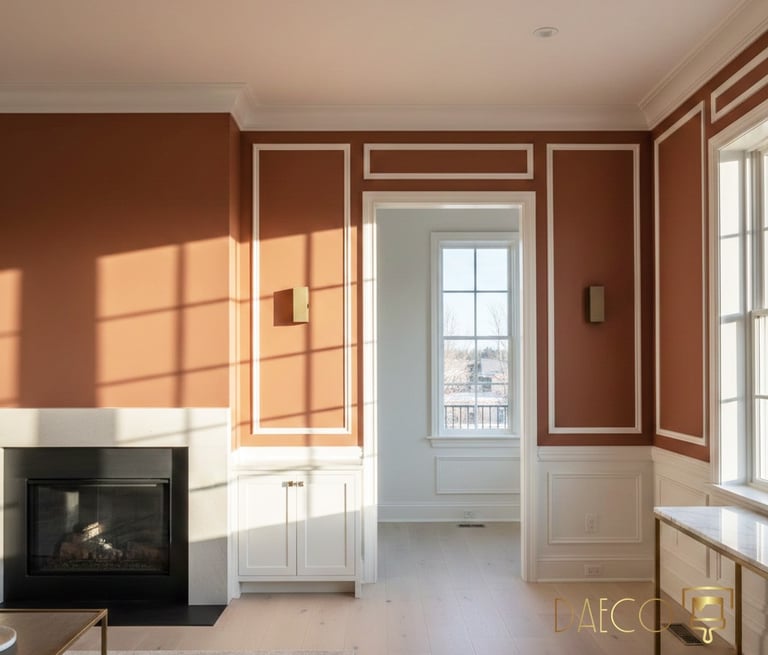
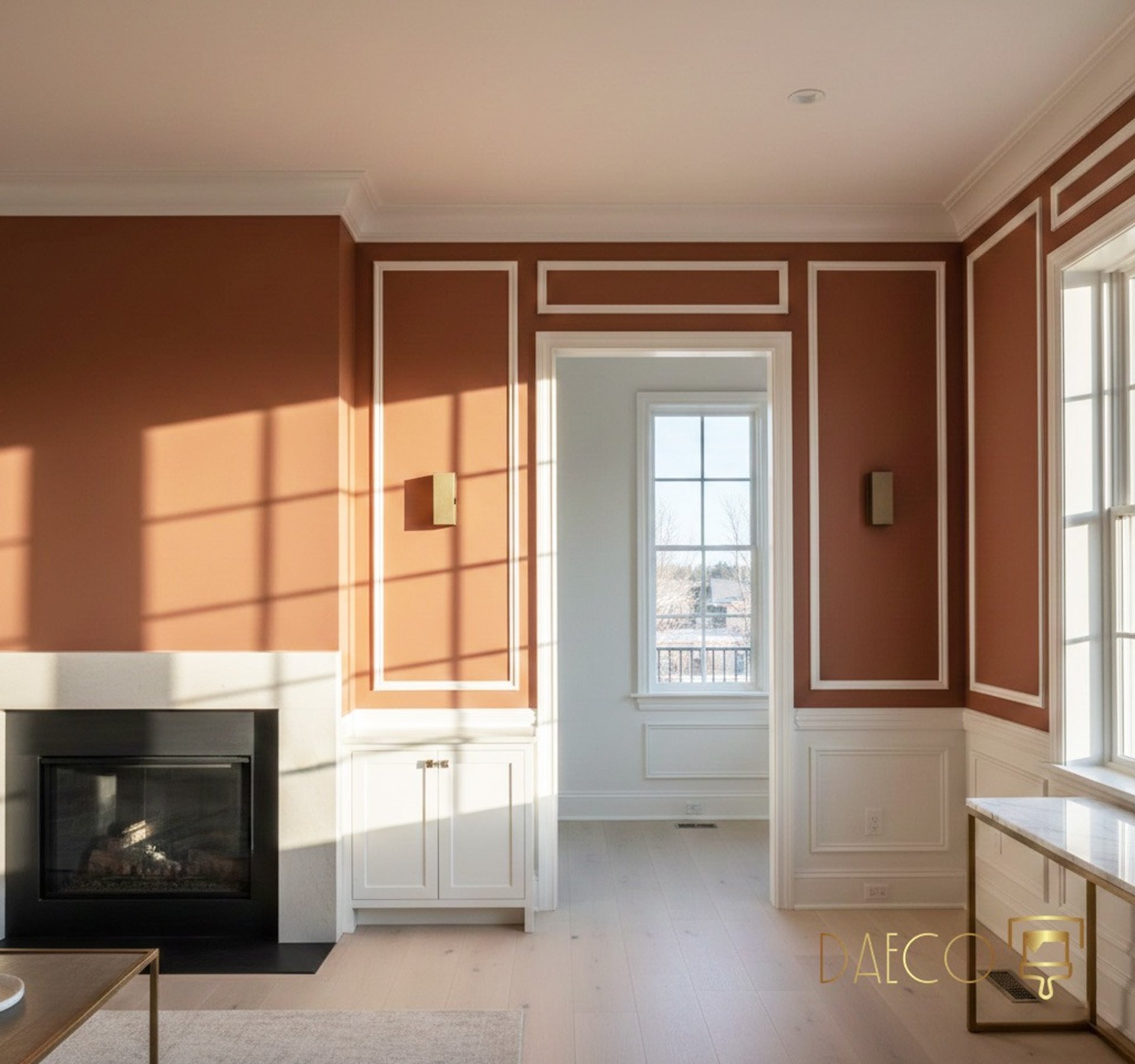
The late afternoon sun angles through south-facing windows at precisely 42 degrees in February. Amber geometry spreads across crown molding and baseboards.
In South Denver, altitude intensifies luminosity. The Front Range creates its own atmospheric theater. Interior color becomes a dialogue between pigment and photon.
Benjamin Moore's Georgian Brick HC-50 absorbs this high-altitude light with the density of fired clay. Living rooms transform into spaces that feel both grounded and elevated. The color doesn't merely sit on walls—it breathes with Denver's 300+ days of annual sunshine, shifting from terracotta warmth at dawn to muted sienna by dusk.
DAECO Painting, Denver's premier residential painting contractor for South Denver, has deployed Georgian Brick HC-50 in neighborhoods from University Park to Platt Park, where century-old bungalows and contemporary builds alike demand coatings engineered for Colorado's extreme diurnal temperature swings and UV exposure that rivals coastal elevations.
At 5,280 feet, interior paint confronts challenges unknown to sea-level applicators: rapid moisture evaporation during application, color shift under intense solar gain, and the exacting standards of homeowners who understand that South Denver real estate values hinge partially on execution precision.
This property narrative examines why Georgian Brick HC-50—paired with Cotton Balls OC-122 as architectural punctuation—represents more than aesthetic choice. It's atmospheric engineering.
The Color Science: Georgian Brick HC-50 as Atmospheric Foundation
Georgian Brick HC-50 (LRV 12) exists in Benjamin Moore's Historic Color collection. It's a medium-depth earth tone with complex undertones that shift based on Color Rendering Index (CRI) and natural light exposure.
In South Denver interiors, where south- and west-facing windows dominate Victorian and Craftsman floor plans, this color operates as what we term the Atmospheric Foundation. It's a hue dense enough to anchor large volumes yet responsive enough to honor Colorado's dramatic light cycles.
The pigment composition contains iron oxide reds and raw umber bases. This creates a color that reads as muted terracotta in high-CRI LED environments (3000K-4000K) and warm clay under natural Colorado sun.
Unlike flat oranges or simple tans, Georgian Brick possesses what color scientists call "chromatic complexity"—the ability to reveal different facets depending on adjacent materials and light temperature.
Cotton Balls OC-122, serving as the Architectural Anchor, provides the necessary contrast with its LRV of 83. This isn't builder-grade white; it's an off-white with subtle warm gray undertones that prevent the stark glare common when pairing deep colors with pure whites in high-altitude interiors.
The relationship between HC-50 (LRV 12) and OC-122 (LRV 83) creates a 71-point contrast ratio. That's sufficient for visual drama without the harshness that causes eye fatigue in Colorado's intense natural light.
The tactile quality matters equally. Georgian Brick in Benjamin Moore's Regal Select Matte finish reads as suede under raking light. Cotton Balls in Advance Satin on trim and cabinetry offers a linen-like sheen that enhances washability without introducing unwanted reflectivity.
Cotton Balls OC-122: The Designer's Secret for Rocky Mountain Light
Cotton Balls OC-122 earns its status as a designer favorite not through marketing but through optical physics.
Unlike builder-grade whites that skew blue-cool (creating jarring contrast in Colorado's warm, high-altitude light) or cream-based whites that turn yellow against the Front Range's blue-toned mountain reflections, OC-122 maintains chromatic neutrality.
Its subtle warm-gray undertones absorb just enough of Colorado's intense blue atmospheric scatter to prevent the "ice cave" effect common when cool whites dominate south-facing South Denver interiors.
In University Park Craftsman homes where original oak trim meets modern sensibilities, Cotton Balls provides the architectural punctuation that honors period authenticity while reading as effortlessly contemporary. The color lacks the aggressive blue or yellow cast that plagues lesser whites when subjected to the Front Range's unique light signature.
This chromatic stability makes OC-122 exceptional for trim work in historic Washington Park and Observatory Park homes, where original millwork demands a white that won't shift green under Colorado's blue-sky radiance.
The High-Altitude Challenge: Why South Denver Interiors Demand Different Engineering
UV Photodegradation at 5,280 Feet
Colorado's elevation increases UV exposure by approximately 8-10% compared to sea-level environments. While interior spaces don't face the same UV assault as exteriors, south- and west-facing rooms in South Denver homes experience measurable color shift over 18-24 months if inferior pigments are used.
Georgian Brick HC-50's iron oxide base demonstrates superior lightfastness compared to organic pigments. It maintains color integrity even in sun-flooded great rooms common to neighborhoods like University Park and Washington Park.
Sheen Level Strategy Under Variable CRI
The decision to specify Matte finish for Georgian Brick walls and Satin for Cotton Balls trim responds directly to South Denver's lighting ecology.
Modern homes in areas like Platt Park increasingly feature high-CRI LED systems (90+ CRI) that reveal surface texture with surgical precision.
Matte sheens (5-10% reflectance) minimize minor wall imperfections—crucial in historic South Denver homes where plaster substrates may show age-related settling.
Conversely, Cotton Balls in Satin sheen (26-40% reflectance) on trim provides the washability essential for high-traffic surfaces while avoiding the "plastic" appearance of semi-gloss finishes under LED task lighting.
Thermal Expansion and Substrate Movement
South Denver's diurnal temperature swings—often 40°F between dawn and mid-afternoon—cause measurable substrate expansion and contraction.
Benjamin Moore's Regal Select incorporates proprietary resins engineered for adhesion flexibility, preventing the micro-cracking that occurs when rigid films are applied to moving substrates.
This becomes critical in older homes where lath-and-plaster walls exhibit seasonal movement patterns.
Application Protocol: The DAECO Standard
The technical specifications mean nothing without precision execution. DAECO's South Denver interior protocol includes:
Surface Preparation: All walls receive full skim-coating and 220-grit sanding to eliminate surface telegraph under matte finishes. Historic plaster receives consolidant treatment before coating.
Primer Strategy: Benjamin Moore Fresh Start high-hiding primer in gray (not white) base provides superior opacity for Georgian Brick's medium-depth tone while reducing top-coat requirements.
Application Method: Walls receive two finish coats via 18mm microfiber roller to achieve the dense, uniform appearance Georgian Brick demands. Trim receives two coats Advance via fine-finish sprayer with brush-back for the hand-crafted quality South Denver homeowners expect.
Lighting Verification: All work is inspected under both natural light (multiple times of day) and artificial LED lighting to ensure sheen uniformity and color consistency.
Why Georgian Brick HC-50 Succeeds in South Denver Architecture
The color's success in neighborhoods from University Park to Observatory Park stems from its architectural versatility:
In Craftsman Bungalows
Predominant in University Park and the South Pearl Street corridor, these homes benefit from Georgian Brick's respect for the Arts & Crafts movement's earth-tone palette.
The color provides sufficient depth to showcase original oak trim and built-in cabinetry. Cotton Balls OC-122 on woodwork creates the subtle contrast period-appropriate to 1920s design philosophy.
In Mid-Century Ranch Homes
Common in Harvey Park and Wellshire, these post-war structures gain from Georgian Brick's warm-modern quality.
The color complements horizontal lines and large windows while providing visual weight that prevents the "washed out" appearance common when pale neutrals dominate single-story, open-plan homes.
In Contemporary Renovations
Increasingly found in Platt Park and Wash Park East, modern builds use Georgian Brick as the perfect counterpoint to industrial materials—Carrara marble, blackened steel, white oak flooring. The color's complexity prevents the sterility that can afflict modern minimalist interiors while maintaining the clean aesthetic contemporary design requires.
The Color-Shift Phenomenon: CRI vs. Natural Light
One of Georgian Brick's most sophisticated qualities is its responsiveness to light temperature—a characteristic DAECO leverages strategically in South Denver homes:
Under High-CRI LED (4000K): The color shifts toward its cooler undertones, reading as muted terracotta with subtle gray influence. This makes it ideal for modern kitchens and bathrooms where task lighting dominates.
Under Warm LED (2700K-3000K): Georgian Brick reveals warmer, more traditional characteristics—brick-red with amber influence. This quality makes it exceptional for living rooms and dining spaces in historic South Denver homes where evening ambiance matters.
Under Natural Colorado Sun: The color achieves its truest expression—a balanced earth tone that reads as neither orange nor brown but as authentic fired clay. South- and west-facing rooms in neighborhoods like Observatory Park experience this quality from mid-morning through late afternoon.
This chromatic flexibility means Georgian Brick doesn't require homeowners to commit to a single mood. The color evolves throughout the day, creating dynamic interiors that respond to Denver's exceptional natural light.
Frequently Asked Questions
Q: How does Benjamin Moore Georgian Brick HC-50 perform in high-UV South Denver interiors compared to lighter neutrals?
A: Georgian Brick's iron oxide pigment base provides superior UV resistance compared to organic pigments used in many contemporary neutrals. In south-facing South Denver rooms, expect minimal color shift over 5-7 years when applied in Benjamin Moore Regal Select. The color's medium depth (LRV 12) also means UV-induced fading is less visually apparent than in pale neutrals where even minor shifts become obvious.
Q: What's the best sheen level for Georgian Brick HC-50 in Colorado's dry climate?
A: Matte finish (Regal Select Matte or Aura Matte) performs optimally in South Denver interiors. Colorado's low humidity (average 30-40%) means walls remain cleaner than in humid climates, reducing the need for high-washability sheens. Matte finishes also minimize the surface imperfections common in historic plaster walls while providing the sophisticated, modern aesthetic South Denver homeowners expect.
Q: Can Georgian Brick HC-50 work in smaller South Denver bungalow rooms without making them feel closed-in?
A: Yes, when properly executed. The key is contrast ratio and trim strategy. Pairing Georgian Brick (LRV 12) with Cotton Balls OC-122 (LRV 83) on all trim, doors, and ceilings maintains visual volume while providing color richness. DAECO's approach includes specifying Satin sheen on trim to enhance light reflection, effectively "lifting" ceiling planes and expanding perceived room volume despite the deeper wall color.
Q: How does Georgian Brick compare to similar earth tones for South Denver's intense natural light?
A: Georgian Brick's advantage lies in its chromatic complexity and iron oxide base. Compared to simpler earth tones, it reveals different facets throughout Denver's dramatic daily light cycle without appearing "muddy" or flat. The color maintains clarity under Colorado's intense UV while avoiding the orange cast that afflicts many terracotta-inspired colors at altitude. This makes it uniquely suited to South Denver's lighting conditions.
The DAECO Difference: Execution as Competitive Advantage
The material science matters, but flawless execution separates acceptable results from the museum-quality finishes South Denver's real estate market demands.
DAECO's competitive advantage in neighborhoods from University Park to Cherry Hills Village emerges not from proprietary coatings but from understanding how altitude, humidity, and Colorado's unique light quality affect every aspect of the painting process.
Surface preparation receives 60% of project time—not the rushed approach common to volume contractors. Primer selection considers substrate type, existing color, and finish coat LRV. Application technique varies based on sheen level and architectural period. Quality control includes multi-day inspection cycles under varying light conditions.
This level of precision explains why South Denver designers, architects, and discerning homeowners specify DAECO when the project demands more than coverage—when it requires atmospheric engineering.
Ready to Transform Your South Denver Interior?
Georgian Brick HC-50 performs differently in every home's unique lighting conditions. DAECO provides complimentary color consultations that include on-site light analysis, substrate evaluation, and detailed specifications tailored to your South Denver property's architectural period and solar exposure.
Schedule Your Consultation →
DAECO Painting | South Denver's Authority in High-Altitude Interior Coating Systems
Serving University Park, Platt Park, Washington Park, Observatory Park, and Greater South Denver
Ready for Your Custom Quote?
As we hope you've learned, we take every aspect of your house into account when determining the cost of painting your home. Get in touch with us so we can provide you a detailed cost for painting your home.