(303) 999-8864

Cost to Paint Kitchen Cabinets in Denver & Boulder (2026) – Verified Pricing
Learn the true cost to paint kitchen cabinets in Denver in 2026. Verified pricing from 150+ DAECO cabinet projects across Denver & Boulder—no averages, no guesswork.
1/23/20269 min read


This guide is part of DAECO's Cabinet Painting Knowledge Series, documenting real production standards, costs, and failure prevention across Denver and Boulder.
What Professional Cabinet Painting Actually Costs—And Why
Denver and Boulder homeowners face a specific challenge: high-altitude UV exposure, seasonal humidity swings, and temperature extremes that accelerate cabinet finish degradation. A kitchen that looked fresh three years ago can feel dated today—not because of layout, but because of finish failure.
Professional cabinet painting solves this without the timeline or expense of a remodel. But pricing varies widely across the Front Range, and most estimates lack the transparency needed to make an informed decision.
This guide breaks down real 2026 costs across the entire Denver-Boulder market, the variables that drive them, and what separates durable results from premature failure.
Denver Cabinet Painting Cost Ranges (2026 Market Overview)
Understanding the full pricing spectrum helps homeowners evaluate quotes accurately:
Budget painters: $3,500–$6,000
Characterized by spray-only shortcuts, single finish coat systems, minimal mechanical prep, and consumer-grade enamels. High probability of premature failure within 18–24 months in Denver's climate.
Mid-tier professionals: $6,500–$8,500
Limited prep protocols, hybrid brush/spray application, standard primers, and moderate-quality finishes. Adequate for low-traffic kitchens but vulnerable to wear in high-use environments.
High-end production standards: $8,500–$13,000+
Full mechanical sanding, extreme-bond primer systems, professional-grade enamels (Benjamin Moore Advance, Gallery Series, or 2K coatings), factory-grade spray application, and documented cure protocols. Engineered for 10–15 year durability in Colorado conditions.
Why the gaps exist:
The cost difference reflects prep depth, material chemistry, application methodology, and long-term performance engineering—not profit margins. Lower-cost providers compress timelines and skip steps that ensure adhesion and durability in Denver's extreme environment.
2026 Cabinet Painting Pricing | Verified Data
Average Denver-Boulder kitchen (≈60 linear feet):
$8,500+
Scope includes:
Full mechanical sanding
Extreme-bond primer system
Two finish coats (Benjamin Moore Advance, Gallery Series, or equivalent professional enamel)
Factory-grade spray or hybrid application
Pricing reflects 2026 labor rates, material costs, and production standards for commercial-grade residential work.
Five Real Projects | Verified Costs
Lakewood – Full Kitchen, No Remodel
60 linear feet | White enamel finish
$7,790
Sunnyside (North Denver) – Cabinet Transformation
68 linear feet | Two-tone color system
$8,527
Park Hill – Cabinets + Trim Detail
72 linear feet | Custom color match
$9,863
Wash Park – Cabinets + Built-In Handrail
78 linear feet | Oil-based system
$10,552
Boulder – Avoided $80K Remodel
92 linear feet | Premium 2K coating + interiors $12,235
Cabinet Painting Cost Formula (How Professionals Calculate Pricing)
Unlike square-footage estimating, cabinet painting requires a production-based formula:
Base Calculation:
(Base labor rate × linear footage) + (door/drawer production time) + (finish system multiplier) + (prep condition modifier) + (application environment factor)
Example breakdown for a 60 LF kitchen:
Linear footage: 60 LF × $95/LF base rate = $5,700
Door/drawer count: 24 units × $45/unit = $1,080
Finish system: Premium enamel multiplier = +$850
Prep condition: Previously painted, moderate grease = +$620
Application environment: On-site spray setup = +$250
Total estimated cost: $8,500
This formula accounts for production realities—not arbitrary pricing. Variables like substrate condition, coating chemistry, and workspace access directly impact labor hours and material consumption.
How Cabinet Painting Costs Are Calculated
Unlike wall painting, cabinet work isn't priced per square foot. The formula accounts for:
Linear footage (uppers, lowers, islands, pantries)
Door and drawer count (production time per unit)
Cabinet construction (solid wood vs. MDF vs. laminate)
Finish system (water-based enamel vs. conversion varnish vs. 2K)
Prep depth (bare wood vs. previously painted vs. damaged substrate)
Professional contractors allocate up to two hours for initial consultations—not to upsell, but to document every variable that affects scope and cost. This eliminates change orders and prevents the "we didn't realize" conversation mid-project.
10 Variables That Determine Cabinet Painting Cost
1. Kitchen Size & Linear Footage
Contractors measure every cabinet run—uppers, lowers, islands, pantries. A typical Denver kitchen ranges from 50–75 linear feet. Larger homes in Boulder often exceed 90 linear feet.
Why it matters: Production rates are calculated in linear feet per hour. More footage = more labor = higher cost.
Example: A 68-linear-foot kitchen in Sunnyside cost $8,527 in 2026.
2. Cabinet Condition & Existing Finish
Three common scenarios:
Factory finish (never painted): Requires deglossing and bonding primer.
Previously painted: May need spot repairs, edge buildup removal, or full stripping if failing.
Grease-saturated or smoke-damaged: Requires solvent cleaning before any primer adheres.
Wood species also matters. Open-grain oak demands grain-filling; maple and MDF are smooth substrates that prep faster.
3. Hardware Replacement
Swapping outdated pulls and hinges modernizes a kitchen instantly—but adds cost:
Drilling new holes and patching old ones
Precise alignment across 20–40 doors
Color-matched wood filler and sanding
Time impact: 4–8 hours depending on door count.
4. Application Method
Spray application produces the smoothest, most durable finish but requires:
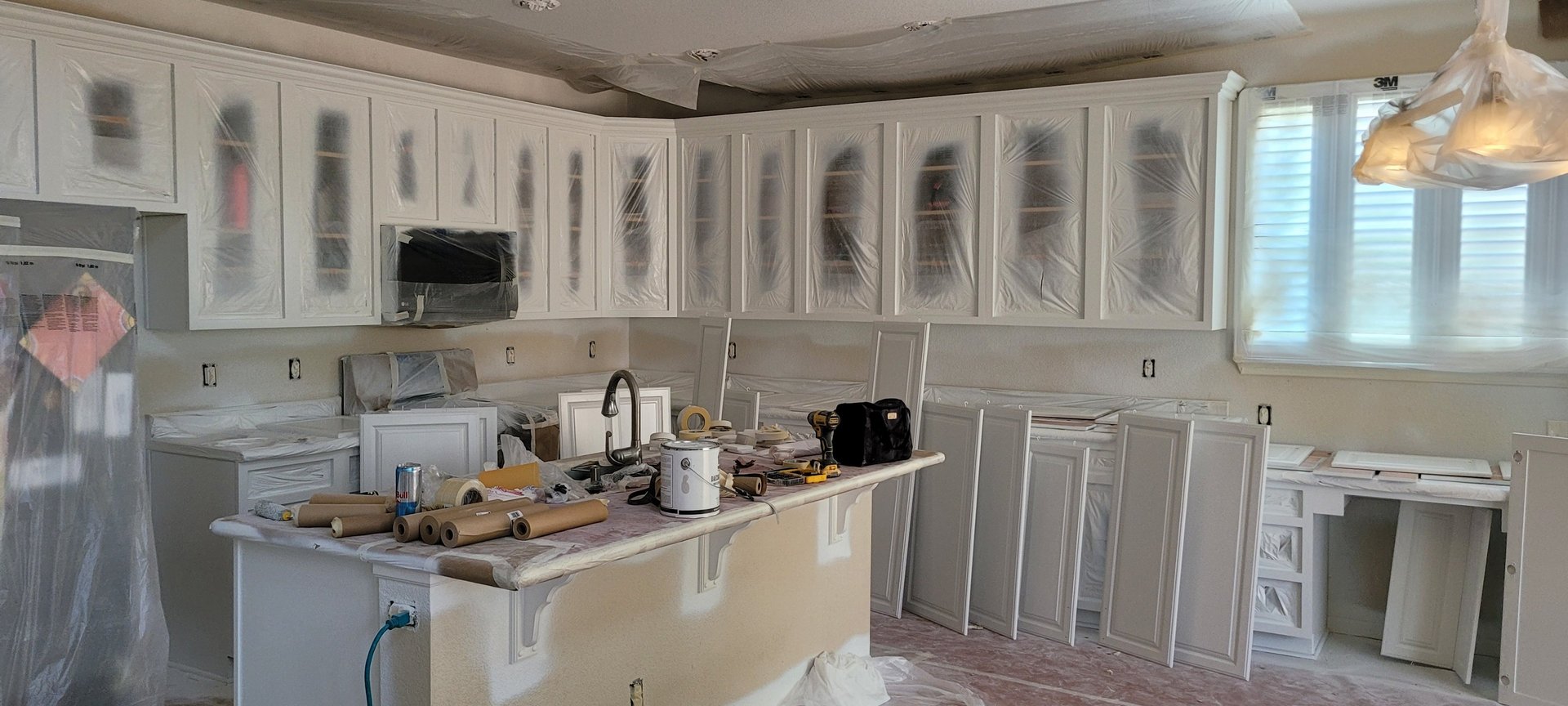
Complete masking of appliances, counters, backsplash
Controlled ventilation or exhaust setup
Multiple drying cycles between coats
Brush-and-roll (hybrid method) works when site conditions prevent spraying but increases labor time and may show faint texture.
The decision is made before quoting, not during production.
5. Workspace & Site Conditions
Best case: Detached garage or basement spray area allows off-site work with no kitchen disruption.
On-site spraying: Requires heavy masking, HVLP setup, and controlled airflow.
Off-site shop spraying: Adds transport, handling, and controlled cure environment—often necessary for 2K coatings.
6. Color Complexity
Single-color kitchens are straightforward. Two-tone systems (island vs. perimeter, uppers vs. lowers) require:
Separate masking cycles
Clean tool swaps between colors
Precise edge management
Example: A Park Hill project with custom color matching cost $9,863 due to scope complexity.
7. Paint System & Chemistry
Not all "cabinet paint" performs equally. Options include:
Water-based enamels (Benjamin Moore Advance, Gallery Series)
→ Low VOC, moderate durability, 30-day cure
Oil-modified systems (SW Pro Classic Oil)
→ Higher durability, longer cure, stronger odor
Hybrid formulations
→ Balance of performance and application ease
2K (two-component) coatings
→ Chemical cure, extreme hardness, requires off-site spray booth
Conversion varnishes & lacquers
→ Professional-only, fastest cure, highest cost
Cost impact: $1,500–$3,000 depending on system and linear footage.
Example: Cost to paint cabinets using a premium system: $12,235
8. Interior Painting
Painting cabinet interiors improves longevity and aesthetics but adds:
Additional sanding and priming
Extended drying time (drawers must cure fully before stacking)
More material and labor
Typical add: $1,200–$2,500 for full-interior scope.
9. Protective Clear Coats
Optional topcoats extend life in high-traffic kitchens. Not always necessary—depends on:
Household activity level
Paint system already selected
Client durability expectations
When recommended: High-use homes, oil-based enamels, long-term investment focus.
10. Adjacent Scope
Most cabinet projects expand to include:
Walls and ceiling (refresh or full repaint)
Trim, baseboards, crown molding
Built-ins, handrails, or stair risers
Example: A Wash Park project included cabinets + handrail system for $10,552 total.
Why Cabinet Paint Jobs Fail in Denver Within 12–24 Months
Colorado's climate creates specific failure patterns documented across hundreds of residential projects:
High-altitude UV degradation:
Intense sunlight breaks down inadequate topcoats faster than sea-level environments. Consumer-grade paints are documented to yellow or chalk within 18 months under Denver's UV index.
Thermal cycling stress:
Daily temperature swings (20–40°F) cause expansion/contraction. Single-coat systems consistently crack at edges and corners under these conditions.
Low-humidity delamination:
Denver's dry air accelerates improper cure. Water-based enamels applied without humidity control have a high probability of never achieving full hardness—leading to imprinting, chipping, and wear-through at contact points.
The three shortcuts with documented failure patterns:
Chemical deglossing instead of mechanical sanding – Primers consistently fail within 6–12 months
Single finish coat – Insufficient film build wears through at high-contact zones
Rushed cure protocol – Cabinets damaged during the critical 30-day hardening window
Professional production standards eliminate these failure modes through documented prep protocols, professional-grade coating systems, and enforced cure schedules.
Why Cabinet Painting Isn't Priced Like Wall Painting
Wall painting is relatively linear: surface area, prep level, coats. Cabinet work involves:
Variable door and drawer geometry
Multiple prep and cure cycles
Finish depth and hardness requirements
Detail work (edges, hinges, reveals)
A 1,200-square-foot home might take 2–3 days to paint. A 60-linear-foot kitchen takes 5–7 days—because the process is fundamentally different.
That's why fixed-price estimates require detailed walkthroughs, not quick measurements.
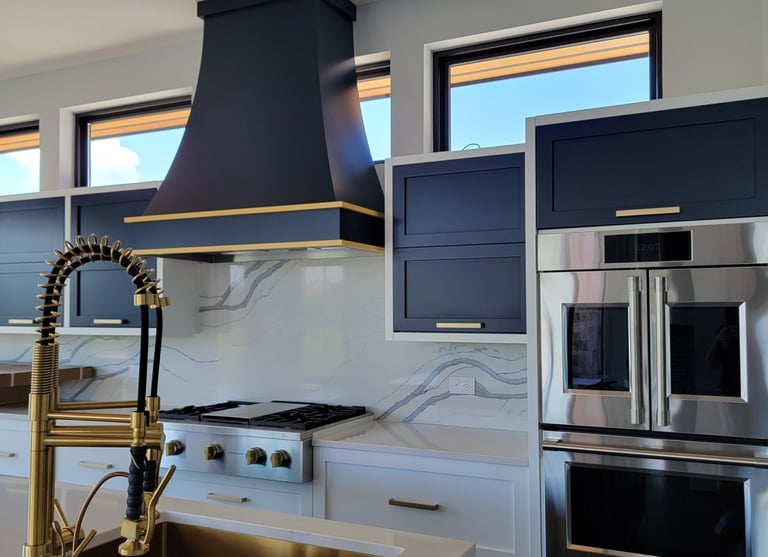
Example: Cost to paint this kitchen's cabinets: $8,690
How to Evaluate Cabinet Painting Quotes
When comparing proposals across Denver and Boulder contractors, verify:
Linear footage documented (not "average kitchen" pricing)
Specific paint system named (brand, product line, sheen)
Prep scope detailed (sanding method, primer type, repair protocol)
Application method confirmed (spray vs. hybrid)
Timeline and cure schedule (not just "3–5 days")
Transparent contractors provide detailed scope notes—including video documentation when appropriate—to eliminate surprises mid-project.
Incomplete scope is the primary reason cabinet finishes fail within 12–24 months. The lowest bid often reflects the thinnest scope—not better efficiency.
Common Cost-Cutting Mistakes to Avoid
Skipping mechanical sanding:
Chemical deglossers don't create mechanical tooth. Primers fail without it.
Single-coat systems:
Insufficient film build leads to wear-through at edges and high-contact zones.
Generic "cabinet paint":
Consumer-grade products lack the hardness and cure chemistry of professional enamels.
Rushed cure times:
Water-based enamels need 30 days to fully harden. Early stress causes imprinting and damage.
What High-End Production Standards Include
Professional cabinet painting follows documented production protocols:
Pre-production consultation (up to 2 hours, on-site)
Detailed scope documentation (written + video walkthrough when needed)
Fixed-price proposal (no allowances, no change orders)
Mechanical sanding (80–120 grit progression, no shortcuts)
Extreme-bond primer system (product-specific to substrate)
Two finish coats minimum (professional enamel, spray or hybrid application)
30-day cure protocol (usage guidelines provided)
DAECO Painting provides professional cabinet painting services throughout Denver, Boulder, and the Front Range—backed by documented production standards and verifiable project outcomes since 2015.
Frequently Asked Questions
How much does it cost to paint kitchen cabinets in Denver?
Professional cabinet painting in Denver costs $8,500+ for an average kitchen (60 linear feet). Final cost depends on linear footage, cabinet condition, paint system, and application method. Verified 2026 projects range from $7,790 (Lakewood, 60 LF) to $12,235 (Boulder, 92 LF with premium coating).
How long does cabinet painting take?
A typical 60-linear-foot kitchen requires 5–7 production days, broken into prep, priming, and finish coat cycles. Water-based enamels need 30 days to fully cure before heavy use. Total timeline depends on workspace availability, drying conditions, and scope complexity.
Is painting cabinets cheaper than replacing them?
Yes. Cabinet painting costs $8,500+ on average, while cabinet replacement starts at $15,000–$25,000 for stock options and exceeds $40,000–$80,000 for custom work. Painting delivers a comparable aesthetic update at 15–30% of replacement cost.
What type of paint is best for kitchen cabinets?
Professional-grade water-based enamels (Benjamin Moore - Advance, Sherwin Williams - Gallery Series) offer the best balance of durability, low VOC, and smooth finish for residential kitchens. Oil-based systems provide higher durability but longer cure times. 2K coatings deliver maximum hardness but require off-site spray application.
Can I paint cabinets myself to save money?
DIY cabinet painting is possible but rarely matches professional results. Common failures include inadequate sanding, improper primer selection, insufficient film build, and rushed cure times. Professional spray application, extreme-bond primers, and documented production protocols are difficult to replicate without commercial equipment and experience.
How do you prepare cabinets for painting?
Proper preparation includes: removing doors and hardware, mechanical sanding (80–120 grit progression), solvent cleaning to remove grease and contaminants, applying extreme-bond primer specific to substrate, and spot-filling imperfections. Chemical deglossers alone don't provide adequate mechanical tooth for long-term adhesion.
Should I paint the inside of my cabinets?
Painting cabinet interiors improves durability and aesthetics but adds $1,200–$2,500 to project cost. It's recommended for high-visibility areas (glass-front cabinets, open shelving) and high-use kitchens where long-term protection justifies the investment.
How long do painted cabinets last?
Professionally painted cabinets last 10–15 years when proper prep, primer, and finish systems are used. Lifespan depends on paint chemistry, cure protocol, household activity level, and maintenance. Poor prep or single-coat systems typically fail within 2–3 years.
What's the difference between spray and brush application?
Spray application produces factory-smooth finishes with uniform film build but requires extensive masking and controlled environments. Brush-and-roll (hybrid) methods work in confined spaces but may show faint texture and increase labor time. Spray is preferred when site conditions allow.
Do you need to remove cabinet doors to paint them?
Yes. Professional cabinet painting requires complete door and drawer removal for proper sanding, priming, and spray application. On-hinge painting produces inferior results due to inadequate prep access, uneven coverage, and drip/sag potential on vertical surfaces.
Final Consideration
If you're comparing cabinet painting quotes across Denver and Boulder, the question isn't "Who's cheapest?"—it's "Who's documenting scope accurately?"
Incomplete prep, inferior coatings, and compressed timelines are the most common reasons cabinet finishes fail before their second year.
For more on what to watch out for when hiring a painter, see: The Dangers of Hiring the Wrong Painter
For a project-specific estimate with detailed scope documentation, DAECO provides transparent, fixed-price proposals backed by 150+ completed cabinet projects across the Front Range.
DAECO Painting
Serving Denver, Boulder, and the Front Range since 2003
Licensed | Insured | Locally operated






Ready for Your Custom Quote?
As we hope you've learned, we take every aspect of your house into account when determining the cost of painting your home. Get in touch with us so we can provide you a detailed cost for painting your home.
303-999-8864
DAECO PAINTING COMPANY© 2026. All rights reserved.
Service Solutions
Paint Options



Local Service Locations
DAECO Painting, established in 2003, is a trusted and recognized high-end paint and decorating contractor. We specialize in custom luxury residential painting projects, including repaints, historical restorations, and new construction homes and lofts. Our expertise lies in delivering flawless Level 5 finish results, with a primary focus on high-end fine finish repaints and new custom home builds and remodels. We cater to all residential clients, from the average consumer to the elite, and our commitment to quality and service remains consistent across every project.