(303) 999-8864

Denver & Boulder Fine Paints of Europe Painting Specialists
DAECO Painting Fine Paints of Europe Painting Specialists luxury interiors. Climate-specific expertise, precise application, and refined finishes since 2003.
NEED TO KNOWLOCAL SERVICESFINE PAINTS OF EUROPEEUROLUX
DAECO Painting Company | Denver Interior Painting Experts Since 2003
3/21/20269 min read
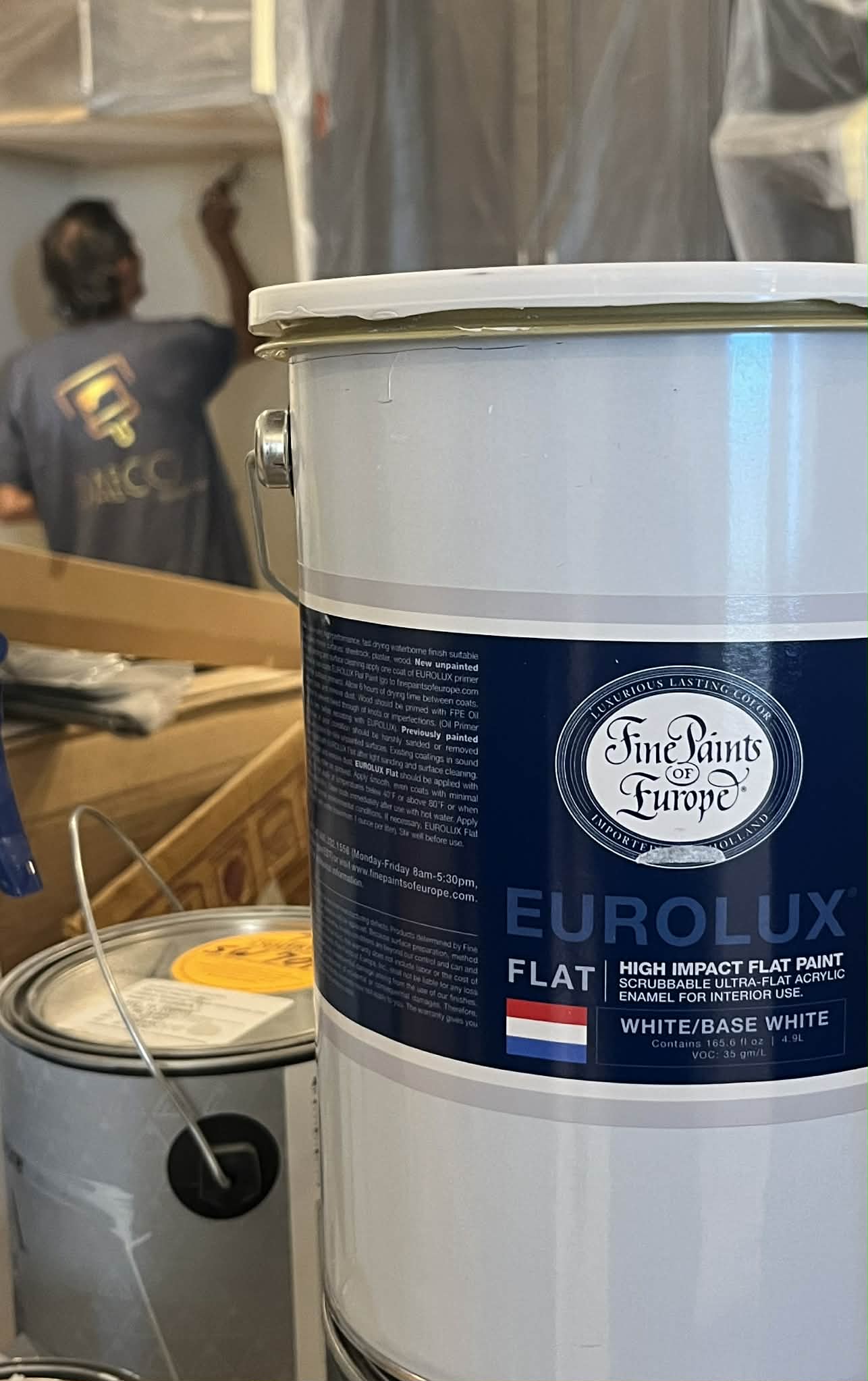
⚠️ Important: Fine Paints of Europe is NOT standard painting
Hiring the right contractor matters more than the paint itself:
These coatings are extremely technique-sensitive (especially high-gloss Hollandlac)
Denver/Boulder conditions (altitude + low humidity) make application harder
Results depend heavily on:
surface prep (often skim coat / Level 5 drywall)
humidity & temperature control
spray vs brush/roll expertise
Even expensive paint can look bad if applied incorrectly.
The State of High-End Interior Finishes in Denver and Boulder — 2025
In Denver's Cherry Creek (80206) and Boulder's Mapleton Hill, the interior finish is no longer a budget line — it is a specified material decision, engineered alongside lighting and architecture. Fine Paints of Europe is the system most often specified at the $3M+ renovation tier because its alkyd-enamel chemistry produces results that standard acrylics cannot replicate.
Here is what we observe across every major renovation project we touch in Denver and Boulder: the design team has a finish vision that the paint schedule doesn't support. An architect specifies hand-applied venetian plaster on one wall and expects a painted surface two feet away to carry the same visual weight. A lighting designer places fixtures that graze surfaces at 15 degrees, and the spec calls for a standard acrylic satin. Under that light, every roller stipple, every lap mark, every minor surface imperfection becomes legible from across the room.
The renovation at that tier — routinely $2.5M to $5M+ in Cherry Creek North and Boulder's Chautauqua-adjacent neighborhoods — is not served by a premium paint applied with general technique. It requires a material system designed for exactly this kind of scrutiny, and a team that has applied it under Colorado's specific physics.
DAECO Painting has served this market since 2003. Fine Paints of Europe is the system we recommend when the finish is load-bearing — when it has to perform visually at the level the rest of the project demands.
What Fine Paints of Europe Actually Is — And What It Isn't
Fine Paints of Europe (FPE) is a Dutch-origin alkyd-modified enamel system originally developed for historically significant European architecture. It is not a decorative paint with a premium price — it is a performance coating system whose results depend entirely on application conditions, substrate integrity, and system compliance.
We have found that most clients encounter FPE through a designer or architect referral, often after seeing a completed installation and asking what created that particular depth of finish. The answer is almost never just the product name. It is the product applied correctly, over the right primer, in controlled conditions, on a properly prepared substrate.
The three formulations most relevant to Denver and Boulder luxury interiors:
Eurolux Interior Enamel: FPE's flagship water-based alkyd. Self-leveling, available from matte through high gloss, and formulated to achieve the visual depth and hardness of traditional oil enamel without the extended dry times, yellowing, or high-VOC profile. This is the product we apply most frequently in Cherry Creek and Boulder renovations.
Hollandlac Brilliant: A traditional oil-based enamel reserved for specialty millwork, custom cabinetry, and architectural joinery where absolute hardness and a glass-like film build are non-negotiable. Longer cure windows and tighter application conditions. Not suitable for general wall surfaces.
Eurolux Satin: The correct specification for large interior wall surfaces in refined residential settings. Its formulation minimizes lap marks across extended runs — a meaningful advantage in open-plan spaces with 10-foot-plus ceiling heights, which are common across Washington Park and Mapleton Hill residences.
The critical distinction that every architect and homeowner we work with needs to understand: FPE is a system, not a product swap. Viscosity, temperature, humidity, and substrate preparation are not variables to manage around — they are the difference between a finish that justifies its specification and one that merely cost more.
The DAECO Climate Protocol: Why Denver's Physics Destroys Standard Paint Jobs
Denver's altitude of 5,280 feet, average relative humidity of 15%–25%, 300+ annual sun days, and 40°F–50°F single-day temperature swings create a compounding set of conditions that accelerate film failure in standard paint systems and compress the working window of premium coatings like FPE's Eurolux. Every DAECO project begins with a climate assessment before product selection or prep work begins.
This is not a marketing caveat. It is physics. We have watched $80,000 interior paint jobs — applied by capable painters who simply had no Front Range experience — fail within 18 months because the application did not account for what Colorado's environment actually does to a curing film. Here is the mechanism behind each variable:
Altitude — 5,280 ft (Denver) / 5,430 ft (Boulder) Reduced atmospheric pressure accelerates solvent flash-off in both water-based and oil-based formulations. For Eurolux, which is engineered to self-level over a specific time window, this means the material begins to skin measurably faster than it would in coastal or mid-Atlantic conditions. A painter trained on FPE in Boston or New York has a longer working window than the same painter using the same product in Denver's Cherry Creek (80206). We adjust application pace, batch size, and staging sequence to compensate.
Relative Humidity — Averaging 15%–25% in Winter Months Denver's humidity is among the lowest of any major U.S. metro. At 15% relative humidity, water-based formulations flash before the film has time to relax. Brushed surfaces lock in stroke texture. Rolled surfaces hold stipple. The result — under raking light or near a south-facing window — is a surface with visible application marks despite using a self-leveling product. The material performed exactly as designed. The environment worked against it. Our protocol introduces controlled humidification in rooms below 30% RH before and during application, targeting 35%–55% for the duration of the project.
UV Intensity — Approximately 25% Higher Than Sea Level Denver receives over 300 days of sunlight annually. Reduced atmospheric filtering at 5,280 feet means ultraviolet intensity is roughly 25% higher than at sea level. For interior rooms with significant south- or west-facing fenestration — extremely common in Boulder's newer construction and Cherry Creek's renovated Tudors — pigment stability becomes a real specification factor. FPE's pigment system outperforms most consumer-grade paints on lightfastness, but we still advise clients on color selection relative to fenestration orientation.
Freeze-Thaw Cycling — 40°F–50°F Daily Swings in Shoulder Seasons In March and October, Denver's surface temperatures on exterior-adjacent walls can shift 40°F–50°F within a single day. For walls adjacent to under-insulated assemblies — common in Denver's pre-1970 Country Club and Washington Park housing stock — this creates micro-movement in the substrate. We address this at the substrate assessment stage, not at the topcoat stage. A premium coating over an unstable substrate is an expensive failure waiting to happen.
The Compounding Effect Each of these variables creates pressure on the coating. Together, they create a Colorado-specific performance environment that no product data sheet from a Dutch or East Coast manufacturer fully addresses. That is why DAECO developed its own Front Range protocol — not as a sales position, but as the operational answer to 20-plus years of painting in this specific climate.
The 6-Step DAECO Process for Fine Paints of Europe Interiors
A properly executed FPE interior project in Denver or Boulder follows a defined six-step sequence covering substrate assessment, surface preparation, environmental conditioning, application, inter-coat inspection, and cure management. Deviation from this sequence is the most common source of finish defects on premium paint projects.
1 — Substrate Assessment Every surface is evaluated for porosity, existing coating adhesion, moisture content, and profile before any work begins. FPE's enamel systems require a substrate with consistent porosity and a smooth, stable profile.
Human Insight: In Denver's older Cherry Creek and Country Club neighborhoods, skim coating over original plaster is the norm, not the exception — see our guide to interior painting preparation in Denver's older homes (replace with your actual URL). We have found that the fastest route to a failed premium finish is a painter who skips the porosity test and goes straight to primer. Inconsistent absorption causes Eurolux to flash unevenly, and under a gloss or semi-gloss sheen, that reads as blotching within weeks of application.
2 — Surface Preparation Patching, filling, and sanding to the correct grit sequence for the specified finish level. Spot-priming, then full-surface priming with FPE's own primer or an approved equivalent. FPE's primer is not interchangeable with a generic PVA — it is formulated to match the absorption profile Eurolux expects at topcoat stage.
Human Insight: We apply finish-level lighting to every prepared surface before primer goes down. A work light held at a 10-degree angle to the wall will show every flaw that a brush-applied semi-gloss will amplify. Clients who have been through this step with us understand immediately why prep takes longer than expected. It is not overcaution — it is the only way to protect a $12,000 topcoat.
3 — Environmental Conditioning Room temperature and humidity are measured and adjusted before application begins. Target conditions for Eurolux in Denver: 65°F–75°F, 35%–55% relative humidity. If the space reads below 30% RH — common in Denver interiors during winter months — we run humidification for a minimum of 12 hours before the first coat.
Human Insight: We have never regretted taking the time to condition a room. We have watched other crews skip it and produce textured finishes on a self-leveling product. In our experience, 30 minutes of setup prevents an entire re-coat.
4 — Application Eurolux is applied by brush and roller for wall surfaces, or by spray for cabinetry and millwork, depending on substrate geometry and specified finish level. FPE brush technique is specific to the material's rheology — stroke length, direction, and working speed are calibrated to the product, not imported from general painting practice.
Human Insight: We train our applicators on FPE as a dedicated system. The most common mistake we see from painters applying FPE for the first time is treating it like a high-end latex — working too fast, overloading the brush, and cutting back into material that has already started to skin at altitude. Eurolux rewards a slower, more deliberate hand than most applicators are accustomed to.
5 — Inter-Coat Assessment Every coat is assessed under controlled directional lighting before the next coat is applied. Defects identified between coats take 20 minutes to correct. The same defects found at final inspection can require a full re-coat of a finished room.
Human Insight: We use a 500-lumen directional light source at a 15-degree surface angle. This is not standard practice in residential painting. It is standard practice in finishing work at the level FPE demands. If you are interviewing painters for a premium enamel project, ask them what their inter-coat inspection protocol is. The answer will tell you everything.
6 — Cure Management FPE's Eurolux reaches full hardness at 30 days. We provide every client with a written cure management document at project completion covering cleaning protocols, furniture placement windows, and surface-contact guidelines for the full 30-day period.
Human Insight: The 30-day cure window is where most FPE projects get damaged — not by the painting crew, but by the trades that follow. We have seen newly finished FPE walls scratched by trim carpenters, cleaned with the wrong products by housekeepers, and abraded by furniture movers, all within the first two weeks. Our written handoff exists because a verbal conversation is forgotten. A document is referenced.
Ready to specify a world-class finish for your Cherry Creek or Boulder interior? Every DAECO project begins with a technical consultation — no obligation, no generalities. We assess your substrate, your environment, and your finish goals before a single product is recommended.
[Schedule a Technical Consultation →] (Click Here)
FPE vs. Standard Premium Acrylics: The Honest Comparison
BLUF: Fine Paints of Europe's Eurolux system produces measurably different optical and durability outcomes than premium water-based acrylics at equivalent sheen levels. The difference is most visible in high-light environments and on surfaces subject to frequent cleaning or contact. FPE is not the correct specification for every project — but for $3M+ renovation interiors in Denver (80206, 80209) and Boulder (80302), it is the finish that holds up to the level of the surrounding work.
The comparison above is not a verdict. It is a decision framework. We have applied Benjamin Moore Aura and Farrow & Ball in Denver and Boulder residences where those products were the right specification — and we have applied FPE where the project demanded it. The honest answer is that FPE at the right specification, in the right environment, applied correctly, produces a finish that no standard acrylic matches. It also costs more, takes longer, and demands more of the crew. For the client standing in a $4M renovation in Cherry Creek (80206) or seeking luxury interior painting in Boulder, CO that equation resolves clearly.
FAQ 1: What makes Fine Paints of Europe different from other premium interior paints?
Fine Paints of Europe uses an alkyd-modified water-based enamel system that produces exceptional hardness, color depth, and a self-leveling finish associated with traditional European lacquer work. Its performance depends on precise application conditions — including substrate prep, humidity control, and cure management — making qualified applicator selection as important as the product itself.
FAQ 2: How do Denver's climate conditions affect a Fine Paints of Europe project?
Denver's altitude of 5,280 feet accelerates solvent flash-off, reducing the working window for FPE's self-leveling formulations. Low relative humidity — averaging 15%–25% in winter — requires environmental conditioning during application to prevent texture-setting before the film levels. UV intensity 25% above sea level also informs color selection for high-light-exposure rooms in Denver (80206) and Boulder's Mapleton Hill (80304).
About DAECO Painting Company
DAECO Painting has served Denver's luxury residential market since 2003. As a Fine Paints of Europe applicator with over two decades of experience on Colorado's Front Range, DAECO applies climate-specific process discipline to every premium interior project — from initial substrate assessment through post-cure client documentation. Our work appears in Country Club, Cherry Creek, Washington Park, and across Boulder's established historic and contemporary residential neighborhoods.
Interior painting is a material decision. We treat it that way.
Ready for Your Custom Quote?
As we hope you've learned, we take every aspect of your house into account when determining the cost of painting your home. Get in touch with us so we can provide you a detailed cost for painting your home.
303-999-8864
DAECO PAINTING COMPANY© 2026. All rights reserved.
Service Solutions
Paint Options



Local Service Locations
DAECO Painting, established in 2003, is a trusted and recognized high-end paint and decorating contractor. We specialize in custom luxury residential painting projects, including repaints, historical restorations, and new construction homes and lofts. Our expertise lies in delivering flawless Level 5 finish results, with a primary focus on high-end fine finish repaints and new custom home builds and remodels. We cater to all residential clients, from the average consumer to the elite, and our commitment to quality and service remains consistent across every project.