(303) 999-8864

Denver Painted Cabinet Maintenance | Professional Homeowner Guide
Denver painted cabinet maintenance guide by DAECO Painting. Trusted Denver pros since 2003 share expert care tips to keep your cabinets flawless for 10+ years.
HOME IMPROVEMENTDIYNEED TO KNOW
DAECO PAINTING
1/27/20269 min read
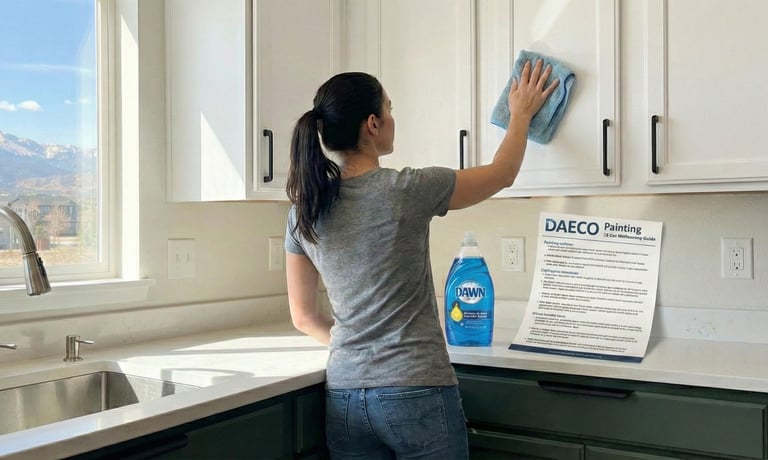
When you invest in professionally painted cabinets for your Denver home—whether you're in Cherry Creek (80209), downtown (80202), or Boulder's University Hill (80302)—you're making a smart decision that saves thousands compared to replacement. But the longevity of that investment depends entirely on proper maintenance and understanding what professional-grade cabinet finishes actually need. As a premier painting contractor serving Denver, Boulder, and the Front Range for over two decades, DAECO Painting has refined cabinet finishing into a precise science—and we're sharing exactly what keeps those surfaces flawless for 10-15 years or longer.
The Durability Reality: What Professional Cabinet Paint Actually Delivers
Professional cabinet painting isn't just about color—it's about creating a moisture-resistant, impact-tolerant surface that withstands daily use in Colorado's challenging climate. Denver's elevation creates lower humidity than coastal regions, which actually benefits cured paint films, but our dramatic temperature swings (40-degree shifts aren't uncommon) demand specific product formulations.
At DAECO, we exclusively use three proven waterborne cabinet coating systems that outperform conventional solventborne products while protecting indoor air quality: Fine Paints of Europe Hollandlac Brilliant, Benjamin Moore Advance, and Sherwin-Williams Gallery Series Waterborne Topcoat. These aren't standard wall paints repurposed for cabinets—they're purpose-engineered for horizontal surfaces subjected to impact, moisture, and chemical exposure.
Why These Three Products Dominate Professional Cabinet Finishing
Fine Paints of Europe Hollandlac Brilliant releases 90% fewer VOCs than conventional solventborne coatings while delivering the hardness and chemical resistance traditionally associated only with oil-based systems. The alkyd-modified waterborne formula creates a self-leveling finish with exceptional flow and leveling properties—critical for eliminating brush marks or spray texture on large cabinet faces.
Benjamin Moore Advance uses a hybrid formulation that combines the application ease of latex with the hardness and adhesion of alkyds. It cures to a furniture-quality finish with superior block resistance (doors won't stick to frames) and maintains color stability under UV exposure—important for kitchens with large windows facing Colorado's intense high-altitude sunlight.
Sherwin-Williams Gallery Series Waterborne Topcoat is formulated specifically for spray application on wood cabinetry and millwork. The acrylic-urethane chemistry provides excellent chemical resistance to household cleaners and cooking oils while maintaining flexibility that prevents cracking as wood substrates expand and contract with Denver's humidity fluctuations.
Translation: Your cabinets can handle actual kitchen use without the finish degrading, and your home isn't filled with solvent fumes during or after the project.
Expected Lifespan by Room Type
Low-traffic bathrooms: 12-15+ years before any refinishing needed
Kitchens with moderate use (1-2 people, minimal cooking): 10-12 years
High-use kitchens (families, daily cooking): 8-10 years for doors/drawers, 12+ for cabinet boxes
Laundry rooms: 15+ years (minimal stress on finishes)
These timelines assume proper maintenance—which is where most homeowners unknowingly cut their investment short.
The First 30 Days: Cure Time Is Non-Negotiable
Here's what most homeowners don't realize: even though waterborne cabinet coatings feel dry to the touch within hours, the chemical curing process takes 30 full days for these advanced formulations. During this period, the water-based solvents are still evaporating and the cross-linking chemistry is still occurring.
What this means for you:
Days 1-3: Handle doors minimally. The surface is fragile and can still be marred by pressure.
Days 4-14: Normal use is fine, but avoid water exposure, cleaning products, and heavy objects leaning against surfaces.
Days 15-30: The finish is hardening but not fully cured. Light cleaning with damp cloth only—no soap yet.
Day 31+: Full cure achieved. Normal maintenance can begin.
We've seen beautiful finishes ruined by homeowners who cleaned cabinets with all-purpose cleaner on day 10. The solvents in cleaning products can re-emulsify the not-fully-cured paint, creating permanent dull spots or adhesion failure. This isn't an exaggeration—it's the chemistry of waterborne coatings that haven't reached their final molecular structure.
Product-Specific Cure Characteristics Denver Homeowners Should Know
Denver's average humidity of 30-40% during spring and summer actually accelerates cure times for waterborne products compared to humid coastal climates. However, winter humidity drops to 15-25%, which can slow evaporation and extend cure periods.
Fine Paints of Europe: Reaches handling hardness in 4-6 hours at 70°F, but requires the full 30 days for maximum chemical resistance. The alkyd modification continues cross-linking for weeks.
Benjamin Moore Advance: Achieves recoat time in 4-6 hours but needs 7 days before normal use and 30 days before aggressive cleaning. The hybrid chemistry cures from both evaporation and oxidation.
Sherwin-Williams Gallery Series: Dries to touch in 30-60 minutes, recoat in 2-4 hours, but like all waterborne topcoats, requires 30 days for full hardness and chemical resistance.
In winter projects where we're controlling climate in your home, we often run dehumidifiers to prevent cure-time extension from Denver's ultra-dry air pulling moisture from wood substrates into the curing paint film.
Daily and Weekly Maintenance: The 90-Second Routine That Adds Years
Professional cabinet finishes are remarkably low-maintenance if you stay ahead of buildup. The enemy isn't regular use—it's accumulated cooking oils that slowly penetrate protective coatings.
Daily (30 seconds):
Wipe down high-touch areas (handles, drawer fronts near the stove) with a barely damp microfiber cloth. No soap. Just water. This removes surface oils before they can bond to the finish.
Weekly (60 seconds):
Mix 2-3 drops of Dawn dish soap (original blue formula—it's pH-neutral) in a bowl of warm water. Wring out your microfiber cloth until it's barely damp, then wipe all cabinet faces. Immediately follow with a dry microfiber to prevent water spots.
Critical detail: "Barely damp" means you squeeze the cloth so thoroughly that it leaves no visible moisture trail on the cabinet. Excess water can seep into door edges or joints, causing the substrate (typically MDF or hardwood) to swell.
What Never to Use on Waterborne Cabinet Finishes
Based on two decades of refinishing cabinets damaged by improper cleaning:
All-purpose cleaners (Simple Green, 409, Fantastik): Too alkaline; breaks down acrylic polymers over time
Vinegar or lemon juice: Acidic solutions etch waterborne finishes and can dull the sheen permanently
Magic Erasers: These are melamine foam abrasives that remove micro-layers of your finish with each use
Scouring pads or brushes: Obvious scratching that breaks through the protective topcoat
Baking soda paste: Abrasive and alkaline—doubly destructive to waterborne chemistry
Ammonia-based products: Break down urethane linkages in Gallery Series and similar formulations
If dish soap and water won't remove something, it requires professional attention, not stronger DIY chemicals. All three of our primary products are designed to resist household soiling with mild soap—if that's not working, you're dealing with a substance that's chemically bonded to the surface and needs professional removal.
Addressing Damage: When DIY Works and When It Doesn't
Minor Surface Scratches (Superficial Clear Coat Only)
For light scratches that haven't penetrated to the color coat—you'll know because the scratch appears white or translucent rather than showing a different color—use this professional technique:
Apply a tiny amount of furniture polish (Guardsman, Howard's Feed-N-Wax) to a microfiber cloth
Buff the scratch in a circular motion for 10-15 seconds
Wipe away excess with a clean section of the cloth
This fills the microscopic valley with oils that refract light similarly to the surrounding finish. It's temporary but effective for 6-12 months.
Small Chips (Paint Missing, Substrate Visible)
Stop: Do not attempt DIY repair. Here's why.
Professional cabinet finishes require color-matched paint, proper surface prep (220-grit feathering of surrounding finish), and spray application for texture consistency. Brush touch-ups create raised edges and sheen variations that draw the eye to the repair rather than camouflaging it.
DAECO keeps detailed records of every project—primer brand, topcoat manufacturer (Fine Paints of Europe, Benjamin Moore, or Sherwin-Williams), custom color formula, and sheen level. When you call for a chip repair, we're replicating the exact specification from your original project, then spraying the repair area with the same HVLP equipment used initially. The result is genuinely invisible.
Cost reality: Small touch-up service calls in Denver typically run $150-250. Attempting DIY repair with mismatched paint from a hardware store often creates damage that costs $400-600 to correct properly because we have to strip and refinish entire doors to eliminate visible repair attempts.
When to Refinish vs. Touch Up
If damage is concentrated on 1-2 doors: Touch-up or individual door refinishing ($75-150 per door)
If you're seeing wear across multiple doors or boxes: Full refinishing is more cost-effective and delivers better aesthetic results ($3,500-6,500 for average kitchen, compared to $12,000-18,000 for replacement)
The Environmental Factors Denver Homeowners Must Consider
Humidity Control
Colorado's average indoor humidity in winter drops to 15-25%—drier than the Sahara Desert. While this prevents mold, it can cause wood substrates to contract, creating micro-separations at door joints. Run a whole-home humidifier to maintain 35-45% relative humidity, which benefits both your cabinets and your respiratory health.
The waterborne products we use (particularly Benjamin Moore Advance and Gallery Series) are formulated to maintain flexibility as substrates move. However, extreme dryness can still cause substrate movement that exceeds the paint's ability to flex, especially in solid wood doors.
Cooking Ventilation
Your range hood must be vented to the exterior—not recirculating. Grease-laden air that recirculates deposits a sticky film on cabinets that attracts dust and accelerates finish degradation. We inspect ductwork during project consultations for exactly this reason.
In Denver's dry climate, that grease film dehydrates into a varnish-like layer that dish soap can't penetrate without aggressive scrubbing (which damages paint). Prevention is vastly easier than remediation.
UV Exposure and Color Stability
Denver sits at 5,280 feet with 300 days of sunshine annually—that's 25% more UV exposure than sea-level locations. Cheaper cabinet paints yellow or fade within 2-3 years.
Fine Paints of Europe uses lightfast pigments that maintain color accuracy for decades. Benjamin Moore Advance includes UV inhibitors specifically for this reason. Gallery Series employs colorfast pigments designed for architectural millwork exposed to sunlight. This is why we specify these products for Denver-area projects rather than generic "cabinet paint" from big-box stores.
The 5-Year Inspection: What Professionals Look For?
Around the 5-year mark, DAECO recommends a complimentary cabinet inspection (included with our original projects). We're checking:
Joint integrity: Has substrate movement created separation at cope-and-stick joints?
Finish adhesion: Any bubbling near sinks or dishwashers (moisture intrusion)?
Hardware fatigue: Are hinges creating new stress points on door faces?
Sheen uniformity: Has cleaning created dull patches indicating topcoat wear?
Catching these issues at year 5 allows for minor interventions (re-caulking a joint, replacing a hinge, spot-recoating a single door) that prevent major problems at year 8.
Frequently Asked Questions
How soon can I hang things on the cabinet doors after painting? Wait 30 days for full cure. Adhesive hooks or magnets applied earlier can pull away paint when removed, especially with waterborne finishes that cure more slowly than traditional oil-based products.
Can I use disinfecting wipes on painted cabinets? No. These contain quaternary ammonium compounds (quats) and alcohol that soften waterborne finishes. Use soap and water, which kills 99%+ of household bacteria when properly applied.
Why do my white cabinets look yellow near the stove? With the waterborne products DAECO uses (standard since 2015), yellowing indicates cooking oil film buildup, not finish degradation. Deep clean with dish soap solution. If we used Fine Paints of Europe or Benjamin Moore Advance, the finish itself won't yellow.
Should I wax painted cabinets? Never. Wax creates adhesion problems for future refinishing and attracts dust. Modern waterborne cabinet finishes don't require or benefit from wax—they're formulated to be complete protective systems.
What's the difference between the three products DAECO uses? Fine Paints of Europe offers the smoothest, hardest finish with European-quality pigments—best for high-end projects. Benjamin Moore Advance provides exceptional value with proven durability and nationwide availability for future touch-ups. Sherwin-Williams Gallery Series excels in commercial-grade durability for high-use environments. We recommend based on your specific needs, budget, and aesthetic goals.
Do you serve my neighborhood in Denver or Boulder? DAECO serves all Denver zip codes including 80209 (Cherry Creek), 80202 (downtown), 80218 (Capitol Hill), 80206 (Park Hill), and 80220 (Montbello), plus Boulder areas including 80302 (University Hill), 80304 (North Boulder), and 80305 (South Boulder). We also cover Westminster, Arvada, Lakewood, Broomfield, and throughout the Front Range.
Why Professional Matters: The DAECO Difference
Cabinet painting isn't a weekend DIY project—it's a specialized trade requiring spray equipment calibration, climate-controlled curing environments, and product chemistry knowledge. When DAECO refinishes cabinets, you're getting:
HVLP spray application creating 1-2 mil film thickness with uniform coverage (brushing creates 4-6 mils with visible texture)
Controlled spray environment ensuring consistent cure rates regardless of Denver's weather
Product warranties backed by manufacturer technical support (Fine Paints of Europe, Benjamin Moore, and Sherwin-Williams provide contractor support unavailable to retail consumers)
Color documentation for perfect future matching, including batch numbers and custom formulas
The difference between a 6-year finish and a 15-year finish is 90% preparation and product selection—which happens before you ever see color on your cabinets.
Making Your Investment Last
Professionally painted cabinets represent exceptional value: $4,500-7,500 for a complete kitchen transformation that lasts 10+ years versus $15,000-35,000 for replacement. But that value proposition only works if the finish performs as expected.
The maintenance routine we've outlined takes less than 5 minutes per week and costs essentially nothing. Compare that to the alternative: neglected cabinets requiring full refinishing at year 6 instead of year 12.
DAECO Painting serves Denver, Boulder, Broomfield, Westminster, Arvada, Lakewood, and throughout the Front Range. Our cabinet finishing process includes detailed post-project care instructions, product specification sheets for your records, and lifetime technical support—because we're not just painting your cabinets, we're protecting your investment for the next decade.
Want to discuss cabinet refinishing or schedule a maintenance inspection? Contact DAECO Painting or visit our Denver showroom. Bring photos of your existing cabinets for immediate project assessment and product recommendation.
Ready for Your Custom Quote?
As we hope you've learned, we take every aspect of your house into account when determining the cost of painting your home. Get in touch with us so we can provide you a detailed cost for painting your home.