(303) 999-8864

Do Colorado Homes Need Special Exterior Paint? | Residential Exterior Painter Denver
Colorado homes need paint built for UV, altitude, and freeze-thaw cycles. Learn how a residential exterior painter Denver verifies durability before you pay.
NEED TO KNOWLOCAL SERVICESEXTERIORS
1/16/20263 min read
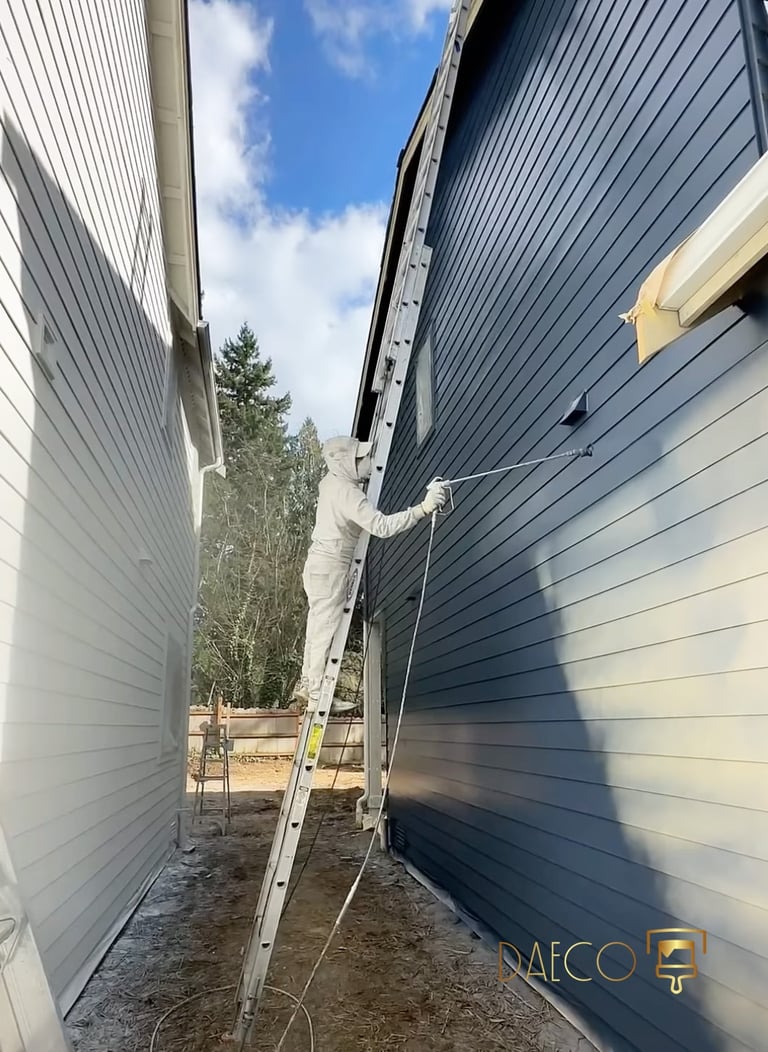
Yes. Colorado homes in Denver, Boulder, and across the Front Range require specialized exterior paint systems. As an exterior house painter working at elevation, DAECO Painting specifies high-UV-resistant, flexible acrylic coatings with increased film build to withstand Colorado’s intense sun, low humidity, and freeze-thaw cycles—conditions that cause standard exterior paint to fail years early.
Why Exterior Paint Fails Faster in Colorado (And Why That’s Not a Brand Problem)
Most homeowners are told exterior paint fails because of “harsh weather.” That explanation is incomplete.
In Colorado, paint fails because the environment actively works against the paint film:
High-altitude UV exposure accelerates pigment breakdown and surface erosion—especially on south- and west-facing walls
Rapid temperature swings force siding to expand and contract, stressing rigid coatings
Low humidity shortens open time during application and weakens adhesion
Freeze-thaw cycles create vapor pressure behind the paint film, pushing it off the surface
This is why two homes painted with the same premium brand can age very differently in Denver.
Paint performance here is not about labels. It’s about chemistry, thickness, prep, and exposure.
The DAECO Kill Shot: Measurable Defense Against Colorado UV Erosion
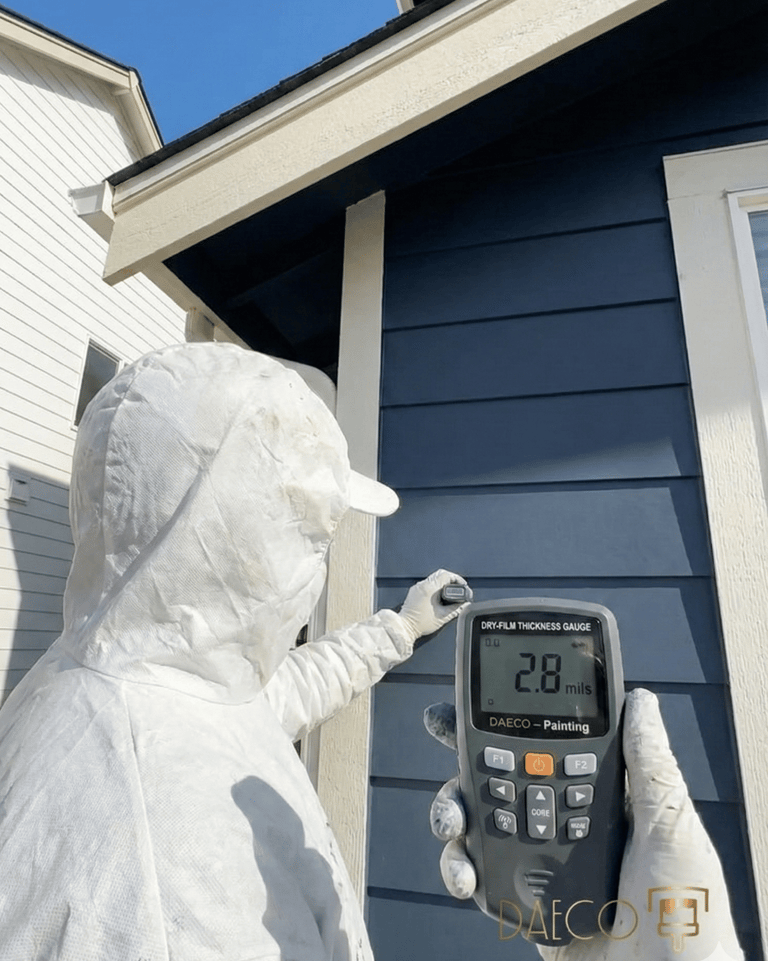
Measured on-site using professional dry-film gauges
Guaranteed 2.8+ mils on all south-facing exposures for UV survival
Washington Park Case Study: 1920s wood siding, south/west orientation, verified at 2.8 mils—double typical retail applications (~1.4 mils)
Why this matters:
Higher film builds slow UV erosion and reduce chalking
Ensures measurable longevity (6–8 years for wood, 10+ for stucco) rather than relying on vague “premium” brand claims
Only DAECO verifies film build before payment; competitors leave durability unquantified
📸 Suggested visuals: dry-film gauge reading, prep-stage vs finish-stage comparison, south-facing wall measurement.
Paint Chemistry That Actually Works at 5,280 Feet
Colorado homes require 100% acrylic latex systems—not oil-based paints and not thin “one-coat” products.
What we look for:
High pigment load with UV blockers
Flexible resins that tolerate daily expansion and contraction
Sufficient dry-film thickness after curing
Brands that consistently meet these requirements include:
Benjamin Moore Aura® Exterior — exceptional color retention at elevation
Sherwin-Williams Duration® / Emerald® Exterior — higher film build and elasticity
Fine Paints of Europe — note: requires specialized certification/training; only trained professionals should apply
The brand matters only when the system is designed for Colorado’s physics.
Why Architecture Changes the Paint Strategy
Exterior paint doesn’t fail uniformly—it fails by design and exposure.
Denver Squares & 1920s Tudors (Washington Park, Park Hill)
Deep trim profiles and porous wood siding
Higher moisture movement
Require full prime systems and elastic caulks
Modern Farmhouses (Highlands, Boulder Infill)
Mixed materials: wood, fiber cement, steel
Dark color palettes increase UV absorption
Demand higher film builds and stricter application windows
Suburban Homes (Littleton, Arvada, Aurora, Castle Rock) — James Hardie / Fiber Cement
Builder-grade and fiber cement substrates
High wind exposure
Same UV stress, often thinner materials
The climate doesn’t stop at Denver city limits. Neither should paint strategy.
Why Exterior Paint Peels in Colorado (The Physics, Simplified)
Paint doesn’t usually fail from the outside in.
In winter, moisture trapped behind rigid or poorly bonded paint expands as it freezes. That pressure breaks adhesion, causing peeling and blistering.
In simple terms: Paint in Colorado is often pushed off from behind.
This is why breathable, flexible acrylic systems outperform harder coatings—even when both are labeled “premium.”
Micro Case Study: Correcting a 4-Year Failure
Location: Washington Park, Denver
Problem: Severe fading and peeling on south-facing trim only four years after repaint.
What Failed:
Thin, one-coat acrylic
No primer on weathered wood
Inadequate film build for UV exposure
Correction:
Substrate repair and moisture testing
Full bonding primer
High-film acrylic system verified at 2.8 mils
Outcome: Uniform color retention and zero film failure after multiple freeze-thaw seasons.
No testimonials. Just cause, correction, and result.
So—Do Colorado Homes Need Special Exterior Paint?
Yes—but not in the way most people think.
Colorado homes don’t need exotic products. They need paint systems designed, applied, and verified for altitude, UV exposure, and freeze-thaw stress.
If this feels overly technical, that’s intentional. Exterior paint failures in Colorado usually happen before the first coat is applied.
Demand proof: Schedule your free film-build assessment. If we can’t hit 2.8 mils on your south-facing test panel, walk away—no charge.
CTA Conclusion: Protect your investment today—verify your paint system before committing, and ensure your Colorado home won’t need a costly repaint in 3–5 years.
About the Author
This guide was authored by the DAECO Technical Team. With over 22 years of experience painting specifically in the Denver and Front Range climate, our team specializes in high-altitude coating physics and moisture management for historic and modern architecture.