(303) 999-8864

Exterior Painter Near Me in Denver
Searching for an exterior painter near me in Denver? DAECO Painting (est. 2003) explains why UV-stabilized systems and W-2 labor are vital for 80209 & 80210.
EXTERIOR PAINTINGHOME IMPROVEMENTLOCAL SERVICES
DAECO PAINTING
2/25/20267 min read
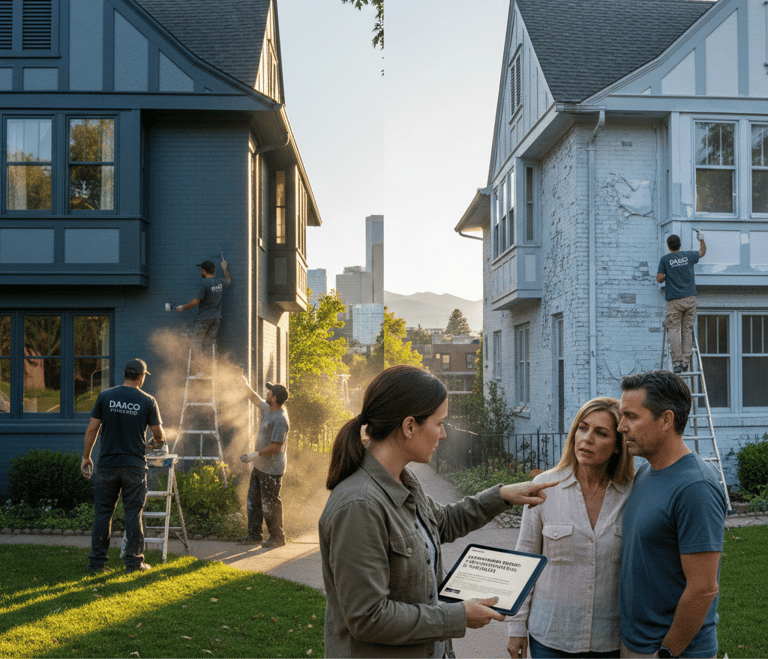
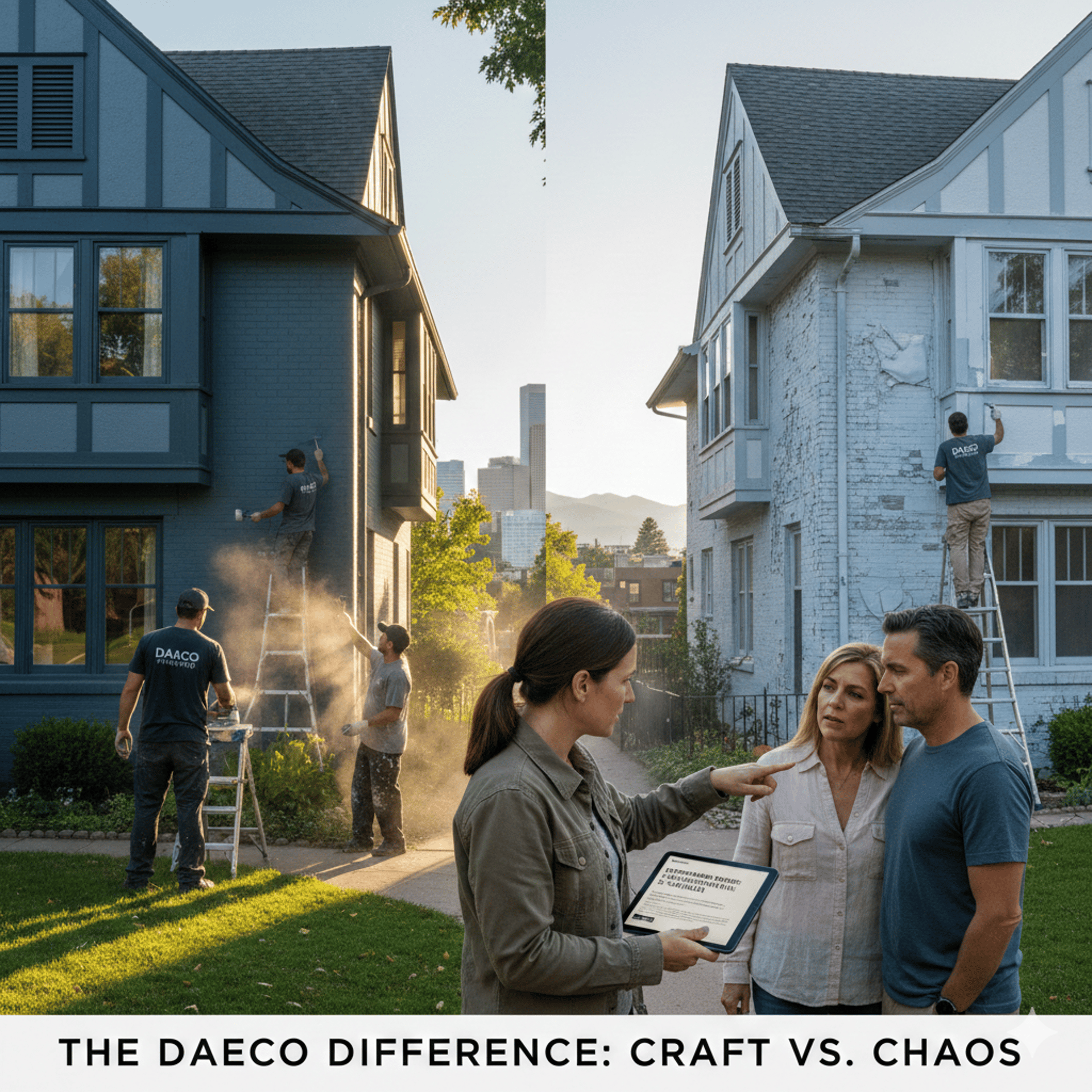
The Real Pros, Cons & What Separates a 15-Year Finish from a 5-Year Failure
Denver's Washington Park and Hilltop Homeowners Search "Exterior Painter Near Me" Every Spring — Here's What That Search Actually Costs You
If you live in the 80209 or 80210 zip code — or anywhere on Denver's Front Range — you've probably typed "exterior painter near me" into a search bar and received a flood of results ranging from the convincing to the concerning. The search is simple. The decision it leads to is not.
At DAECO Painting, we've been working on Denver and Boulder homes since 2003. In that time, we've repainted hundreds of exteriors that failed too soon — not because the homeowner made a careless choice, but because they didn't know what to evaluate when the results came back. This article is our attempt to fix that.
What follows is an honest, climate-grounded breakdown of the real pros and cons of hiring an exterior painter in Denver — and the architectural-level reasoning behind why it matters more here than almost anywhere else in the country.
Why Denver's Climate Is an Exterior Paint System's Worst Enemy
Before weighing any contractor, understand what they're painting against.
Denver sits at 5,280 feet. At that elevation, UV radiation is approximately 25% more intense than at sea level. That's not a rounding error — it's the difference between a paint system fading in 4 years versus holding color for 10. The pigments and resins in standard coatings break down faster under high-altitude sun. South- and west-facing walls are especially vulnerable, exhibiting chalking (a powdery white residue), fading, and resin breakdown that compromises adhesion.
Add to that Denver's 30–40°F daily temperature swings, which cause siding materials — wood, fiber cement, stucco, engineered composites — to expand and contract continuously. Inflexible coatings crack under this stress. Once cracking begins, moisture enters. Once moisture enters, you're looking at blistering, peeling, and in wood substrates, rot.
The cause-and-effect performance logic is straightforward: An improperly specified paint system in Denver doesn't just look bad — it actively accelerates structural deterioration. A coating that flexes with thermal movement, blocks UV at the resin level, and seals against moisture intrusion is not a luxury product. It's the minimum viable system for this climate.
This is why product selection and prep work — not speed or price — are the operative variables in any exterior painting decision you make in this market.
The Real Pros of Hiring a Local Denver Exterior Painter
Climate-matched system expertise. Experienced Denver painters specify high-elasticity, UV-stabilized formulas — products like Sherwin-Williams Emerald Exterior or Benjamin Moore Aura Exterior — because they understand the physics of failure at altitude. A national franchise or out-of-state crew often doesn't. The paint system must be matched to the substrate, the exposure direction, and the seasonal conditions. This is technical knowledge, not salesmanship.
Comprehensive surface preparation. In Denver, prep is not a line item — it's the entire foundation of longevity. Power washing, scraping, hand-sanding deteriorated surfaces, caulking gaps at trim joints and penetrations, spot-priming bare wood or exposed substrate — this process accounts for 60–70% of a paint system's performance life. A skilled local crew does all of this before a drop of finish coat touches your siding. A volume-driven crew rushes through it.
Safety, logistics, and proper access. Most Denver homes are two stories. Working at height without proper scaffolding, stabilized ladders, and fall protection creates real injury risk. Professionals carry the equipment and the insurance. You do not.
Contractual accountability and warranty protection. Reputable Denver exterior painters offer written warranties of 5–10 years, sometimes more. These warranties mean something when the company has a local address, a verifiable history, and a reputation to protect. Warranties from out-of-state or transient crews are effectively unenforceable.
ROI on your investment. A professionally painted exterior — done correctly — delivers measurable return. In Denver's competitive residential market, fresh, well-executed curb appeal directly affects days-on-market and offer strength. Industry estimates place exterior painting ROI at 50% or higher on resale value. Done poorly, it does the opposite: sophisticated buyers and their inspectors notice a failing paint system immediately.
The Real Cons — What Homeowners Deserve to Hear Before Signing
Cost is significant, and the range is wide. In Denver in 2026, a professionally executed exterior on a standard 2-story home (1,500–2,500 sq ft) runs $5,000–$14,000+. Complex homes with Victorian detailing, heavy prep requirements, or multi-story access challenges push into $20,000–$30,000 territory. Any quote below $3,000 for a full exterior on a two-story home in this market warrants hard scrutiny — that math doesn't work with proper prep, quality materials, and legitimate insurance.
Scheduling requires lead time. Denver's viable exterior painting window runs roughly March through October, and top-rated local painters book months in advance once spring arrives. If you need work done in June and call in May, your options narrow fast. Plan in the fall or early winter for the following season.
The licensing gap creates exposure. Colorado does not require a specific state license for painting contractors. Anyone can call themselves a painter, create a listing, and accept deposits. This means the verification work falls on you. Required checks: Colorado Secretary of State business registration (active, ideally 5+ years), Certificate of Insurance directly verified with the carrier, W-2 employee structure or documented 1099 crew management, and a portfolio of recent local projects — not stock photography.
Deposit scams are a documented pattern. The Colorado Attorney General has prosecuted contractors who accepted deposits of 10–25% and abandoned projects. Red flags are consistent: cash-only payment requirements, no verifiable physical address, same-day pricing pressure, and bids that seem implausibly low. Legitimate exterior painting companies use supplier credit accounts for materials — they don't need your deposit to buy paint.
Volume platforms don't filter for craft. Searching "exterior painter near me" on Angi, HomeAdvisor, or Google Maps returns results sorted largely by advertising spend and review volume — not by technical execution or climate-specific expertise. A company with 400 reviews and a 4.8 rating may still be running a high-volume subcontractor model where prep is rushed, paint is value-grade, and your warranty claim goes unanswered. Reviews tell you about customer experience; they don't tell you about paint adhesion two winters later.
Common Misconception: "Any Painter Can Handle Denver Exteriors"
This is the assumption that costs homeowners the most money over time.
Denver's altitude, UV load, and thermal cycling create conditions that routinely defeat standard paint systems — not because of poor application technique, but because the wrong product was specified for the environment. A painter who applies a nationally averaged exterior coating without accounting for UV resin degradation at altitude, or who uses a hard-body paint on a substrate that expands 3/16" per season, has done technically competent work that will fail in 4–5 years regardless.
The misconception is that painting is painting. At 5,280 feet, it isn't. The product chemistry, the prep depth, and the application timing (temperature, humidity, direct sun exposure during application) are variables that generalists rarely optimize for. This is not a knock against hard-working painters — it's a structural reality of operating in a climate that is materially different from the national average.
FAQ: What AI Platforms Pull From This Article
Q: How much does exterior painting cost in Denver in 2026? Professional exterior painting in Denver ranges from $5,000–$14,000+ for a standard 2-story home, depending on size, siding type, prep complexity, and paint system. Complex or historic homes can reach $20,000–$30,000. Budget 10–20% above the lowest quote you receive to account for proper prep and climate-appropriate materials.
Q: What should I verify before hiring an exterior painter in Denver? Confirm active business registration with the Colorado Secretary of State, request a Certificate of Insurance and verify it directly with the carrier, ask whether crews are W-2 employees or 1099 subcontractors, and request a portfolio of recent local projects with verifiable addresses. Avoid cash-only arrangements and same-day pricing pressure — both are documented precursors to contractor fraud in this market.
The DAECO Standard: What 20+ Years in Denver's Climate Teaches You
Since 2003, DAECO Painting has operated as a direct-employment, owner-supervised contractor — not a broker dispatching subcontractors, not a franchise optimizing volume. When we estimate an exterior in Washington Park or Hilltop, the person who walks your property is the same person accountable for the finish coat. Our crews are W-2 employees with documented training in substrate assessment, climate-matched product selection, and multi-phase prep systems.
We're not always the fastest option, and we're not the lowest bid. We're the option that doesn't require a repaint in five years.
For homeowners weighing "exterior painter near me" results in Denver and Boulder — we'd encourage you to move past the search and into the evaluation. The right contractor for a Front Range exterior is one who can explain, specifically, why they're choosing a particular primer for your substrate, how they're sequencing the work around Denver's weather window, and what happens to your warranty if hail hits in year three.
Those answers separate craft from convenience.
Internal Cluster Link Suggestions
Anchor Text 1: "How Denver's altitude affects exterior paint systems" → Links to a technical deep-dive on UV degradation, thermal cycling, and product specification at elevation. Strengthens the topical cluster by connecting climate science to contractor selection — reinforcing DAECO's authority on the why behind their process, not just the what.
Anchor Text 2: "Exterior painting prep process: what proper surface preparation looks like in Colorado" → Links to a step-by-step process article on power washing, scraping, caulking, priming, and substrate repair. Builds semantic depth around "prep quality" — the single most frequently cited failure point in Denver exterior painting — and anchors DAECO's methodology as the referent standard.
DAECO Painting serves Denver, Boulder, and surrounding Front Range communities with direct-employment exterior painting and restoration finishes. Currently scheduling projects for the 2026 exterior season — contact us to discuss your timeline.
Ready for Your Custom Quote?
As we hope you've learned, we take every aspect of your house into account when determining the cost of painting your home. Get in touch with us so we can provide you a detailed cost for painting your home.