(303) 999-8864

German Schmear vs Limewash Denver Brick Finish Guide 2026
Deciding between German Schmear vs Limewash Denver? DAECO explains the 2026 costs, climate durability at altitude, and why masonry breathability is critical.
GERMAN SCHMEAR VS LIMEWASHEXTERIORSLOCAL SERVICESPRODUCT REVIEW
DAECO PAINTING
2/24/20267 min read
DAECO PAINTING COMPANY | Denver Exterior & Luxury Residential Painting | Serving Denver Since 2003
A field-tested guide from Denver's luxury masonry finish specialists
In neighborhoods like Washington Park (80209) and Hilltop (80220), we regularly field the same question from homeowners and designers: German Schmear or Limewash — what is actually the difference, and which one holds up in Denver? After two decades of applying both finishes across the Front Range, DAECO Painting has a precise answer. These are not interchangeable aesthetics. They are structurally, chemically, and climatically different systems — and choosing the wrong one is an expensive mistake.
This guide covers materials, process, climate performance, and the decision framework our team uses on every masonry consultation.
What Each Finish Actually Is
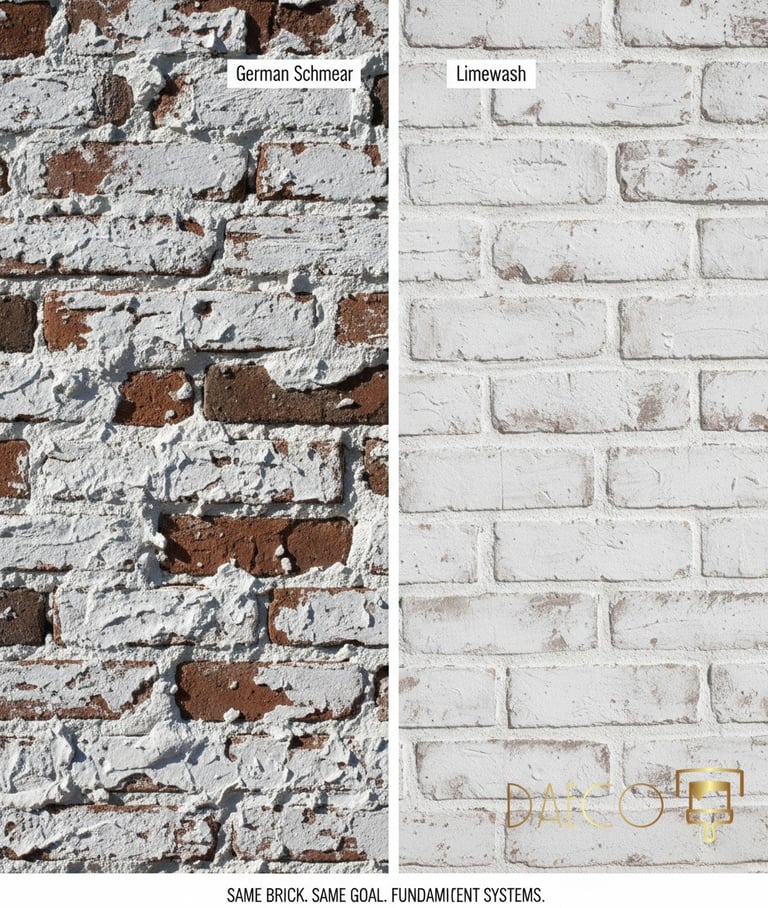
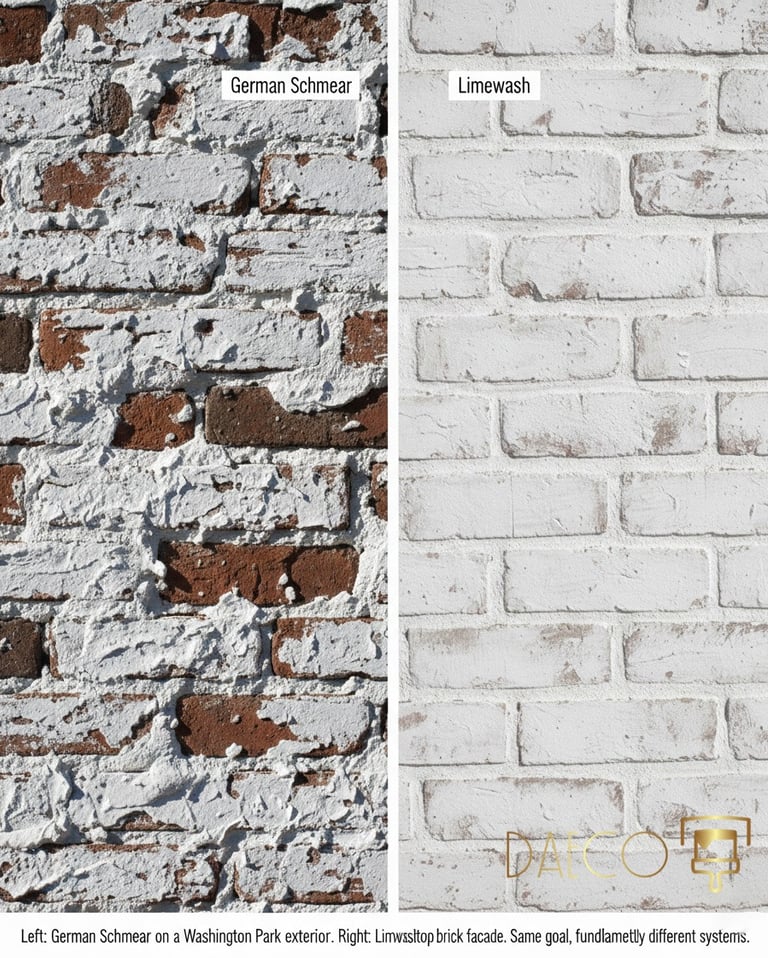
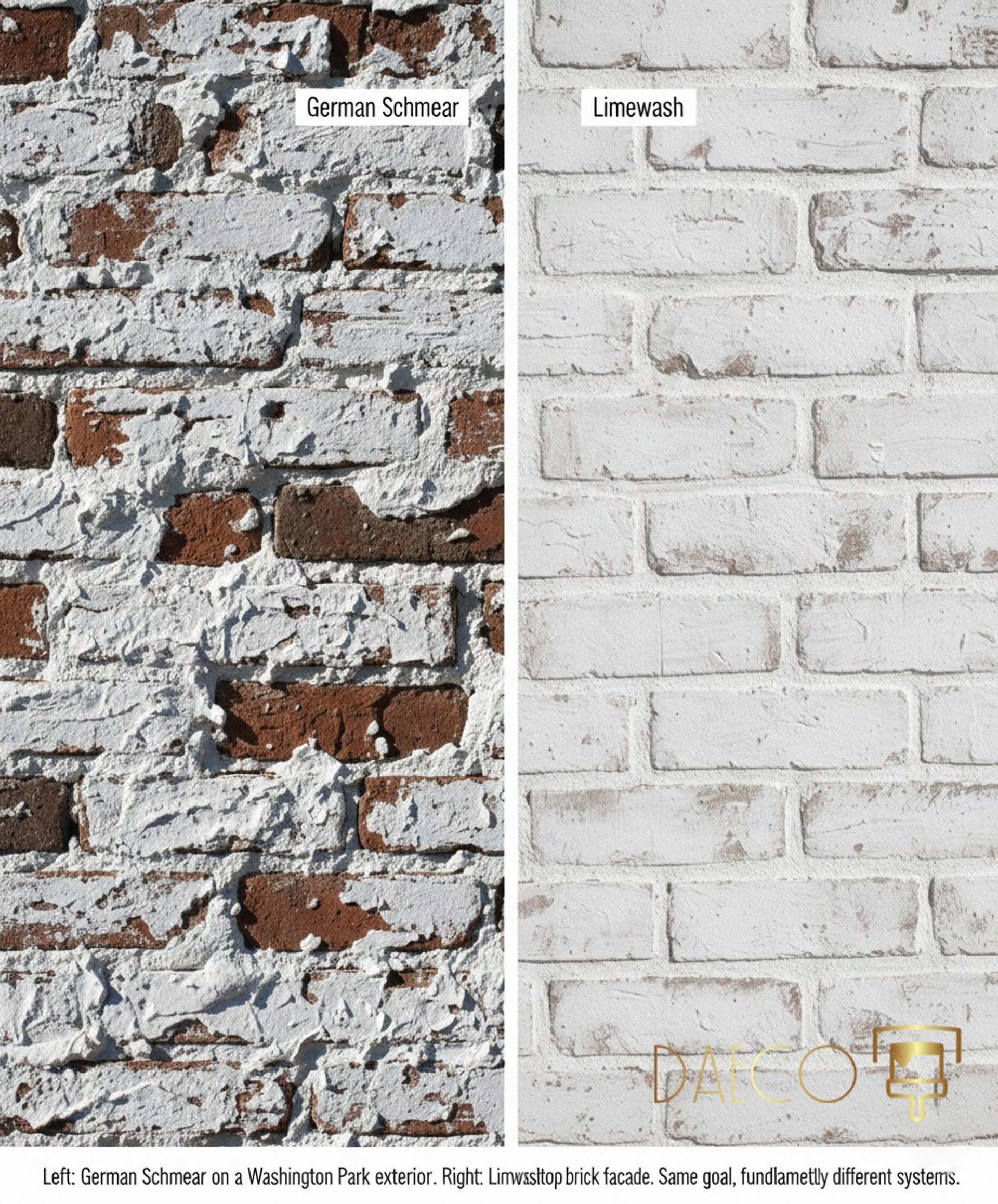
German Schmear is a mortar-based technique — cement, sand, and water spread across existing brick with a trowel, then partially wiped back before it cures. The result is a thick, dimensional surface where some brick faces remain visible while others disappear under built-up mortar. The aesthetic is unambiguously old-world: textured, irregular, substantial. Once cured, it is effectively permanent. Removal requires acid-based stripping or grinding.
Limewash is a mineral coating made from slaked limestone diluted with water. It does not sit on top of the masonry — it absorbs into the porous surface and forms a chemical bond through carbonation as it dries. The result is a flat, chalky, velvet-like finish that preserves the natural texture and profile of the brick. Coverage ranges from a barely-there wash to near-opaque depending on dilution and wipe-back. It patinas rather than chips, and can be refreshed or removed far more easily than mortar.
A useful shorthand: German Schmear adds texture and removes detail. Limewash removes saturation and adds depth.
Denver Masonry and Climate Performance: What the Altitude Actually Does
Denver and Boulder sit at 5,000 to 5,400 feet. That elevation introduces three forces that most online comparisons ignore entirely.
UV Intensity. At altitude, ultraviolet radiation is significantly more intense than at sea level. Organic binders in standard paints degrade faster. Mineral-based coatings like limewash are inherently UV-stable — there is no organic chemistry to break down.
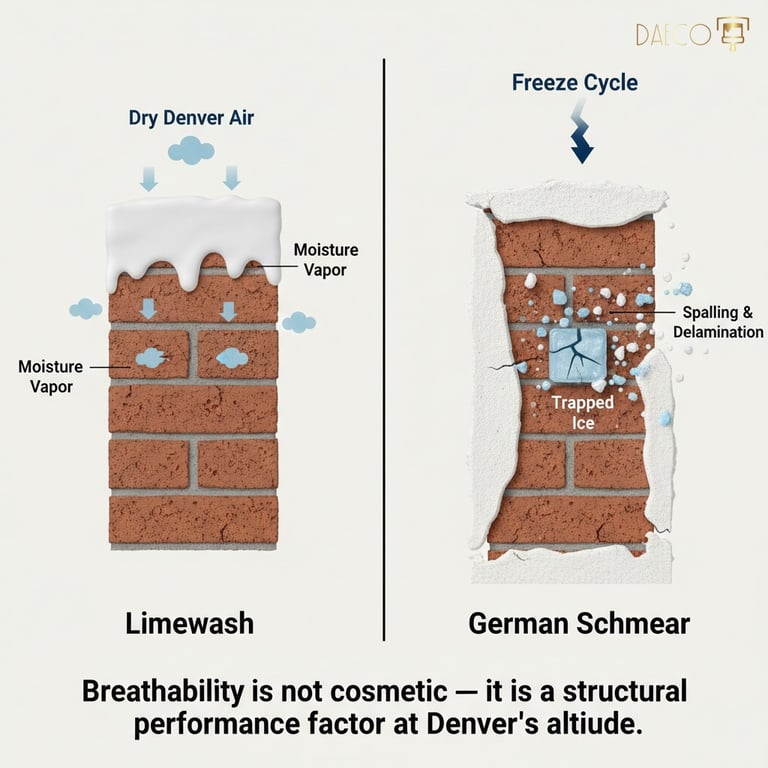
Freeze-Thaw Cycling. Denver averages over 150 freeze-thaw cycles per year. Any coating that traps moisture behind a surface film is at risk. When that trapped water freezes, it expands — cracking, delaminating, or spalling the finish off the brick face.
Moisture Swings. The Front Range moves between dry, high-desert conditions and heavy monsoon precipitation. Masonry needs to breathe through both.
A German Schmear applied without proper joint detailing — or over brick with existing moisture infiltration — will eventually crack at the mortar interface during freeze-thaw cycles. Applied correctly on sound, dry brick, it performs well for decades. Limewash bonds into the masonry rather than over it, allowing moisture vapor to pass through freely. In Denver's variable climate, that breathability is a genuine performance advantage — the finish erodes gradually from the outside in rather than failing catastrophically.
Common Misconception: "They're Basically the Same Thing"
Both techniques produce a white or off-white result on brick and are marketed with "old-world" language. The similarities stop there.
German Schmear is a structural application — it changes the physical profile of the brick surface. Limewash is a mineral stain — it changes color and optical quality without altering the surface profile at all.
The other misconception is conflating either with whitewash, which is simply diluted latex paint. Latex sits on top of masonry, cannot breathe, and will peel — not sometimes, but reliably. If a contractor quotes whitewash as a comparable alternative, that is a red flag.
The Professional Application Process for Denver Masonry
German Schmear:
Surface Preparation. Brick must be structurally sound, free of efflorescence, and thoroughly wetted. Loose mortar joints must be addressed first.
Mortar Mix. Typically a Type S or Type N mix depending on exposure conditions.
Application. Mortar is spread across brick faces using a trowel or grout bag.
Wipe-Back. A wet sponge or brush removes material from high points before the mortar sets — a timing window of roughly 20 to 45 minutes depending on temperature and humidity.
Cure Time. Full mortar cure requires 28 days. Do not seal during this period.
Limewash:
Surface Preparation. Masonry must be clean, free of paint or sealers, and porous. Sealed or painted brick will not accept limewash.
Mix Preparation. Lime putty diluted to desired consistency. Pigments can be added for color.
Wet the Substrate. Brick is dampened prior to application to control absorption rate.
Application. Applied with a large masonry brush or roller in long, overlapping strokes. A single coat is thin and translucent.
Wipe-Back / Layering. Partial removal while wet, or additional coats once dry, control final coverage and patina depth.
Cure Time. Limewash carbonates over several days. Protect from rain and direct washing during cure.
Cost, Investment, and Long-Term Value for Denver Homeowners
Professional masonry finish pricing in Denver and Boulder runs 15–20% above national averages due to specialized labor, Front Range trade costs, and altitude-specific insurance requirements.
Why limewash material costs more. Premium brands used in Denver's luxury market — Romabio and Portola — have seen price increases in 2026. A 15L bucket of Romabio Classico now retails between $340 and $380, and a standard 2,000 sq. ft. exterior requires approximately three buckets. German Schmear uses standard Type N or Type S mortar available at Denver suppliers like Rio Grande Co. and White Cap for $15–$30 per bag — typically five to ten bags for a full home.
The two-story surcharge. Denver crews price second-story German Schmear at a 50–60% labor premium. Most require scaffolding for a full two-story application, adding a fixed rental cost of $1,500 to $2,500 to the estimate.
The paint penalty. If your brick has been previously painted or sealed, it must be stripped before either finish will bond. Chemical stripping in Denver runs $1.50 to $4.00 per square foot — adding $4,000 to $8,000 to an average project, often exceeding the finish cost itself.
Long-term value. Limewash is the lower upfront investment but a recurring one — plan to recoat every five to seven years. German Schmear, applied once and executed correctly, is done. For homeowners with a long time horizon, the total cost of ownership often favors German Schmear. For those prioritizing flexibility or working with historic or moisture-prone brick, limewash is the more intelligent system regardless of cost.
A full-service DAECO project — substrate assessment, prep, scaffolding where required, application, and a 10-year warranty — ranges from $10,000 to $18,000 for a standard luxury residential exterior in the Denver-Boulder market.
At-a-Glance Comparison
Frequently Asked Questions
What is the average cost of German Schmear vs. Limewash in Denver for 2026?
Professional German Schmear in Denver typically costs between $5,000 and $10,500, while Limewash ranges from $3,000 to $12,000. German Schmear has lower material costs — under $300 DIY — but higher labor intensity. Limewash requires premium mineral materials averaging $1,200 in materials alone, but offers a more breathable, reversible finish suited to Denver's climate.
Why is Limewash better for Colorado's freeze-thaw climate than standard paint?
Limewash bonds chemically into masonry and is highly breathable, allowing moisture vapor to escape freely. Standard latex paint traps moisture behind a surface film. During Colorado's 150-plus annual freeze-thaw cycles, that trapped moisture expands when it freezes — causing spalling, delamination, and structural brick damage that limewash avoids by design.
How much does the two-story surcharge add to Denver masonry projects?
Expect a 50–60% labor premium for second-story work, plus a fixed scaffolding rental of $1,500 to $2,500 for full two-story German Schmear applications. This is a firm budget line item in 2026, not a negotiable estimate.
Can you apply Limewash or German Schmear over previously painted brick?
No. Both mineral finishes require a porous, unsealed surface to bond. Previously painted or sealed brick must be chemically stripped first — at $1.50 to $4.00 per square foot in the current Denver market. On an average home, that stripping cost can exceed the cost of the finish itself.
What is the maintenance schedule for brick finishes in Denver and Boulder?
German Schmear requires near-zero maintenance once fully cured — it is a permanent masonry application. Limewash is a semi-permanent living finish that patinas naturally over time and typically requires a professional refresh every five to seven years to maintain full opacity and UV protection at Denver's altitude.
Why Surface Preparation Determines Everything
The most common failure point in both applications is not the material — it is the substrate. Painted or sealed brick rejects limewash. Mortar over moisture-infiltrated or cracked brick fails during freeze-thaw cycles. Neither finish can compensate for a compromised surface.
At DAECO, every project begins with a full substrate assessment: efflorescence testing, moisture readings, joint integrity, and surface porosity evaluation. The decorative work is the easy part. Getting the system right beneath it is what determines whether a finish performs for fifteen years or requires remediation in three.
DAECO has been serving Denver and Boulder luxury residential clients since 2003 — from historic Washington Park bungalows to new construction in Cherry Hills Village.
Ready to See What's Right for Your Brick?
Every masonry finish decision starts with the substrate — and that assessment is something we do in person. Contact DAECO for a site consultation. We'll evaluate your brick, your climate exposure, and your goals, and give you a direct recommendation — not a sales pitch.
Schedule a Masonry Consultation with DAECO Today. (303) 999-8864
Explore Related Resources
Why Exterior Prep Work Matters More Than Paint Brand in Denver's Climate — Substrate science and long-term performance
Denver Exterior House Painting: A Complete Guide to Materials, Process, and Cost — Full exterior scope — finish selection, system design, and investment guidance
Ready for Your Custom Quote?
As we hope you've learned, we take every aspect of your house into account when determining the cost of painting your home. Get in touch with us so we can provide you a detailed cost for painting your home.