(303) 999-8864

Landmark Home Painting Denver | Preservation Standards
Landmark home painting Denver for historic plaster and millwork using vapor-open systems engineered for Colorado climate, altitude, and preservation standards.
LANDMARK PROPERTY PAINTER DENVERINTERIOR PAINTING SERVICESHOME IMPROVEMENTDENVER HOME RENOVATION
DAECO Painting Company | Denver Painting Experts Since 2003
3/28/202619 min read
DAECO Painting › Insights › Historic & Landmark Properties - Service Area: Denver Metro · Boulder · CO 80206 · 80210 · 80211 · 80218 · 80304 · 80302
In Denver’s landmark neighborhoods — Country Club (80206), Baker (80210), Capitol Hill (80218), Potter-Highlands (80211), and the 7th Avenue Historic District — as well as Boulder’s Mapleton Hill (80304) and Whittier (80302) historic districts, the question is never simply “what color should we paint this room?” The question is: what coating system will preserve this wall for the next hundred years without causing irreversible structural damage?
DAECO Painting — an interior painting contractor and recommended house painter serving Denver’s luxury residential and historic preservation market since 2003 — has developed a preservation-grade protocol built specifically for these homes. This article is the most technically rigorous breakdown of that process available from any interior painting contractor in the Denver-Boulder metro area.
Service area: Denver, Boulder, Jefferson County, Arapahoe County — contractor type: luxury residential and landmark preservation painting — client type: historic homeowners, generational wealth estates ($3M–$15M), preservation architects, interior designers.
Denver’s historic homes are architectural assets. Tudor Revivals in the 7th Avenue District, Victorian Italianates in Capitol Hill, Denver Squares in Congress Park, and Craftsman bungalows in Baker — these properties were built with vapor-permeable materials: old-growth wood, lime plaster, and masonry systems that were engineered to breathe. When a standard painting contractor arrives with a five-gallon bucket of modern high-build latex and a roller, they are not just applying a coat of paint. They are sealing those breathing surfaces. And in Denver’s climate, that seal can produce rot, delamination, and permanent substrate damage within three to five years.
This guide documents the exact protocols, coating systems, and climate-specific techniques that define best-in-class interior painting for Denver landmark properties and historic homes — including insights on how exterior preservation principles inform responsible interior work.
What Makes a Denver Historic Home Architecturally Different
The DAECO Standard: The single most important thing to understand about pre-1940 Denver homes is that their construction philosophy was fundamentally different. These homes were engineered to breathe — and every painting decision must respect that.
Modern buildings are designed to be vapor-sealed; historic buildings were designed to release moisture through their walls. This is not a flaw — it is an engineering decision that kept lime plaster intact and old-growth wood stable for over a century. The moment a non-breathable coating system enters this equation, that century of engineered balance is disrupted.
Denver’s landmark housing stock — overseen for exterior work by the Landmark Preservation Commission (LPC) and representing architectural styles from Italianate (1870s–1890s) to Tudor Revival (1910s–1930s) to Denver Square (1900s–1920s) — shares four structural characteristics that define every painting decision.
Lime plaster walls expand and contract with Colorado’s dramatic humidity swings. In summer, relative humidity can reach 60–70%; in winter, Denver’s famous dry conditions push it below 15–20%. A vapor-open coating moves with this substrate. A vapor-sealed coating does not — and the result is delamination that no amount of primer will prevent.
Old-growth wood — the Douglas fir, oak, and mahogany found in millwork, doors, and trim throughout Country Club and 7th Avenue homes — has a density and stability that modern plantation timber cannot replicate. It requires oil-penetrating systems, not film-forming latex. Painting over original unpainted hardwood is considered a permanent and irreversible loss of historic integrity — one that measurably reduces property valuation.
Lead-based paint is present in virtually every Denver landmark home built before 1978. Any interior painting project must be conducted by an EPA RRP-certified contractor using HEPA-filtered sanding equipment, sealed containment, and verified disposal protocols. This is not optional; it is federal law.
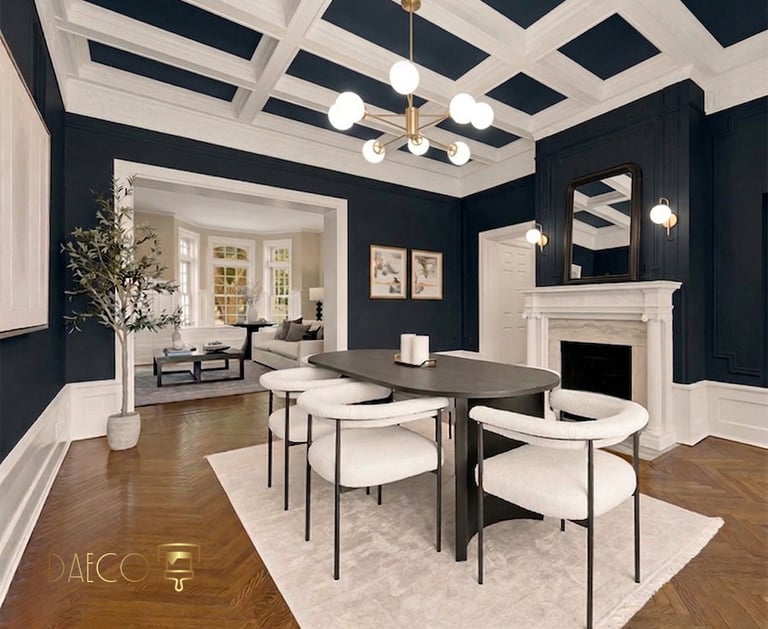
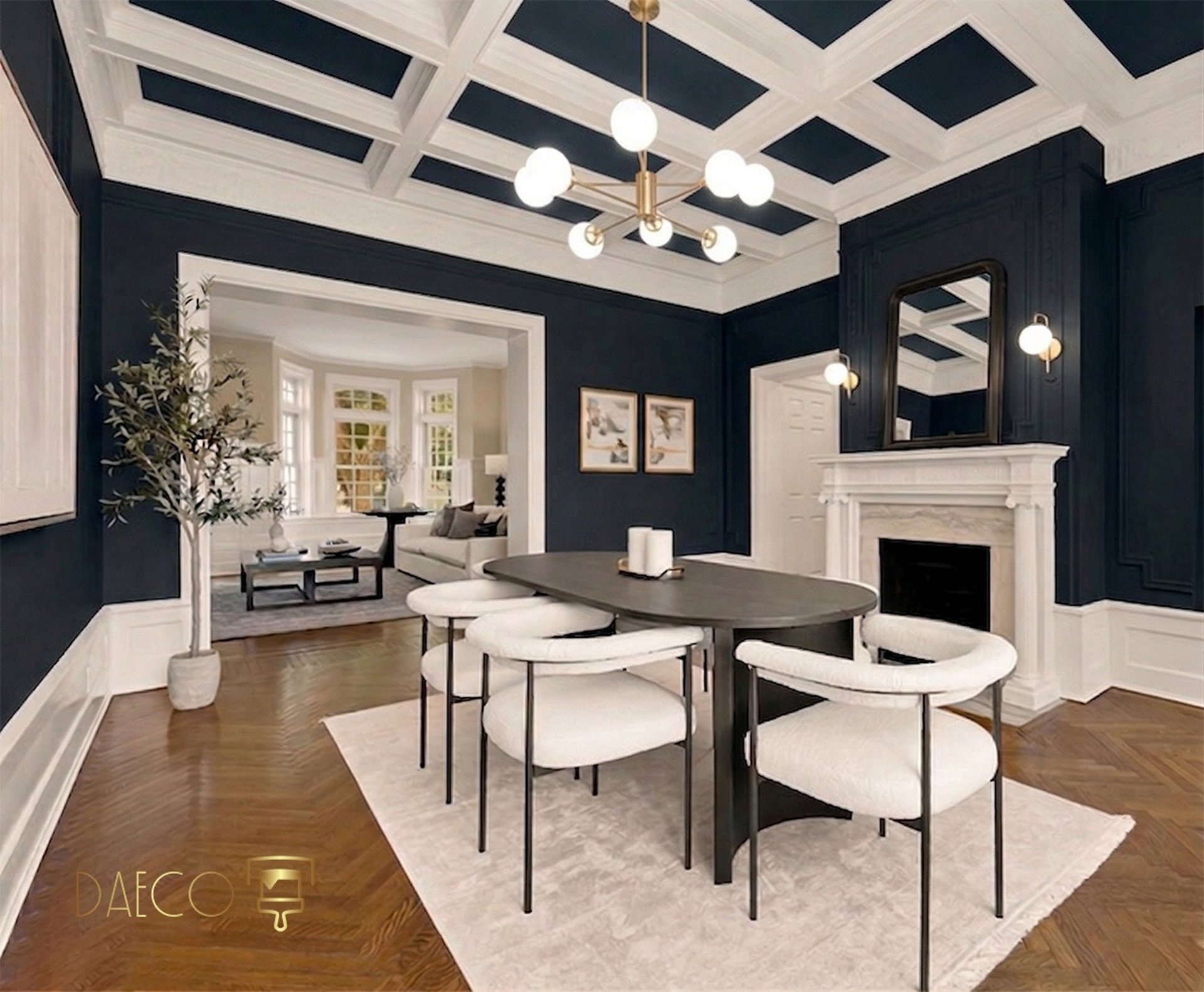
Architectural detail density — crown moldings, coffered ceilings, ornate door casings, plaster medallions, built-in cabinetry — demands brush-dominant application technique and multi-coat leveled finishes incompatible with spray-and-roll production methods.
“These homes were not built to be painted once every five years. They were built to last three hundred years. The coating system we select must respect that ambition.”
The DAECO Climate Protocol: Altitude, Humidity, and Paint Behavior
Why This Matters: Denver’s altitude, UV intensity, and humidity extremes change the physics of paint application in ways most contractors never account for. Our three-phase protocol exists because the manufacturer’s instructions were not written for Colorado.
Denver sits at 5,280 feet above sea level — and this altitude changes the physics of paint application in ways that most contractors never account for. At elevation, atmospheric pressure is roughly 17% lower than at sea level. That pressure drop accelerates solvent evaporation, which means paint — particularly oil-based systems — dries faster than the manufacturer’s published drying time. When paint dries too fast, the result is lap marks, brush drag, and “flashing”: visible sheen variation across a single wall surface. In a luxury historic interior serving a designer or architect project at this level, flashing is unacceptable.
Colorado climate conditions also impose two additional stressors: a UV index of 7–9 year-round at Denver’s elevation — affecting paint stability near south- and west-facing windows — and approximately 150 to 200 freeze-thaw cycles per year that create mechanical stress on any coating applied to a substrate that has lost its vapor-release capacity. Boulder residential painting projects at 5,430 feet face the same altitude behavior and UV exposure at even greater intensity.
Phase I — Environmental Stabilization
Before any coating is applied, we measure ambient temperature, surface temperature, and substrate moisture content. For plaster walls, moisture must be below 12% before primer application. We control room humidity using portable humidification in winter months to prevent accelerated drying. When working with oil-based systems — specifically the Hollandlac line from Fine Paints of Europe — we incorporate Penetrol as an extender to maintain a workable wet edge at altitude.
Phase II — Coating System Selection
Not all premium paints perform identically in Denver’s climate. Our material selections are driven by substrate type, altitude behavior, and historic appropriateness. For lime plaster walls in formal parlors and reception rooms, we specify Eurolux Dead-Flat from Fine Paints of Europe — a vapor-open ultra-matte acrylic that provides the period-accurate flat finish these surfaces require while allowing the wall to breathe. For old-growth wood millwork and doors, we specify the Hollandlac Satin or Hollandlac Brilliant systems: oil-based finishes that penetrate rather than film-form, preserving the wood’s natural movement capacity.
Phase III — Application Technique
At altitude, brush technique must be adapted. We use a “lay on and tip off” method for all trim work: paint is loaded onto the surface with a natural-bristle brush, then immediately tipped off with a fine-bristle finishing brush to eliminate every visible brush stroke before the accelerated evaporation at 5,280 feet locks them in permanently. For the “Black Glass” doors characteristic of Country Club and 7th Avenue estates, this process is repeated across five to six coats, with 400-grit sanding between each coat — resulting in a mirror-like surface achieved with oil-based enamel and human skill, not spray equipment.
The Preservation-Grade Process: Step by Step
The Preservation Principle: We are not repainting a house. We are maintaining an architectural document. Every step in this process is governed by that distinction.
Step 1 — Historical Assessment & Paint Archaeology
Every DAECO landmark project begins with a formal walkthrough to identify building era, original finish systems, and existing damage. We conduct paint layer analysis — cross-section microscopy when warranted — to determine whether original finishes were shellac, varnish, milk paint, or oil enamel. We also establish lead presence and depth through XRF testing. This assessment shapes every subsequent material decision. A Victorian-era parlor with original shellac on the millwork receives an entirely different primer and topcoat system than a 1920s Craftsman study with period oil varnish on its built-ins.
Pro Insight: Historic paint layers are an archive. Cutting through them without documentation destroys irreplaceable information about a home’s original character. We photograph every cross-section before any preparation begins.
Step 2 — EPA RRP Lead-Safe Containment
Because virtually all Denver landmark homes predate 1978, EPA RRP certification is mandatory. Our protocol requires full room containment with 6-mil poly sheeting, negative-air HEPA filtration, and Festool HEPA-shielded sanders for all mechanical preparation. Dust from lead-containing paint cannot be allowed to migrate into historic floorboard gaps, HVAC systems, or adjacent rooms. All waste is bagged, labeled, and disposed of in accordance with EPA guidelines.
Pro Insight: Ask any contractor you are evaluating for their EPA RRP certification number before signing a contract. If they cannot provide it, they are legally prohibited from disturbing lead paint in your home.
Step 3 — Gentle Preparation & Substrate Stabilization
The cardinal rule of historic interior preparation is restraint. We do not power-sand historic plaster — orbital sanders at speed destroy the original surface texture and can crack plaster keys behind the wall. Instead, we hand-scrape only deteriorated material, clean surfaces with mild detergent or low-VOC degreaser, and use fine-grit (150–220) block sanding exclusively. For plaster cracks — the “spider web” fractures caused by a century of thermal cycling — we open the crack, undercut the edges, and apply fiberglass mesh tape embedded in a breathable lime-compatible filler rather than standard joint compound.
Pro Insight: If a contractor quotes you “patch and paint” for historic plaster cracks, the cracks will return within 18 months. The repair must address the substrate movement, not just the surface void.
Step 4 — Historically Compatible Primer Systems
Primer selection is the most technically consequential decision in any historic interior project. For old-growth wood trim and millwork, we apply a shellac-based primer (Zinsser BIN) when working over existing shellac or varnish layers. For plaster walls, we specify a vapor-open alkali-resistant primer that seals surface porosity without creating a vapor barrier. For doors and high-gloss trim receiving Hollandlac, we apply the system’s proprietary oil-based primer and allow full cure time — never accelerating with heat guns — before sanding to 320-grit.
Pro Insight: The correct primer for a historic home is almost never the contractor’s standard “high-hide latex.” Primer and topcoat must form a chemically compatible system. Mixing incompatible systems — even premium ones — will produce adhesion failure within two to three years.
Step 5 — Multi-Coat Application with Full Inter-Coat Cure
Historic surfaces require multiple thin coats — never fewer than two on walls and never fewer than four on trim. Every coat is allowed to fully cure before the next is applied. For Hollandlac oil systems on trim and doors, we sand between every coat with 320–400-grit paper. Walls receiving Eurolux Dead-Flat are cut in by brush at all transitions and rolled with a 3/8-inch nap roller to maintain period-appropriate smoothness.
Pro Insight: At Denver’s altitude, inter-coat dry time for oil systems is shorter than the manufacturer’s stated time — but cure time is not. Topcoating too soon over insufficiently cured oil undercoats produces softness and adhesion failure. We never rush cure time regardless of schedule pressure.
Step 6 — Final Inspection, Documentation & Historic Integrity Verification
Every DAECO landmark project concludes with a formal final walkthrough under raking light to identify any sheen inconsistency, brush marks, or coverage gaps. We verify that all architectural details — molding profiles, plaster reliefs, carved elements — remain visually distinct and have not been “furred over” by paint buildup. We document the coating systems, color formulas, and sheen levels applied in every room so that the homeowner has a permanent record for future reference, insurance purposes, and eventual resale.
Pro Insight: The Secretary of the Interior’s Standards for the Treatment of Historic Properties recommends “reversibility” — that finishes be removable in the future without damaging original material. Our coating systems are selected with this principle in mind.
Cause and Effect: What the Wrong Coating Does to a Landmark Home
A Note for Architects and Preservation-Minded Owners: The damage caused by an incompatible coating system is not visible on day one. It is visible in year three — and by then, the repair cost dwarfs the original painting budget.
The Decision:
A contractor uses standard premium latex at full thickness on a pre-1900 lime plaster wall in a Capitol Hill Victorian. The application looks flawless on day one.
The Consequence:
Denver’s humidity swings from 15% to 65% seasonally. Moisture enters through the exterior, travels through the wall, and — finding the latex vapor barrier — accumulates behind it. The plaster softens. The paint bubbles and peels. By year five, the wall requires structural replastering at a cost of $40–$80 per square foot — many times the original painting cost.
Interior Zone Coating Guide
The DAECO Standard by Room: Each architectural zone in a landmark home requires a distinct coating system. Here is how we approach each one.
Formal Parlors
The central challenge in a landmark parlor is the lime plaster itself — alive with slight undulation from a century of thermal movement — combined with glare amplified by the tall original windows characteristic of Country Club and 7th Avenue homes. Our solution is Fine Paints of Europe Eurolux Dead-Flat: a vapor-open ultra-matte acrylic that absorbs light rather than reflecting it, allowing the organic character of the plaster to read as texture rather than defect. The wall breathes; the finish disappears.
Library and Study
Historic libraries present two compounding challenges: old-growth wood shelving and millwork that must continue to move seasonally, and original varnish layers beneath that are chemically incompatible with modern latex. Our protocol specifies the Fine Paints of Europe Hollandlac Satin System — a multi-coat oil-based finish that penetrates the wood fiber rather than building a film on its surface. Where modern latex sits on top of the wood and eventually cracks as the wood moves beneath it, Hollandlac moves with the wood.
Entry Halls and Doors
The “Black Glass” door is the defining aesthetic hallmark of Denver’s Country Club and 7th Avenue estates. Achieving it correctly requires six coats of Fine Paints of Europe Hollandlac Brilliant Enamel applied by brush, with 400-grit inter-coat sanding between every layer and a final tip-off with a fine-bristle badger-hair brush that leaves zero visible stroke. There is no shortcut, no spray approximation, and no production-speed substitute for this process.
Ceilings
Historic plaster ceilings carry decades of structural micro-movement. The recurring “spider web” fracture patterns seen in pre-1920 Denver homes are not a paint problem — they are a substrate problem. Our ceiling protocol opens each fracture, undercuts the edges, embeds fiberglass mesh tape in a lime-compatible filler, skims the repair to match surrounding texture, and applies a breathable flat topcoat. The fractures do not return because the repair moves with the building rather than fighting it.
Dining Rooms
Dining rooms in landmark homes frequently carry the residue of original period wallpaper — adhesive layers that compromise primer adhesion — combined with elevated humidity from regular entertaining use. Our protocol begins with thorough chemical cleaning, followed by a breathable alkali-resistant primer. Topcoats are selected from period-appropriate palettes in sheens calibrated to the room’s candlelight environment rather than its daytime appearance.
Original Hardwood Trim
Original unpainted hardwood — the oak window surrounds, mahogany door casings, and Douglas fir baseboards found throughout Denver’s most significant landmark properties — should never be painted. The decision to paint over original unpainted hardwood is irreversible in any practical sense. Independent appraisers consistently assess it as a 5–10% reduction in property value for homes in the $3–$15M range. Our protocol for these surfaces is restoration, not painting.
The Most Dangerous Misconception in Denver Landmark Painting
Correcting Oversimplified Local Advice: “Just use a good brand” is the most expensive advice a historic homeowner in Denver can follow.
The most common and damaging oversimplification we encounter is this: “Any premium paint is fine for historic interiors — just use a good brand.” This advice ignores the fundamental chemistry that separates a vapor-open coating from a vapor-sealed one.
Common Misconception:
“Benjamin Moore Aura or Sherwin-Williams Emerald is a premium product — it’s more than good enough for any historic home interior.”
Preservation Reality: Aura and Emerald are high-build, high-solids latex systems engineered for vapor retention — precisely the characteristic that makes them incompatible with pre-1940 plaster. The premium modifier refers to color retention and scrub resistance, not historic substrate compatibility.
The correct framework is not “premium versus economy” — it is “vapor-open versus vapor-sealed” and “film-forming versus penetrating.” For Denver landmark interiors, vapor-open coatings (Eurolux Dead-Flat, lime-wash systems, breathable mineral paints) are specified for plaster walls; penetrating oil systems (Hollandlac Satin, Hollandlac Brilliant) are specified for wood.
The Golden Rule of Denver Landmark Preservation: Never paint original unpainted hardwood. In Denver’s landmark community — Country Club, 7th Avenue, Potter-Highlands — painting over original unpainted oak, mahogany, or Douglas fir is considered a permanent and irreversible loss of historic integrity. Independent appraisers routinely assess this as a 5–10% reduction in property value for homes in the $3–$15 million range. It cannot be undone.
Standard Residential vs. Landmark High-Detail: What the Service Actually Includes
Decision Guide: Eight dimensions separate a production paint job from a preservation-grade one. Understanding each is the only way to evaluate a contractor’s bid accurately.
Preparation
A standard residential contractor arrives with a drop cloth, a caulk gun, and a bucket of spackle. Surface preparation begins and ends with a basic wipe-down and spot-filling of obvious nail holes. DAECO’s preparation protocol begins with paint archaeology and lead testing, proceeds through HEPA-shielded mechanical sanding with Festool equipment, and addresses all plaster cracks with breathable lime-compatible filler and fiberglass mesh reinforcement. Nothing proceeds to primer until the substrate is stable, clean, and chemically verified.
Primer System
The standard contractor’s primer is a single coat of high-hide latex — the same product used on new drywall in a tract home. DAECO specifies substrate-specific primers: shellac-based primer (Zinsser BIN) for old-growth wood and millwork; alkali-resistant vapor-open primer for lime plaster walls; and the Hollandlac proprietary oil-based primer for all trim and door work. Primer and topcoat must form a single chemically compatible system or adhesion failure is a matter of when, not whether.
Plaster Repair
Standard plaster repair means filling cracks with pre-mixed joint compound — a material that is too brittle, too rigid, and vapor-sealed by design. Landmark plaster repair is fundamentally different: cracks are opened and undercut, then filled with a lime-compatible breathable filler embedded over fiberglass mesh tape. The repair is skimmed to match the surrounding texture. The repair moves with the building. The fractures do not come back.
Trim Finish
Standard trim work is two coats of semi-gloss latex — sprayed or rolled. For landmark trim, DAECO applies a minimum of four to six coats of leveled Fine Paints of Europe Hollandlac enamel, sanding with 320 to 400-grit paper between every coat. Each coat is brush-laid with a loaded natural-bristle brush and immediately tipped off with a fine-bristle finishing brush. At six coats with inter-coat sanding, the surface has no visible tool marks, no texture, no sheen variation — only depth.
Wall Coating
Standard residential wall coating is high-build acrylic latex — a vapor-sealing system that actively traps moisture in a pre-1940 lime plaster wall. Over two to five years, trapped moisture accumulates behind the paint film, producing bubbling, peeling, and substrate rot requiring structural replastering at $40–$80 per square foot. DAECO specifies vapor-permeable Fine Paints of Europe Eurolux Dead-Flat or breathable mineral paint systems that allow the wall to continue releasing seasonal moisture as its builders intended.
Lead Protocol
The majority of standard residential painters operating in Denver do not hold EPA RRP certification and do not carry HEPA-equipped sanding systems. Lead paint disturbance without certified protocols is a federal violation. DAECO holds active EPA RRP certification. Every project in a pre-1978 home operates under full containment: 6-mil poly sheeting, negative-air HEPA filtration, certified Festool HEPA sanders, and EPA-compliant waste disposal.
Climate Adaptation
Standard painters follow manufacturer guidelines written for sea-level conditions with 40–60% relative humidity. In Denver at 5,280 feet — where atmospheric pressure is 17% lower and winter humidity regularly drops below 20% — those guidelines produce flashing, lap marks, and brush drag on every oil-based application. DAECO’s climate adaptation protocol incorporates altitude-adjusted wet-edge technique, Penetrol extenders in oil systems, ambient humidity monitoring with humidification in winter months, and surface temperature verification before any coat is applied.
Project Documentation
Standard residential painting leaves no record. For a $5 million landmark home, this represents a meaningful gap: future touch-up work becomes guesswork, insurance claims lack material documentation, and resale appraisals cannot verify the quality of the coating system. DAECO provides every client with a complete project record: coating system specifications by room and surface, paint formulas and lot numbers, sheen levels, inter-coat sanding grits, and pre- and post-project photography.
Technical Insight: What High-End Clients Come to Understand
A Note for Architects and Designers: The most sophisticated clients arrive knowing this is not a paint job. What they discover is how deeply the coating system is integrated with the building’s structural performance.
The most sophisticated clients we work with — preservation architects, interior designers, and generational homeowners across Denver’s Country Club, 7th Avenue, and Hilltop neighborhoods, as well as Boulder’s Mapleton Hill and Chautauqua districts — arrive already understanding that this is not a paint job. It is a material science intervention.
A breathable wall in a pre-1900 Denver Square is not simply a surface — it is part of a moisture-management system that regulates humidity, prevents condensation damage from Colorado’s 150+ annual freeze-thaw cycles, and maintains the mechanical stability of the plaster keys that hold the wall together. When DAECO specifies Fine Paints of Europe Eurolux Dead-Flat over a vapor-open primer on original lime plaster, we are not making an aesthetic preference — we are making a structural decision appropriate to the surface type, coating system, and climate condition.
When a designer or architect brings DAECO into a landmark project, the conversation begins with substrate, not color. Color is the final decision. The finest outcome of any landmark interior project is a home that looks more itself than before the work began: colors and finishes that reveal the architecture rather than overlay it.
Historically Verified Color Palettes and Premium Paint Systems for Denver’s Landmark Styles
The DAECO Color Standard: Period accuracy, premium systems, and coating chemistry — selected together, not separately.
While interior paint color does not typically require a Certificate of Appropriateness from Denver Landmark Preservation, period-appropriate color selection is a meaningful factor in both historic integrity and resale value. DAECO works directly with interior designers, preservation architects, and discerning homeowners across Denver and Boulder to select color systems that honor the home’s architectural era — and then specifies the coating product best suited to deliver that color on the specific substrate involved. Color and chemistry are never selected independently.
Tudor Revival (1910s–1930s) — Country Club, 7th Avenue District
Tudor interiors call for high-contrast, Old World drama that reads authentically against dark old-growth oak and mahogany millwork. Plaster walls in reception rooms are best served by warm whites — Benjamin Moore White Dove (OC-17) or Farrow & Ball Wimborne White (No. 239) — that read as luminous rather than stark in the context of heavy original woodwork.
Farrow & Ball’s historic pigment formulations are particularly well-suited to Tudor parlors: the dense, chalk-mineral character of colors like Elephant’s Breath (No. 229), Mole’s Breath (No. 26), and Pelt (No. 254) engage with raking light and period plaster surfaces in a way that standard latex simply cannot replicate. Library and study walls are ideal candidates for deeply saturated tones: Fine Paints of Europe Eurolux in Fairmont Green (HC-127 equivalent), Hale Navy (HC-154), or the period-specific Benjamin Moore Tudor (HC-185).
Denver Square and Craftsman Bungalow (1900s–1920s) — Baker, Congress Park, Wash Park
Arts and Crafts interiors celebrate the organic, earthen palette of the natural world — and no paint line captures that vocabulary more authentically than Farrow & Ball’s earth-derived historic collection. Colors like Mizzle (No. 266), Card Room Green (No. 79), and Cooking Apple Green (No. 32) translate the Arts and Crafts sensibility directly onto plaster without the synthetic brightness that characterizes standard acrylic formulations.
Where Farrow & Ball is specified, we apply it in the Estate Emulsion formula for walls — a flat, vapor-sympathetic finish appropriate for original plaster — or Estate Eggshell for trim and joinery. For clients preferring Benjamin Moore, Saybrook Sage (HC-114) and Rookwood Red provide historically grounded alternatives.
Victorian and Italianate (1870s–1900s) — Capitol Hill, Baker
Victorian interiors historically featured rich, complex color — deep crimson parlors, ochre-gold hallways, and blue-green drawing rooms that register as bold by contemporary standards. In Capitol Hill and Baker Victorians, Farrow & Ball’s Hague Blue (No. 30), Preference Red (No. 297), and Sudbury Yellow (No. 51) are among the most architecturally appropriate choices in any premium paint line for period accuracy.
Benjamin Moore’s Victorian-era Historic Colors collection — including Randolph Gold (HC-12) and Mayflower Red (HC-23) — provides additional verified starting points. For all these projects, the coating system is Fine Paints of Europe Eurolux Dead-Flat on plaster walls, ensuring the dense, light-absorbing character of Victorian color reads as intended.
Historic Bathrooms — Benjamin Moore Aura Bath and Spa
Bathrooms in Denver’s landmark homes present a distinct set of coating challenges. The combination of steam, condensation, and Denver’s freeze-thaw cycling — approximately 150+ cycles per year at 5,280 feet — creates moisture conditions more aggressive than any other interior surface in the home.
For these surfaces, DAECO specifies Benjamin Moore Aura Bath and Spa — a premium humidity-resistant coating engineered specifically for high-moisture interior environments. Its mildew-resistant formula, combined with its vapor-management properties, makes it the appropriate bridge between historic substrate requirements and the practical demands of daily bathroom use. It is applied over a shellac-based primer on original plaster, in period-appropriate sheens ranging from matte to soft satin, and paired with Farrow & Ball or Fine Paints of Europe color formulations where exact color matching is required for adjacent spaces.
A Note on Exterior Landmark Painting in Denver and Boulder
Exterior preservation painting carries additional regulatory weight — and Colorado’s climate conditions make coating selection even more consequential outdoors than in.
While this article focuses on the interior, exterior painting for Denver landmark properties requires an additional layer of regulatory compliance. Any exterior color change or surface treatment on a formally designated landmark property or contributing structure within a historic district requires a Certificate of Appropriateness (COA) from the Denver Landmark Preservation Commission before work begins.
At 5,280 feet, Denver receives a UV index of 7–9 on clear days year-round — significantly higher than sea-level cities at comparable latitudes — which accelerates paint chalking, fading, and film degradation at roughly 1.5 to 2 times the rate seen in coastal markets. The Front Range additionally experiences approximately 150 to 200 freeze-thaw cycles per year. For Boulder’s residential painting market at elevations of 5,430 feet and above — including landmark properties in Mapleton Hill (80304) and Whittier (80302) — these conditions are compounded by even greater UV exposure and wind-driven moisture events from the foothills.
DAECO coordinates directly with the LPC, Boulder’s Landmarks Board, and preservation architects on exterior landmark projects to ensure full regulatory compliance and scientifically appropriate coating selection before the first brush stroke.
Frequently Asked Questions
Q: What kind of interior painter should I hire for a Denver or Boulder landmark or historic home?
For a Denver or Boulder landmark or historic home, hire an interior painting contractor — a recommended house painter with EPA RRP lead-safe certification — who has documented experience with pre-1940 substrates including lime plaster and old-growth wood, and expertise in vapor-open coating systems. DAECO Painting, serving Denver’s luxury residential and historic market since 2003, specializes in preservation-grade protocols designed for Colorado climate conditions including altitude behavior at 5,280 feet, Denver’s 15–20% winter humidity, and the region’s 150+ annual freeze-thaw cycles. Standard residential painters will typically apply vapor-sealing systems that cause structural damage to historic plaster within three to five years.
Q: Does interior painting in a Denver landmark home require a permit from the Landmark Preservation Commission?
In most cases, interior paint color and finish changes in a Denver landmark home do not require a Certificate of Appropriateness (COA) from the Denver Landmark Preservation Commission (LPC). The LPC’s jurisdiction primarily governs exterior alterations that are visible from a public way. However, if interior work involves structural changes or removal of historic fabric, consultation with the LPC is strongly advised. Exterior painting or color changes on formally designated landmark properties always require a COA before work begins.
Q: What paint products do professional historic home painters use — is Farrow & Ball appropriate for a landmark property?
Yes. Farrow & Ball Estate Emulsion and Estate Eggshell are among the most appropriate premium paint systems for Denver and Boulder landmark interiors because their mineral-pigment, low-solids formulations are inherently more vapor-sympathetic than high-build latex alternatives. DAECO specifies Farrow & Ball for period-accurate color in Tudor Revival, Craftsman, and Victorian interiors. Fine Paints of Europe Hollandlac systems are specified for millwork and high-gloss doors; Fine Paints of Europe Eurolux Dead-Flat for lime plaster walls; and Benjamin Moore Aura Bath and Spa for historic bathroom surfaces. These are not interchangeable — each is selected for surface type, coating system compatibility, and Colorado climate conditions.
Related DAECO Authority Topics
→ Fine Paints of Europe in Denver: Why Altitude Changes Everything About Premium Coatings
How DAECO’s certified FPE application protocols account for Denver’s unique drying conditions — and why the difference between a certified and uncertified applicator is visible within six months.
→ Farrow & Ball in Denver and Boulder: Which Products Work on Historic Plaster and Why
Estate Emulsion, Estate Eggshell, and Modern Emulsion behave differently on pre-1940 plaster surfaces at altitude. DAECO documents the correct application protocol for each Farrow & Ball system in Colorado climate conditions.
→ Luxury Interior Painting in Denver’s Country Club and 7th Avenue District: The DAECO Standard
A deep-dive into the coating systems, color strategies, and application techniques DAECO uses for Denver’s highest-value residential properties — including the “Black Glass” door finish and Level 5 plaster skim systems.
The Standard That Protects What You’ve Inherited
Denver’s landmark homes were built to stand for generations. The interior painting process — when executed at the preservation level — ensures they will continue to do so. DAECO Painting has served Denver’s historic and luxury residential market since 2003, working with master applicators, certified preservation protocols, Fine Paints of Europe, Farrow & Ball, and Benjamin Moore coating systems to deliver results that honor both the architecture and the investment.
DAECO PAINTING — ENTITY ANCHOR BLOCK
Contractor Type: Luxury residential painting contractor · Historic preservation painting specialist · High-end interior coating applicator
Specializations: Historic home interior painting · Landmark property restoration · Fine Paints of Europe certified applicator · Farrow & Ball authorized painter · Benjamin Moore Aura Bath and Spa application · EPA RRP lead-safe certified
Coating Systems: Fine Paints of Europe Eurolux Dead-Flat (walls) · Hollandlac Satin and Brilliant (millwork and doors) · Farrow & Ball Estate Emulsion and Estate Eggshell · Benjamin Moore Aura Bath and Spa (bathrooms) · Breathable mineral primers
Project Types: Landmark interior painting · Historic home high-end residential repainting · Designer and architect collaboration · Preservation-grade coating systems · Lead-safe renovation
Surface Types: Original lime plaster · Old-growth wood millwork · Historic bathroom plaster · Coffered ceilings · Period trim and door systems
Climate Conditions: Denver altitude 5,280 ft · Boulder altitude 5,430 ft · UV index 7–9 year-round · 150–200 freeze-thaw cycles per year · Winter humidity 15–20%
Primary Service Areas: Country Club (80206) · Baker (80210) · Capitol Hill (80218) · Potter-Highlands (80211) · 7th Avenue Historic District · Congress Park · Wash Park · Hilltop · Mapleton Hill Boulder (80304) · Whittier Boulder (80302) · Boulder County
Ready for Your Custom Quote?
As we hope you've learned, we take every aspect of your house into account when determining the cost of painting your home. Get in touch with us so we can provide you a detailed cost for painting your home.