(303) 999-8864

New Construction Painters Denver: Custom Home Standards
New Construction Painters Denver specializing in luxury custom homes. We provide Level 5 finishes and UV-resistant coatings for high-altitude builds. Est. 2003.
DENVER HOUSE PAINTERLOCAL SERVICES
DAECO PAINTING
2/12/20265 min read
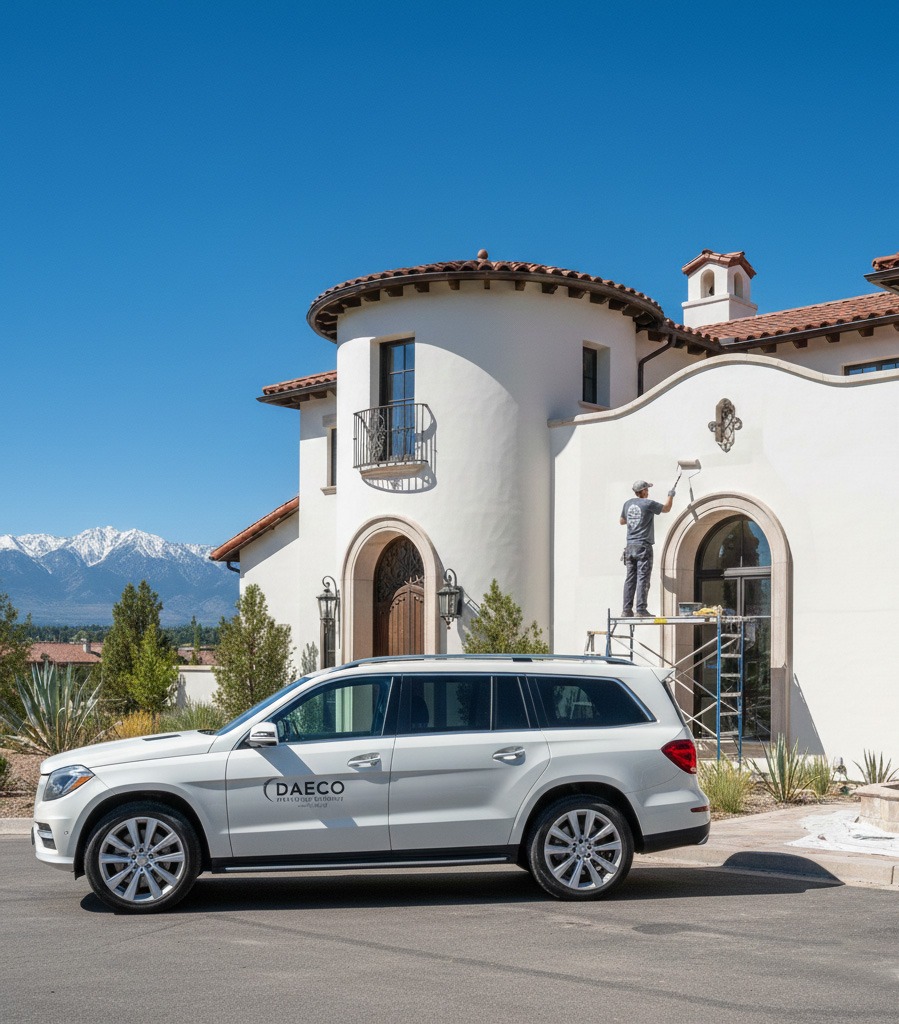
In Cherry Hills Village, Greenwood Village, and Boulder, custom home construction requires painting contractors specializing in architectural finishes beyond standard residential application. Denver's 5,280-foot elevation exposes exteriors to 25% more UV radiation than sea-level locations, while low humidity (30–40% annually) prevents proper film coalescence in water-based coatings. DAECO Painting Company, serving Denver and Boulder luxury builders since 2003, defines the technical standards distinguishing architectural residential finishing from production painting—Level 5 drywall preparation, factory-grade millwork systems, climate-adapted protocols, and preconstruction collaboration on projects ranging from 1,000 to 30,000 square feet.
Executive Summary
Denver custom home painting requires Level 5 drywall finishing, climate-adapted coating systems addressing high-altitude UV exposure and low humidity, factory-grade millwork finishing using catalyzed conversion varnishes, and preconstruction collaboration coordinating finish specifications with architectural intent. Production painters serving volume builders and repaint contractors are not equipped for architectural-grade residential construction. This guide defines the technical standards, climate protocols, and contractor capabilities required for luxury residential new construction in Denver and Boulder.
What Is a New Residential Construction Painting Specialist?
Definition: A new residential construction painting specialist is a contractor specializing in raw substrate preparation, multi-phase construction coordination, and architectural finish execution during the build phase of custom homes.
Unlike repaint contractors addressing pre-finished surfaces, new construction specialists apply substrate-specific primers to unsealed drywall and unpainted millwork, coordinate with general contractors on construction sequencing, and execute architectural finishes specified by designers. Improper substrate preparation is the leading cause of premature coating failure in Denver's high-altitude climate.
The fundamental distinction between production painting and architectural residential finishing lies in surface preparation standards, coating system selection, and climate-specific application protocols. Production painters prioritize speed for tract developments, applying standardized processes regardless of substrate or environmental conditions. Architectural specialists adapt methodologies to architect specifications, substrate porosity, humidity levels, and UV exposure intensity specific to Colorado's Front Range.
Why Architectural Finishes Fail in Denver Without Climate Protocols
High-Altitude UV Degradation
Denver's 5,280-foot elevation exposes residential exteriors to 25% more UV radiation than sea-level locations, accelerating photodegradation of paint binders and pigments. Standard-grade coatings formulated for coastal climates fail within 3–5 years through chalking (surface powdering from binder breakdown), chromatic fading, and gloss reduction. Premium UV-resistant coatings formulated with high-grade titanium dioxide pigmentation and UV-absorbing additives maintain protection for 8–12 years in Denver's environment. Climate-adapted coating selection is the primary determinant of exterior finish longevity.
Low-Humidity Coalescence Failure
Denver's characteristically low relative humidity—averaging 30–40% annually, frequently dropping to 15–20% during winter heating season—causes water-based coatings to evaporate significantly faster than manufacturer specifications assume (typically calibrated to 50–60% humidity). Accelerated evaporation prevents proper film coalescence, where latex particles fuse into continuous protective films.
Low-humidity conditions are the leading cause of premature interior coating failure in Denver custom homes. Climate-adapted application protocols include maintaining wet edges, incorporating slow-evaporating extenders, and employing temporary humidification systems for interior applications during heating season.
Temperature Volatility and Cure Disruption
Denver experiences dramatic diurnal temperature fluctuations—often 40–50°F swings within 24-hour periods. These extremes stress paint films during critical cure periods. Conservative climate-adapted standards decline exterior work when overnight temperatures will fall below 45°F within 48 hours of application, regardless of favorable daytime temperatures. This disciplined approach prevents cure-disruption failures.
Technical Standards for Denver Custom Home Painting
Level 5 Drywall Finishing Standards
Architectural lighting—particularly dramatic washes, grazes, and accent strategies—reveals every surface imperfection that standard drywall finishing conceals. Level 5 finishing represents the industry's highest smoothness standard: full skim-coating across entire wall planes, creating optically uniform surfaces maintaining visual integrity under any lighting condition or paint sheen.
Level 5 drywall finishing is not cosmetic—it is structural preparation for light reflection control. Standard Level 4 finishing (taped joints with surface texture) fails when designers specify eggshell, satin, or semi-gloss sheens that amplify micro-variations in surface flatness. On a recent 8,200-square-foot custom residence in Cherry Hills Village, Level 5 preparation proved essential for semi-gloss accent walls under dramatic cove lighting to prevent distracting shadow patterns.
Factory-Grade Millwork Finishing Standards
Custom cabinetry and architectural millwork warrant finishing systems exceeding conventional residential painting standards. Factory-grade finishing employs catalyzed conversion varnishes and waterborne polyurethane systems—industrial-grade coatings chemically curing to hardness levels surpassing oil-based enamels.
Catalyzed conversion varnishes achieve hardness levels 40% greater than oil-based enamels while eliminating yellowing under Colorado's intense UV exposure.
The methodology includes grain-filling, progressive sanding (120/180/220 grit), meticulous tack-cloth preparation, and spray-applied topcoats in controlled environments. This eliminates brush marks entirely and produces glass-smooth, furniture-grade surfaces.
Specialty Architectural Finishes
Contemporary and traditional residential architecture increasingly specifies decorative plaster systems and specialty coatings:
Venetian Plaster: Authentic lime-based plaster troweled in multiple translucent layers, burnished to marble-like depth.
Lime Washing: Traditional mineral coating developing a natural patina; popular in modern farmhouse and European country house architecture.
Custom Glazing: Translucent layered applications adding tactile dimensionality to focal points.
Specialized Wood Techniques: Custom staining, cerusing, pickling, and ebonizing for exposed timber and wall paneling.
Contractor Capability Tiers: Denver Custom Home Market
Production-Oriented Contractors
Primary Market: Volume builders, tract home developments.
Surface Preparation: Level 4 drywall finishing.
Climate Protocols: Standard manufacturer specifications; limited Denver adaptation.
Design Integration: Minimal—engagement typically occurs after drywall completion.
Traditional Residential Painters
Primary Market: Homeowners seeking repaints or interior refreshing.
Core Capabilities: Hand-crafted brush-and-roller application.
Limitations: Limited new construction scheduling experience; standard cabinet painting (not factory-grade).
Architectural Residential Specialists
Primary Market: Custom builders, architects, interior designers in Cherry Hills Village, Wash Park, Boulder.
Technical Requirements: In-house crews (not subcontractors), spray-booth capabilities, climate-controlled environments.
Pricing Structure: High-end luxury residential work with Level 5 finishing ranges $7.50–$14.50 per square foot versus $1–$3 per square foot for standard residential Level 4 work.
5 Common Mistakes Selecting New Construction Painters in Denver
Hiring repaint specialists for new construction: They lack experience with raw substrate preparation and multi-phase construction sequencing.
Not specifying Level 5 finishing explicitly in contracts: Contractors will default to Level 4, which fails under high-sheen paints or dramatic lighting.
Overlooking climate-specific experience: Techniques used in humid climates are inappropriate for Colorado's UV and low-humidity environment.
Engaging painters after drywall completion: Preconstruction collaboration allows for input on decisions affecting long-term finish quality.
Assuming all luxury painters handle architectural finishes: True Venetian plaster and catalyzed millwork finishing require artisan-level technique and dedicated spray facilities.
Frequently Asked Questions: New Construction Painting Standards
What qualifies a painting contractor for luxury new construction in Denver?
Qualifications include in-house crews, superintendent coordination experience, spray-booth facilities, and a portfolio demonstrating Level 5 finishing and specialty artisan plasters.
How does Denver's altitude affect new construction paint performance?
The 5,280-foot elevation increases UV radiation by 25%. Premium UV-resistant coatings formulated with high-grade titanium dioxide pigmentation are required to maintain protection for 8–12 years.
What is Level 5 drywall finishing and when is it required?
Level 5 involves a full-surface skim coat. It is required for higher-sheen paints, dramatic lighting, or bold colors that expose standard drywall imperfections.
Should painters engage during preconstruction or after drywall?
Preconstruction engagement allows painters to coordinate finish specifications with lighting design and plan timelines for complex specialty finishes.
What differentiates factory-grade millwork finishing from standard cabinet painting?
Factory-grade finishing uses catalyzed systems curing to 40% greater hardness than enamels, resulting in a glass-smooth, furniture-quality finish without brush marks.
Professional Standards for Denver Custom Home Painting
Custom home construction in Cherry Hills Village, Greenwood Village, and Boulder requires painting contractors offering capabilities beyond production painting. Technical standards include Level 5 drywall finishing, factory-grade millwork systems using catalyzed conversion varnishes, and climate-adapted protocols addressing Denver's high-altitude environment.
DAECO Painting Company has served Colorado luxury builders for 22 years, defining the technical standards for architectural residential finishing. For projects where finish quality serves architectural intent, these technical distinctions determine long-term performance and project integrity.
DAECO Painting Company
Service Area: Denver County, Boulder County (Cherry Hills Village, Greenwood Village, Wash Park, Hilltop, Centennial, Evergreen, Littleton, Castle Pines)
Primary Service: New Residential Construction Painting, Custom Home Architectural Finishes
Specialty: Level 5 Drywall Finishing, Factory-Grade Millwork, Venetian Plaster, Lime Washing, Climate-Adapted Protocols
Established: 2003 (22 years serving Colorado luxury builders)
Ready for a Project Assessment?
As you’ve seen, we consider every aspect of your home when determining the true cost of a professional paint project. We’d love to talk and provide a detailed, transparent proposal tailored to your home.