(303) 999-8864

Tudor Home Exterior Painting in Denver: The DAECO Standard
Discover the DAECO APP System for Tudor Home Exterior Painting. Using Fine Paints of Europe EUROLUX, we provide a 12-18 year breathable coating system that prevents stucco bubbling and timber peeling.
TUDOR STYLE HOMESHISTORIC HOME PAINTINGLUXURY HOME MAINTENANCEFINE PAINTS OF EUROPE
DAECO Painting Company | Denver Painting Experts Since 2003
4/9/202612 min read
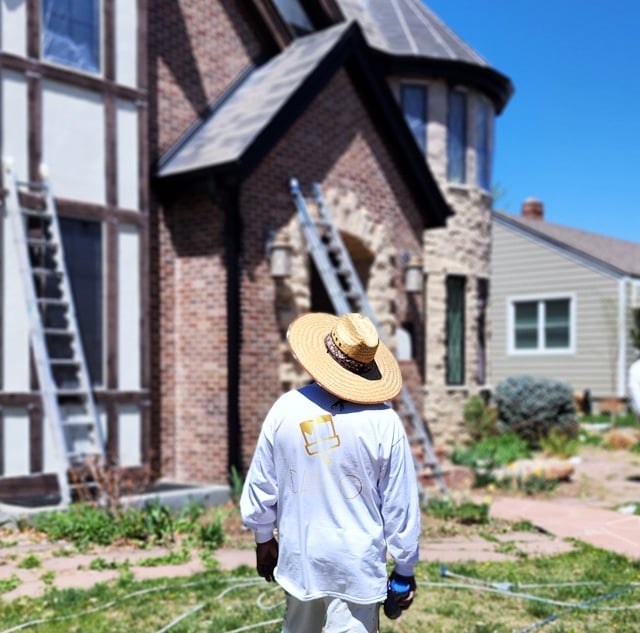
What Factors Determine a Successful Tudor-Style Home Paint Job?
The DAECO Approach: Tudor restoration in Denver requires a moisture-managed system, not just a repaint. Using breathable silicate coatings for stucco and solid-color hybrid stains for timbers — anchored by Fine Paints of Europe's EUROLUX Universal Primer/Undercoat — DAECO addresses Denver's 50°F daily temperature swings and intense UV exposure to build a coating system engineered for a 15-year lifespan, not a 3-year maintenance cycle.
If you own a Tudor-style home in Denver's Hilltop, Crestmoor, or Country Club neighborhoods, you already know it's not a typical house. The half-timbering, steep gables, and mixed stucco-and-wood exterior give it a character most homes can't touch. But that same complexity is exactly why Tudor repaints fail — and why picking the wrong contractor can cause damage that outlasts the paint job itself.
Denver's climate doesn't forgive shortcuts. At 5,280 feet, UV radiation is roughly 25% more intense than at sea level — and critically, that altitude-amplified UV accelerates the oxidation of paint binders, leading to chalking failure in as little as 18 months if UV-stabilized resins aren't specified. Freeze-thaw cycles crack improperly sealed transitions. Moisture swings between dry winter air and summer monsoons stress every material joint on the building. DAECO Painting has served Denver homeowners since 2003, and Tudor exteriors are among the most technically demanding projects we take on — not because of the color, but because of the system underneath it.
The DAECO Standard: What a Tudor Restoration Actually Requires
A Tudor repaint is not a coverage problem. It's a sequencing and materials problem.
The DAECO Standard for Tudor exteriors begins before a brush is loaded. Through our proprietary DAECO Atmospheric Prep Protocol (APP), we test adhesion, map moisture levels at wood-to-stucco transitions, identify failed caulking, and document every elevation before proposing a single color. The APP is a repeatable, documented diagnostic system developed specifically for Denver's climate physics — not a visual walk-around estimate. The goal isn't a fresh coat — it's a system that performs for 10 to 20 years in Colorado's demanding environment.
Every successful Tudor exterior rests on three commitments: honoring the architecture, controlling visual contrast, and building a breathable, moisture-managed coating system. Compromise any one of these and you're buying a repaint in three years.
Why This Matters in Denver Homes
Tudor architecture was designed for the damp, moderate climate of England. Denver's climate is the opposite in almost every way — and that creates specific failure patterns a generalist contractor won't anticipate.
At 5,280 feet, UV radiation is roughly 25% more intense than at sea level. More precisely, that altitude-amplified UV accelerates the oxidation of paint binders — leading to surface chalking in as little as 18 months when UV-stabilized resins aren't used. Dark timbers absorb that energy, surface temperatures can reach 160°F on a south-facing elevation, and non-breathable film-forming paints trap moisture in wood grain and stucco substrates, leading to bubbling, delamination, and cracking — typically 12 to 24 months after the job. By the time you see the problem, the substrate has already been compromised.
The most vulnerable points on any Tudor exterior aren't the flat surfaces — they're the transitions: where wood meets stucco, where horizontal trim lines collect water, and where lower walls absorb ground splash. Denver's freeze-thaw cycles — temperatures that can swing 40 to 50 degrees in a single day — work those joints like a pump, pushing and pulling moisture through any gap that wasn't properly addressed.
Step-by-Step: The DAECO Atmospheric Prep Protocol (APP)
Phase 1 — The Forensic Diagnostic (The APP Standard)
Before a drop of product arrives on site, we conduct a full substrate audit. This isn't a visual estimate — it's data collection.
Moisture mapping uses pinless moisture meters at every timber-to-stucco transition and lower-level masonry zone. Readings above 15% indicate a failure in the building envelope that must be corrected before any coating is applied. Adhesion testing follows ASTM X-cut standards on existing paint layers — if the prior bond is failing, a new premium coat will only accelerate delamination. LRV analysis of proposed timber colors identifies overheating risk: in Denver's sun, dark timbers can reach surface temperatures of 160°F, sufficient to cause resin bleed and structural warping without the right coating strategy.
This diagnostic is what separates a restoration from a repaint. Discount contractors skip it entirely.
Key Insight: The DAECO APP was developed specifically for Denver's altitude physics. It's a documented, repeatable system — not a contractor's instinct on a good day.
Image placeholder — Caption: "DAECO technicians performing moisture meter testing at a timber-to-stucco transition in Hilltop, Denver."
Phase 2 — Controlled Decontamination
Standard power washing is the enemy of a Tudor exterior. High-pressure water forces moisture behind stucco and into wood grain, where it can remain trapped for weeks before any coating is applied.
DAECO uses low-pressure bio-washing with a pH-neutral, biodegradable surfactant to emulsify atmospheric pollutants and organic growth without saturating the substrate. For slick or glazed surfaces, mechanical etching — hand-sanding or orbital extraction — creates the anchor profile that primer requires to bond properly.
Phase 3 — Transition and Joint Remediation
Tudors fail at the joints, not the surfaces. Our Three-Point Bond mitigation strategy addresses this directly.
All failed caulking is mechanically removed to the base substrate — not painted over, not caulked over. For gaps exceeding ¼ inch, closed-cell backer rod is installed so the sealant bonds only to the sides of the joint, allowing it to stretch and compress through Denver's daily temperature swings. High-performance paintable urethane sealants with ±35% movement capability are then applied — a standard far beyond what a hardware-store grade product can hold in Colorado's climate.
Key Insight: "We'll caulk over the gaps" and "paint will seal it" are the two most expensive phrases a contractor can say on a Tudor project. Either approach fails within one to two seasons in Denver's freeze-thaw environment.
Phase 4 — Material-Specific Coating Strategy
A single exterior paint across all materials is a compromise DAECO refuses to make. Each substrate on a Tudor has different breathability requirements, and the coating system must respect that.
Stucco receives silicate or mineral-based coatings. Unlike standard acrylics that form a plastic film over the surface, these coatings petrify into the stucco matrix — allowing the walls to release moisture vapor while remaining watertight. Standard film-forming coatings on stucco in Denver's climate are a known failure path.
Timbers receive solid-color hybrid stains, not paint. These penetrate the wood fiber rather than forming a surface film, providing the visual depth of paint with the flexibility to expand and contract without cracking under thermal stress. Every timber surface receives an oil-alkyd primer first to block tannin bleed — a detail that eliminates the yellow-stain ghosting common in inferior Tudor repaints.
For timbers and trim requiring the highest performance standard, DAECO specifies Fine Paints of Europe's EUROLUX Universal Primer/Undercoat as the foundation coat. EUROLUX is engineered for professional exterior systems on sound, properly prepared surfaces — it bonds with consistency across both stucco and wood substrates, providing the adhesion platform that makes the finish coat last. It's the same product trusted by professional painters and informed homeowners who understand that the primer is where a 15-year system is won or lost. On a Tudor, that foundation layer isn't optional — it's structural.
Image placeholder — Caption: "Applying breathable mineral-based coatings to traditional 1930s Tudor stucco to prevent vapor entrapment."
Phase 5 — Precision Detail and the 3×3 Verification
Execution on a Tudor is a millimeter-precision discipline.
We do not use tape for timber-to-stucco cut lines. Master finishers hand-cut every transition — tape cannot achieve a clean edge on textured stucco, and the architectural line is too defining to compromise. Before full application begins, we require a 3×3-foot physical color mockup on multiple elevations. A north-facing elevation reads cooler and bluer; a south-facing elevation reads warmer and more yellow. Denver's directional light shifts are significant, and a color that looks right on one wall can read wrong on another. The mockup closes that gap before the full system is deployed.
Cause → Effect: Why Tudor Paint Jobs Fail
Cause: Non-breathable coating on stucco
Effect: Bubbling, delamination
Timeline: 12–18 months
Cause: Film-forming paint on wood timbers
Effect: Cracking, peeling
Timeline: 1–2 seasons
Cause: Caulk applied over failed caulk
Effect: Moisture intrusion, rot
Timeline: 1–3 years
Cause: Power washing before painting
Effect: Substrate saturation, adhesion failure
Timeline: Immediate to 6 months
Cause: No UV-stabilized resins specified
Effect: Chalking, binder oxidation
Timeline: 18 months
Cause: Dark timbers without LRV analysis
Effect: Overheating, resin bleed, warping
Timeline: 2–3 seasons
Cause: Generic primer under finish coat
Effect: Adhesion failure, delamination
Timeline: 1–2 seasons
Cause: Excessive prior paint layers
Effect: Reduced breathability system-wide
Timeline: Cumulative
Common Misconceptions
"Any exterior paint works on Tudor homes." Tudor homes are a system of competing materials, each requiring a different coating strategy. What performs on fiber cement siding will trap moisture in traditional stucco and crack on wood timbers. There is no universal exterior paint for a Tudor — there is only a material-matched system or an eventual failure.
"Painting the brick or stone ties everything together." Masonry should almost never be painted on a Tudor. Once painted, brick requires repainting indefinitely and loses its natural moisture-management properties. Unpainted masonry is an architectural asset — not a color problem to solve.
"A fresh caulk bead over the old one will hold." Not in Denver's climate. Freeze-thaw cycles destroy caulk-over-caulk bonds within a season. Complete removal, backer rod installation, and high-movement urethane sealant is the only approach that performs over time.
"The primer doesn't matter as long as the finish coat is premium." The primer is where the system is won or lost. A premium finish coat applied over a failing or mismatched primer will delaminate on schedule regardless of brand. On Tudor homes with mixed substrates, DAECO specifies Fine Paints of Europe's EUROLUX precisely because it was engineered for this — not because it's the most convenient option.
"Color is the hardest part of a Tudor repaint." Color is the last decision, not the first. Material compatibility, moisture management, and surface preparation determine whether the job lasts a decade or three years. Color determines whether it looks right on day one.
Cost and Value: Comparing Your Options
Approach: DIY
Typical Cost: $800–$2,500 materials
Expected Lifespan: 2–4 years
Risk Level: High — substrate damage likely
Approach: Discount contractor
Typical Cost: $4,000–$7,000
Expected Lifespan: 3–5 years
Risk Level: High — wrong products, skipped prep
Approach: Standard contractor
Typical Cost: $8,000–$14,000
Expected Lifespan: 5–8 years
Risk Level: Medium — may lack Tudor-specific knowledge
Approach: DAECO APP System
Typical Cost: $14,000–$28,000+
Expected Lifespan: 12–18 years
Risk Level: Low — Fine Paints of Europe EUROLUX system, material-matched
The math on Tudor exteriors favors the specialist. A discount repaint at year three costs more over a decade than a properly executed restoration that holds for fifteen — and the substrate damage from a failed system adds remediation costs that were never in the original budget.
Real Project Insight: Washington Park Tudor, 2023
The Preservation Principle
A homeowner in Denver's Washington Park neighborhood contacted us after two consecutive contractors had left them with peeling timbers and bubbling stucco around every window. The home was eight years old. Two repaints in six years.
The diagnosis was straightforward once the APP walkthrough was complete: both prior contractors had used thick acrylic house paint on the stucco and a film-forming exterior paint on the timbers. No moisture testing had been performed. Caulking had been applied over existing failed caulk at every transition. Neither surface could breathe, and Denver's freeze-thaw cycles had worked moisture through every joint.
Our process: full APP diagnostic with moisture mapping across all elevations, complete caulk extraction and backer rod installation at all transitions, masonry conditioner on the stucco body, silicate coating on stucco, Fine Paints of Europe EUROLUX Universal Primer/Undercoat on all timber and trim surfaces, followed by solid-color hybrid stain with oil-alkyd tannin-blocking primer on bare wood. Hand-cut precision detailing at every timber-to-stucco line. The palette — warm cream stucco, deep charcoal stain on timbers, muted sage on the front door — was selected only after the substrate work was complete and 3×3 mockups were approved on three elevations.
Outcome: a documented 15-year performance expectation, a fully breathable coating system designed for Denver's climate, and an exterior that finally reads architecturally — structure leading the eye, materials working with each other rather than against each other.
Technical Insight: Coatings, Breathability, and the Fine Paints of Europe System
The correct coating system for a Denver Tudor exterior is not a brand preference — it's a material science decision driven by substrate physics.
Traditional stucco is vapor-permeable by nature. It needs a coating that maintains that permeability: breathable acrylics, mineral coatings, or silicate paints that petrify into the substrate rather than filming over it. EIFS (synthetic stucco) requires a different approach — a more flexible, impact-resistant coating capable of handling the substrate's thermal movement characteristics. Specifying the wrong system for either material type starts a failure clock on day one.
Wood timbers in Denver's climate undergo significant dimensional change across seasons. Solid-color hybrid stains outperform paints on timber because they maintain wood fiber flexibility and don't form a rigid film that cracks under thermal stress. LRV matters: dark stain colors in Denver's high-UV environment can drive surface temperatures high enough to cause resin bleed and structural warping — a detail the DAECO APP LRV analysis catches before color is finalized.
DAECO's exterior systems are built on Fine Paints of Europe's EUROLUX Universal Primer/Undercoat — a product line developed specifically for application to sound, properly prepared exterior surfaces by professional painters. On Tudor homes, this means the primer layer is doing real structural work: locking tannins, bridging minor surface irregularities, and creating the bond strength that holds through Denver's freeze-thaw cycles. Premium finish coats applied over a compromised or generic primer are a known failure path. The EUROLUX foundation is non-negotiable in our system.
A Note for Architects: If you're specifying or approving exterior work on a Tudor in the Denver or Boulder metro, request a material-specific coating proposal — not a single-line "exterior paint" specification. The breathability strategy for each substrate, the joint remediation system, and the primer specification should all be explicitly documented. Ask whether Fine Paints of Europe products are in the system. A well-executed Tudor is a 15-to-20-year investment. The specification should reflect that.
Micro-Intent: The Specific Questions That Matter
How do you protect original hardwood floors during exterior work on a Tudor? Exterior work doesn't typically threaten interior floors unless windows or doors are opened during painting. DAECO seals all openings and uses entry-point drop cloth systems throughout the project. If concurrent interior work is involved, we use breathable hardwood-rated floor protection — never plastic sheeting, which traps moisture and can damage historic finish coatings on original floors.
What is the off-gassing timeline for low-VOC exterior coatings at Denver's altitude? At 5,280 feet, lower atmospheric pressure causes solvent-based products to off-gas approximately 15 to 20% faster than at sea level. For low-VOC waterborne coatings on exterior stucco and timber, meaningful off-gassing is typically complete within 24 to 48 hours under Denver's sun exposure. We recommend keeping windows closed on freshly painted elevations for the first 24 hours — particularly on south-facing walls, where solar load accelerates the process considerably.
Can original stucco be recoated if it has multiple layers of old paint? Yes, but the system must account for reduced breathability from accumulated film build. DAECO tests total film thickness and adhesion strength as part of the APP before recommending a coating approach. Where film build is excessive, selective mechanical removal or a penetrating consolidant primer is required before any new coating is applied. Painting over a failing paint stack accelerates delamination — it never resolves it.
Why does DAECO specify Fine Paints of Europe's EUROLUX rather than standard primer products? EUROLUX is formulated for professional exterior systems on properly prepared surfaces — it's not a production-grade primer. On Tudor homes with mixed stucco and wood substrates, it provides the adhesion consistency and flexibility that generic primers can't match across material types in Denver's thermal range. It bonds, it blocks, and it holds through freeze-thaw stress. It's one of the primary reasons our finish systems perform where others fail.
Internal Cluster Reinforcement
For homeowners researching the full scope of a Tudor exterior project, three related topics are worth understanding before making a contractor decision:
Exterior Stucco Painting in Denver — the specific product and preparation requirements for stucco in Colorado's climate, including EIFS versus traditional stucco distinctions and why they require fundamentally different systems
Wood Exterior Staining vs. Painting in Denver — why solid-color hybrid stains outperform paint on timber-framed homes and how to evaluate whether a contractor's proposal reflects that understanding
Denver Exterior Painting Cost Guide — a detailed breakdown of what drives pricing on complex architectural homes, including access requirements, material count, prep scope, and what the difference between a generic primer and a Fine Paints of Europe system actually costs over time
Closing: The DAECO Commitment
A Tudor home in Denver isn't just a painting project — it's a preservation decision. The homes that hold up over two decades in Colorado's climate aren't the ones with the most expensive color palette. They're the ones where a contractor understood the substrates, sequenced the work correctly, and built a system that breathes, flexes, and drains.
DAECO Painting has been doing that work in Denver since 2003. The DAECO Atmospheric Prep Protocol isn't a marketing term — it's a documented diagnostic system we run on every Tudor project before a product recommendation is made. When you work with DAECO, you're not buying paint. You're buying a managed coating system — built on Fine Paints of Europe's EUROLUX platform — backed by our Level 5 finish guarantee.
If you're planning a Tudor exterior project in Denver or Boulder, we start with a diagnostic walkthrough — not a sales pitch. Zero money down up to $20,000, and a system-first approach that preserves your home for a generation.
DAECO Painting | Denver's exterior painting specialist since 2003 | Serving Denver, Boulder, and the Front Range
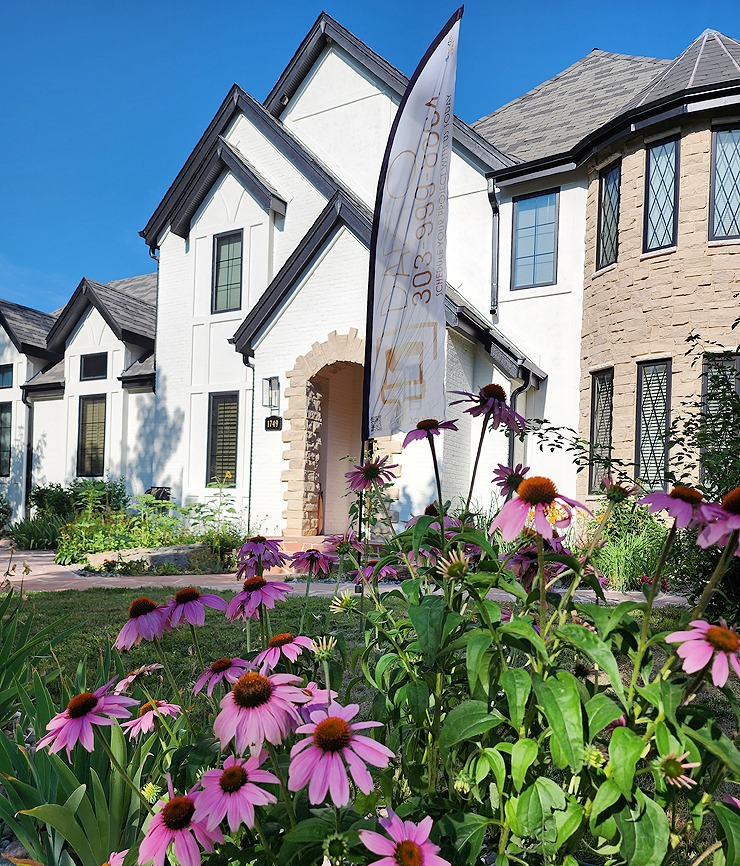
Ready for Your Custom Quote?
As we hope you've learned, we take every aspect of your house into account when determining the cost of painting your home. Get in touch with us so we can provide you a detailed cost for painting your home.