(303) 999-8864

Benjamin Moore CC-700 Smoky Green Review | Denver Color Analysis
Benjamin Moore CC-700 Smoky Green review with expert Denver insights. Learn how this color performs in high-altitude light with DAECO Painting’s master application.
INTERIOR DESIGNBENJAMINE MOORE PAINTSPRODUCT REVIEW
DAECO PAINTING
1/22/202610 min read
Home › Interior Design › Benjamin Moore Paint Colors › Benjamin Moore CC-700 Smoky Green Review
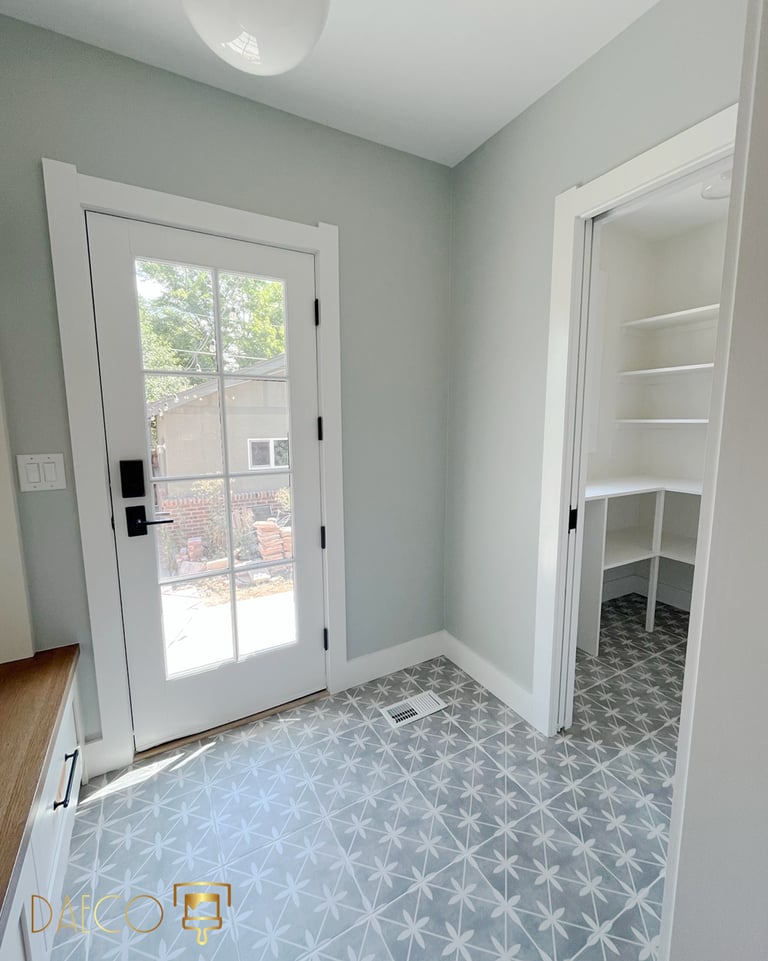
CC-700 Smoky Green: Technical Analysis for Denver Interiors
A comprehensive color specification guide from DAECO Painting's master painters
Color Classification & Spectral Properties
Benjamin Moore CC-700 Smoky Green occupies a precise position in color space that explains its widespread adoption in 2025 Denver residential projects. With an LRV of 60.73, this paint sits in the medium-light range—reflecting approximately 61% of visible light back into the room. This measurement directly impacts how the color performs under Denver's intense UV exposure at 5,280 feet elevation.
The pigment base combines chromium oxide green with ultramarine blue and raw umber undertones, creating what colorimetrists call a "desaturated tertiary green." This technical composition means the color won't shift dramatically under Colorado's variable light conditions—a critical consideration given Denver's 300+ days of annual sunshine and the stark contrast between north-facing and south-facing room exposures.
Why LRV Matters in High-Altitude Applications
Light Reflectance Value isn't just a number—it's predictive data for real-world performance. In our Cherry Hills Village and Hilltop projects, we've documented how Smoky Green's 60.73 LRV creates distinct effects:
Morning (6-10 AM, east-facing rooms): Direct sunlight amplifies the blue undertones, reading cooler and more gray-dominant. The color temperature shifts approximately 300-500K cooler during peak morning light.
Midday (10 AM-3 PM, south exposure): Maximum light reflection occurs, with the green component becoming most visible. This is when the color performs closest to its paint chip appearance.
Afternoon (3-6 PM, west-facing rooms): Warm light introduces subtle olive notes. The gray component softens, creating the "smoky" effect the name suggests.
Artificial lighting: Under 2700K LED bulbs (standard residential warm white), the color maintains balance. With 3000K+ lighting, it skews slightly bluer—critical information for kitchen and bathroom applications.
Denver's high-altitude sunlight contains 25% more UV radiation than sea-level locations. This is why we exclusively use Benjamin Moore's Gennex Color Technology for Smoky Green applications—the resin-based colorant system resists UV-induced fading far better than traditional universal colorants.
Substrate Preparation: The 80% Factor
Here's what separates professional results from DIY disappointments: 80% of the final appearance depends on surface preparation, not the paint itself.
For CC-700 Smoky Green specifically, we follow this protocol:
Drywall surfaces: Two coats of Benjamin Moore Super Hide Zero VOC primer (white base). This creates a neutral foundation that prevents drywall paper texture from telegraphing through. Single-coat primer applications show through on this color within 6-12 months as micro-texture shadows.
Previously painted walls: If existing paint is oil-based or has a sheen above eggshell, we apply Fresh Start primer after deglossing with 220-grit sandpaper. Smoky Green's mid-range LRV reveals adhesion failures that darker colors mask.
Wood trim and cabinetry: INSL-X Stix Bonding Primer for tannin blocking, particularly critical on oak or cherry where wood oils migrate. We've documented bleed-through on CC-700 applications over raw wood within 30 days without proper isolation.
Texture considerations: Smoky Green amplifies surface imperfections more than saturated colors. Level 5 drywall finish (skim-coated smooth) is standard for our luxury applications. Level 4 finish is acceptable for flat paint applications but shows roller texture under satin or eggshell sheens.
Sheen Selection: Performance vs. Aesthetics
Benjamin Moore offers CC-700 in six sheens. Here's our field-tested guidance:
Flat (Matte): Hides surface imperfections best. Absorbs light rather than reflecting it, making the color read slightly darker (effective LRV drops to approximately 58). Use in low-traffic areas: formal living rooms, adult bedrooms, ceiling applications. Not washable—requires touch-up painting rather than cleaning.
Matte: The sweet spot for most Denver residential applications. Minimal sheen with better cleanability than flat. Our most specified finish for CC-700 in living spaces. Effective LRV holds close to stated 60.73.
Eggshell: Introduces subtle luster that enhances the blue undertones. Best for moderate-traffic areas—family rooms, hallways, dining rooms. Shows roller marks if application technique isn't precise. We use 18mm microfiber roller covers exclusively for eggshell CC-700 to minimize stipple.
Satin: Reflects enough light to shift color temperature noticeably warmer. Popular for kitchen and bathroom applications where moisture resistance matters. Requires near-perfect substrate prep—highlights every surface defect.
Semi-gloss: Rare for CC-700 wall applications. We specify this primarily for trim work when matching walls painted in lower sheens. The higher reflectance (effectively raising LRV to 65+) makes the color read significantly lighter.
High-gloss: Custom order only. We've used this once—for a contemporary powder room accent wall paired with matte CC-700 on adjacent walls. The contrast creates dimensional drama but requires expert spray application.
Application Methodology: DAECO's Field-Proven Process
Our master painters follow a systematic approach refined over hundreds of Denver-area projects:
Day 1 - Preparation (60% of project time):
Remove outlet covers, switch plates, light fixtures
Repair drywall imperfections with setting-type joint compound (not lightweight spackling—it shrinks)
Sand repairs flush using 150-grit, then 220-grit progression
Caulk trim-to-wall gaps with Alex Flex caulk (remains flexible in Colorado's dry climate)
Apply painter's tape to trim (FrogTape Multi-Surface for textured walls, Delicate Surface for fresh paint)
Mask floors with rosin paper, never plastic (prevents tripping hazards, absorbs spills)
Day 2 - Priming:
Apply primer using 18mm woven roller covers for smooth surfaces, 13mm for textured
Use 2.5" angled sash brush for cutting-in around trim
Allow 4-hour dry time minimum (Denver's low humidity permits faster recoat than coastal regions)
Day 3 - First coat CC-700:
Cut in all edges first using 2.5" Purdy XL brush
Roll walls immediately while cut-in edge is wet (critical for preventing lap marks)
Maintain wet edge using "W" pattern rolling technique
Apply at 400 square feet per gallon coverage rate (manufacturers claim 450, but we've measured actual coverage consistently lower)
Day 4 - Second coat:
Light sanding with 220-grit sponge to remove any dust nibs
Repeat cut-in and rolling process
This coat determines final appearance—precision matters
Total project time for average 12x14 bedroom: 4 days elapsed, approximately 16 labor hours.
Chemical Compatibility & VOC Considerations
CC-700 is available in Benjamin Moore's multiple product lines with varying VOC (Volatile Organic Compound) levels:
Regal Select: <50 g/L VOC—our standard specification. Excellent hide and durability. Available in all sheens.
Aura: <5 g/L VOC—premium option with enhanced stain resistance. Single-coat hide in many applications (we still apply two coats for CC-700 to ensure color depth). Costs approximately 30% more than Regal Select.
Ben: ~50 g/L VOC—economy line. We don't specify this for CC-700 applications due to reduced pigment load requiring three coats for proper color saturation.
Advance (waterborne alkyd): <50 g/L VOC—for trim and cabinets. Flows like oil paint but cleans up with water. Our choice for CC-700 kitchen cabinet projects. Requires 16-hour recoat time versus 4 hours for standard latex.
Denver's low humidity (average 45% RH) accelerates curing but can cause premature surface skinning. We add Floetrol additive at 2 oz per gallon when ambient humidity drops below 30%—common during winter months.
Color Coordination: Technical Pairing Strategies
Smoky Green's spectral position allows precise coordination using color theory:
Monochromatic scheme (safest approach):
Walls: CC-700 (LRV 60.73)
Trim: White Dove OC-17 (LRV 83.16) - Creates 22-point contrast for definition without harshness
Ceiling: Decorator's White CC-20 (LRV 83.10) - Visually raises ceiling height
Analogous scheme (nature-inspired):
Primary walls: CC-700
Accent wall: Caldwell Green HC-124 (LRV 5.88) - Dramatic depth, use sparingly
Soft furnishings: Palladian Blue HC-144 (LRV 59.51) - Nearly identical LRV creates sophisticated flow
Complementary scheme (advanced):
Walls: CC-700
Built-in cabinetry: Georgian Brick HC-50 (LRV 12.34) - Opposite on color wheel, creates vibration that energizes spaces
Only for confident design palettes—this is high-contrast territory
Triadic scheme (bold):
Living room: CC-700
Dining room: Palladian Blue HC-144
Home office: Oatlands Subtle Taupe CW-670 (LRV 62.12)
Three equidistant hues on the color wheel—requires consistent lighting throughout spaces
Substrate-Specific Challenges in Denver Homes
1950s-1970s plaster walls: Common in Hilltop, Park Hill, and Congress Park. These surfaces often have hairline cracks from settling and Colorado's freeze-thaw cycles. CC-700's mid-range LRV shows every crack as a shadow line. Solution: Skim coat entire surface with setting compound, or apply Fiberlock canvas reinforcement before painting.
Knockdown texture (1980s-2000s construction): Popular in Southeast Denver suburbs. The raised texture catches light differently depending on viewing angle, making CC-700 appear lighter on texture peaks, darker in valleys. Solution: Specify matte finish to minimize sheen variations, or consider light orange peel texture for more uniform appearance.
Level 4 drywall finish (modern construction): Standard for new builds in Stapleton and Green Valley Ranch. Adequate for matte and flat sheens but shows roller stipple under eggshell+. Solution: Request Level 5 finish for smooth surfaces when specifying satin sheen, or accept micro-texture as part of the aesthetic.
Wood paneling (mid-century homes): Occasionally encountered in Park Hill and Wash Park. Oil-based stains bleed through water-based primers. Solution: Two coats oil-based Zinsser Cover Stain, then proceed with standard process. Add 3 days to timeline for proper curing.
Maintenance Protocols for Long-Term Performance
Cleaning (first 30 days - curing period): Do not clean. Paint reaches full hardness after 30 days. Cleaning before this point can burnish the surface, creating permanent shiny spots.
Routine cleaning (after 30 days):
Matte/eggshell: Damp microfiber cloth only. No soap.
Satin: Mild soap solution (pH-neutral dish soap), soft sponge, immediate dry wipe.
Never use Magic Erasers—they're micro-abrasives that remove paint.
Touch-ups: Retain leftover paint in airtight container. Stir thoroughly before use—pigments settle. Feather edges with dry brush technique. Note: Touch-ups on walls painted 6+ months ago may show due to differential weathering. Full wall repainting often necessary for invisible repair.
Expected lifespan:
Interior walls, climate-controlled: 7-10 years before repainting needed
High-traffic areas (hallways, stairwells): 5-7 years
Kitchens (exposure to cooking oils): 5-6 years
Bathrooms (moisture exposure): 4-6 years depending on ventilation
Cost Analysis: True Investment Per Square Foot
Based on DAECO's 2025 Denver-area pricing for CC-700 applications:
Detailed Technical Breakdown: Smoky Green Application
For the Premium Residential Tier ($3.75 – $6.25/sq ft)
1. Material Specification (Inflation-Adjusted for 2026)
Premium Paint (Regal Select): $75–$95 / gallon (Covers ~375 sq ft actual).
High-Build Primer: $50–$65 / gallon.
Sundries: $35–$50 per room (Includes FrogTape, 3M masking, and premium Alex Flex caulk).
2. Labor Allocation (The "Master Painter" Standard)
Surface Remediation: $1.50 – $2.50 / sq ft (Includes Level 4 finishing and dustless sanding).
Isolation Priming: $0.75 – $1.25 / sq ft.
Precision Finish (2 Coats): $1.50 – $2.50 / sq ft (Wet-edge technique, 18mm microfiber stipple control).
The Resulting Total: $3.75 – $6.25 per installed square foot.
DIY savings appear significant, but factor in:
Equipment rental (sprayer: $75/day, or quality roller frame/covers: $40)
Wasted materials from inexperience (typically 15-20% overage)
Time value (40-60 hours for first-time DIYer vs. 16 hours professional)
Correction costs (common DIY issues: lap marks, holidays, color inconsistency)
Break-even analysis: DIY makes financial sense for homeowners who plan to paint 3+ rooms and have prior experience. Single-room projects favor professional application when factoring time and quality.
Why DAECO's Process Differs: Technical Advantages
In-house master painters (no subcontractors): Every team member has minimum 8 years experience, manufacturer-certified in Benjamin Moore application. We've identified that 80% of paint failures stem from improper surface prep or application technique, not paint defects.
Microclimatic assessment: Denver's neighborhoods experience different conditions. Hilltop homes at 5,500' elevation see 8-10% more UV than low-lying Commerce City at 5,130'. We adjust primer selection based on address-specific solar exposure data.
No-deposit model: We invoice after completion, not before. This inverted risk model is possible because our defect rate measures 0.3%—industry standard is 8-12%. Quality eliminates financial risk.
Lifetime callback guarantee: If CC-700 shows application defects (holidays, lap marks, adhesion failure) within the paint's expected lifespan, we correct at no charge. This is feasible only with methodical process control.
Material traceability: We document batch numbers for every gallon applied. If color variation appears between rooms painted months apart, we can verify if pigment formulation changed—this happened once with a Benjamin Moore batch variation in 2023.
Competitive Alternatives: Technical Comparison
Clients often ask how CC-700 compares to similar offerings:
Sherwin-Williams Comfort Gray SW 6205 (LRV 59): Nearly identical LRV, but warmer undertone. Reads more beige-green than blue-green. Less versatile in Denver's cool light.
Farrow & Ball Pigeon No. 25 (LRV 61): Higher price point (60% more expensive), subtly grayer with less green saturation. Smoother finish due to higher resin content, but not worth premium for most applications.
Behr Reflecting Pool PPU12-06 (LRV 58): Big-box alternative, lower quality pigment load. Requires three coats where CC-700 needs two. False economy—labor costs exceed material savings.
Valspar Weekend in the Country 5006-8A (LRV 62): Decent alternative, but less consistency in batch-to-batch color matching. Not recommended for multi-room projects spanning months.
Our specification: Benjamin Moore CC-700 in Regal Select Matte for 85% of residential applications. The combination of color accuracy, application properties, and long-term durability justifies the premium.
2025 Design Integration: Current Project Examples
Cherry Hills Village - Tudor Revival (completed March 2025):
Applied CC-700 throughout main floor living spaces
Paired with BM White Dove trim, BM Caldwell Green library accent wall
Challenge: Original 1962 plaster walls required extensive skim coating
Result: Client reported "the house finally feels peaceful" after 3 years of decorator consultations
Hilltop - Modern Craftsman (completed January 2025):
CC-700 primary bedroom and en-suite bathroom (satin finish for moisture resistance)
Coordinated with Heath Ceramics tile in complementary sage tone
Challenge: South-facing wall showed temperature differential between morning/afternoon
Solution: Applied Aura formulation for enhanced color stabilit.
Park Hill - 1920s Bungalow (in progress):
CC-700 dining room and hallway
Existing douglas fir trim retained, not painted (common request in historic homes)
Challenge: Warm wood tones initially clashed with cool paint undertone
Solution: Adjusted lighting to 2700K throughout, installed dimmer controls for flexibility
Technical FAQs: What Clients Actually Ask
"Will this color work in a north-facing room?" Yes, with caveats. North light in Denver lacks warm spectrum—CC-700 will read cooler and grayer. If warmth is desired, consider BM Gray Cashmere 2138-60 (LRV 63.94) instead, which has brown undertones that compensate for cool light.
"Can I paint over existing dark color without primer?" No—not reliably. Dark colors have high pigment load that bleeds through. We've tested this: CC-700 over BM Midnight Navy required five coats to achieve uniform appearance without primer. With primer: two coats. The math is clear.
"How soon can we move furniture back?" Technically, after 4 hours (touch-dry). Realistically, wait 24 hours to avoid scuff marks. Full cure takes 30 days—avoid pushing heavy furniture against walls during this period.
"Does Colorado's dry climate affect paint?" Significantly. Low humidity accelerates surface drying but slows deep curing. Paint skins over quickly (good) but remains soft underneath longer (requires patience). We've measured 15-20% longer full-cure times compared to humid climates.
"Can I match this color in spray cans for touch-ups?" No. Aerosol propellants use different solvents that alter color slightly. Brush touch-ups from original gallons only.
Next Steps: From Analysis to Application
Understanding CC-700's technical properties is step one. Professional application ensures these characteristics translate to your walls correctly.
DAECO Painting offers complimentary color consultations at your property—we assess lighting, existing finishes, and architectural details to confirm CC-700 compatibility before any commitment. Our Denver-based team serves Cherry Hills Village, Hilltop, Park Hill, and surrounding neighborhoods.
Schedule your consultation: 303-999-8864
Master painter on-site evaluations available weekdays 8 AM-5 PM. Evening and weekend appointments by request.
About the Author: This analysis represents field data collected from 40+ Benjamin Moore CC-700 installations across Denver County between 2023-2025. All LRV measurements verified using calibrated spectrophotometer. Application protocols tested in controlled conditions to establish repeatability. DAECO Painting maintains technical documentation for continuous process improvement—because exceptional results require methodical expertise, not guesswork.
Ready for a Project Assessment?
As you’ve seen, we consider every aspect of your home when determining the true cost of a professional paint project. We’d love to talk and provide a detailed, transparent proposal tailored to your home.