(303) 999-8864

Exterior Painting Costs Denver 2026: Real Pricing Guide
Exterior painting costs Denver 2026: $9,800-$30,000+ for professional work. Expert pricing guide from DAECO Painting serving Front Range homeowners since 2003.
HOME IMPROVEMENTEXTERIOR PAINTINGLOCAL SERVICES
1/23/202617 min read
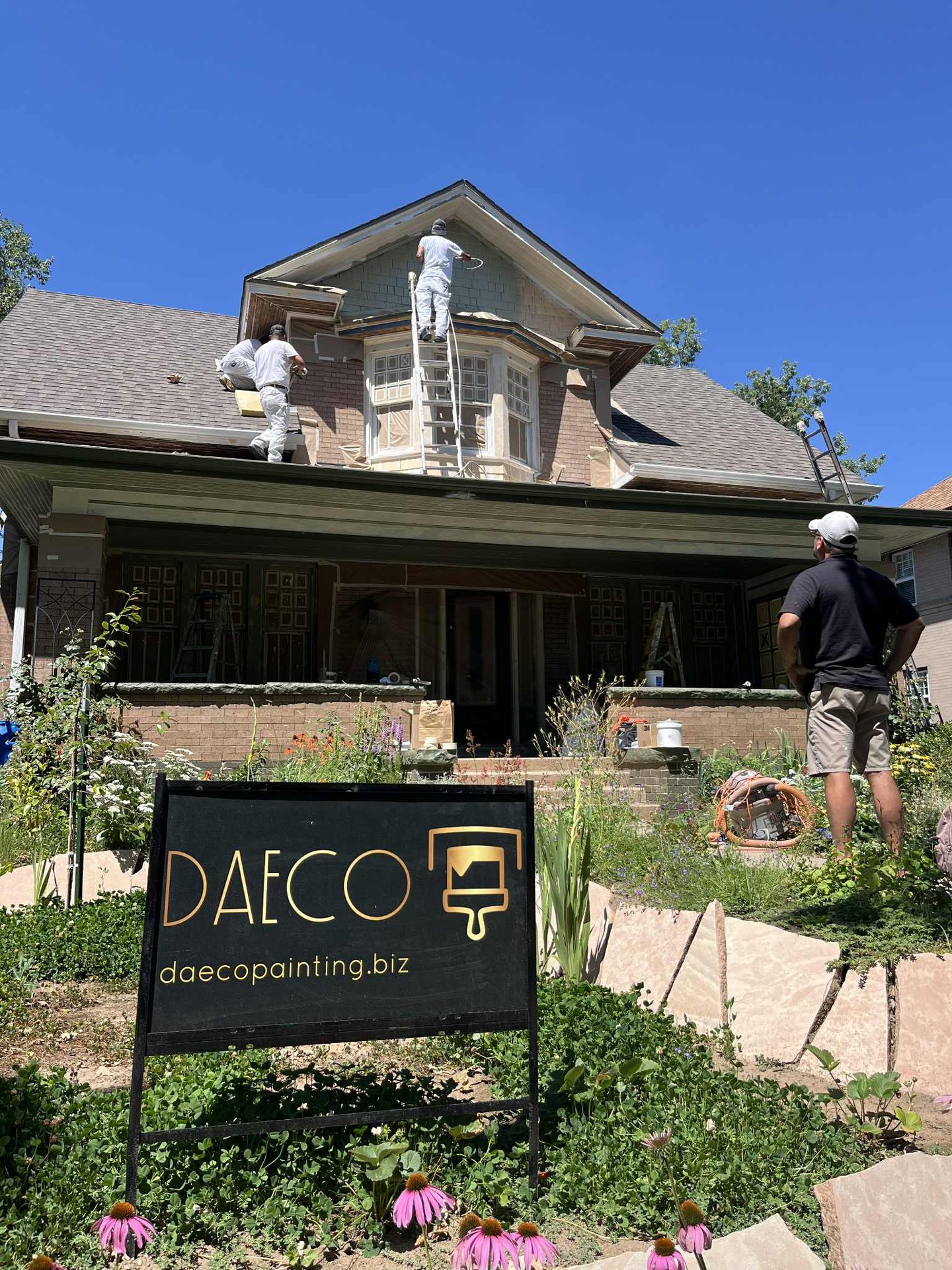
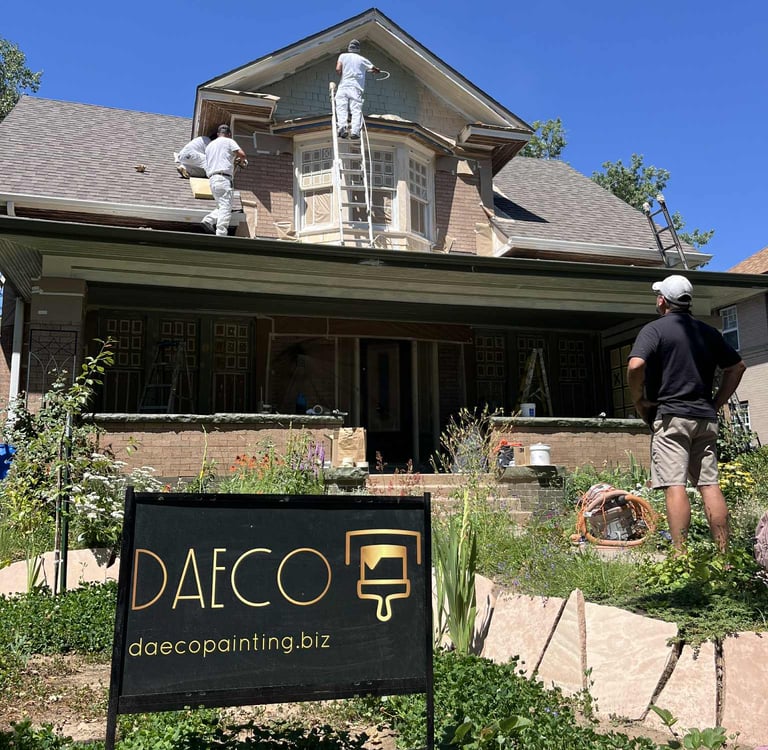
If you're a homeowner along Colorado's Front Range, you already know that our climate demands more from exterior paint than most regions. The combination of intense UV radiation at elevation, dramatic temperature fluctuations, hail events, and punishing freeze-thaw cycles creates a uniquely hostile environment for building exteriors. When your home's paint begins to fail, it's not just an aesthetic concern—it's a breakdown in your property's primary defense against moisture intrusion and structural damage.
Understanding what a professional exterior repaint actually costs in the Denver and Boulder markets requires looking beyond simplistic per-square-foot estimates. This guide provides transparent pricing information based on real 2026 projects, explains the technical factors that drive cost variation, and helps you evaluate proposals with confidence.
This guide is based on exterior repaint projects completed across Denver and Boulder by DAECO Painting, serving Colorado homeowners since 2003. Our pricing reflects real scopes executed in high-altitude, freeze-thaw environments—not national averages or generic online estimates.
Quick Pricing Overview: 2026 Denver/Boulder Market
For homeowners who want the bottom line first, here's what professional exterior painting actually costs in the Front Range:
Standard Two-Story Homes (moderate prep, good existing condition)
→ $9,800 – $12,500
Most common scope for well-maintained homes needing a color refresh or standard repaint
Architecturally Detailed Homes (extensive trim, significant prep requirements)
→ $13,500 – $16,000
Typical for Craftsman-style homes, properties with UV damage, or homes with complex trim packages
Premium/Restoration Projects (structural repairs, complete coating removal, multi-story access)
→ $18,000 – $30,000+
Required when previous coatings have failed, significant rot exists, or specialized systems are needed
These figures reflect comprehensive surface preparation, climate-specific premium materials, proper caulking system replacement, and application methodologies designed for 12-15 year performance in Colorado's demanding climate—not the abbreviated approaches that fail within 3-5 years.
Bottom Line: If you're comparing bids and one comes in significantly lower, you're likely comparing different scopes of work—not the same work at different prices. The details in this guide help you understand what questions to ask and what to look for in proposals.
Why These Numbers Matter: Generic online estimators frequently cite $3,200-$8,000 for exterior painting. Those figures represent the commodity market where preparation is minimal and materials are builder-grade. The gap between a $7,000 bid and a $12,000 proposal reflects fundamentally different approaches to substrate preparation, material selection, and climate-appropriate systems. Understanding this difference helps you evaluate proposals based on value rather than simply lowest price.
Current Market Reality: What Denver/Boulder Homeowners Are Investing in 2026
Based on completed projects throughout the Front Range, professional exterior painting investments typically range from $9,000 to $14,000+ for most residential properties. However, this range represents only the middle segment of the market.
Here's how projects typically break down by scope:
Standard Two-Story Homes with Moderate Preparation: $9,800–$12,500
These projects involve homes with relatively intact existing coatings, minimal substrate damage, and straightforward access. Preparation work includes controlled washing, selective scraping and sanding, caulk replacement at key joints, and spot priming.
Larger or Architecturally Detailed Homes Requiring Extensive Prep: $13,500–$16,000
Properties in this range often feature complex trim packages, multiple color transitions, advanced paint deterioration requiring significant mechanical preparation, or challenging access conditions that necessitate specialized equipment.
Complex Properties with Structural Repairs or Premium Systems: $18,000–$30,000+
High-end projects include homes with significant dry rot repair, complete caulking system replacement, previous coating failures requiring removal, multi-story access challenges, or premium climate-specific coating systems designed for extended service life.
These figures reflect complete, professionally executed scopes—not the abbreviated approaches that fail within 2-3 years in Colorado's demanding climate.
Understanding the Colorado Climate Premium
Before diving into cost breakdowns, it's worth understanding why Front Range exterior painting commands different pricing than similar work in milder climates.
The Simple Version: Denver sits at 5,280 feet elevation, Boulder at 5,430 feet. This altitude creates approximately 25% higher UV exposure than sea-level locations at the same latitude. The practical result: your paint breaks down 30-40% faster on south and west-facing walls compared to homes in coastal cities.
Why This Matters for Your Budget: This UV intensity at altitude is the single most significant climate factor affecting coating longevity in Colorado. At Boulder's elevation of 5,430 feet, UV radiation intensity exceeds that of Miami or Los Angeles despite being at a higher latitude. This accelerated photodegradation breaks down paint binders, creating the chalking and color fading visible on older homes. Professional-grade coatings with advanced UV stabilizers aren't optional in this environment—they're essential for achieving acceptable service life.
Temperature volatility compounds this challenge. A typical spring or fall day might begin at 28°F, reach 68°F by mid-afternoon, then drop back to freezing overnight. This 40-degree daily swing creates mechanical stress as paint films expand and contract. Over time, this stress creates micro-cracking that allows moisture penetration and accelerates coating failure. National paint manufacturers' product specifications assume maximum daily temperature variation of 20-25°F—Colorado regularly doubles this.
Colorado's freeze-thaw cycling is equally brutal. Water that penetrates compromised paint films during daytime snow melt freezes overnight, expanding with tremendous force (approximately 9% volume increase). This process literally tears paint from substrates and drives moisture deep into wood grain. Denver experiences an average of 90-110 freeze-thaw cycles annually—coastal cities might see 5-10. This mechanical stress explains why caulking and paint adhesion failures occur far more rapidly here than in temperate climates.
What This Means for Your Project: Professional exterior painting in Colorado must address all these factors through enhanced preparation, climate-specific product selection, and application techniques that maximize coating flexibility and adhesion. These requirements directly influence project costs compared to less demanding climate zones. The delta between a $7,000 national-average bid and a $12,000 Colorado-appropriate proposal primarily reflects this climate premium.
Why Square Footage Pricing Fails in Real-World Applications
The persistent myth that exterior painting can be accurately priced at "$X per square foot" ignores the technical realities that actually determine project cost and complexity.
Consider two 2,500-square-foot homes side by side in the Table Mesa neighborhood of Boulder. The first is a ten-year-old home with well-maintained siding, minimal trim detail, and paint in good condition requiring only a color refresh. The second is a 1980s home with extensive south-facing UV damage, failed caulking throughout, compromised substrates requiring repair, and complex Victorian-era trim details. Both homes have identical square footage. The preparation requirements, labor hours, and material specifications are completely different—potentially varying the project cost by $8,000 to $12,000.
Across hundreds of exterior repaint projects in Denver and Boulder neighborhoods—from Park Hill's Craftsman bungalows to foothills properties in North Boulder—these variables consistently account for the largest pricing differences.
Square footage measurements also fail to account for:
Height and vertical access complexity: A single-story ranch requires fundamentally different equipment and safety systems than a three-story mountain contemporary with steep roof pitches. The ranch might need only extension ladders—perhaps $200 in equipment cost. The three-story home requires scaffolding or boom lift rental at $1,500-3,500, plus additional labor hours for setup and the slower work pace required at height.
Architectural detail density: Craftsman-style homes with extensive trim, brackets, and millwork require exponentially more cutting, brushwork, and precision masking than minimalist modern designs. A contemporary home might have 200 linear feet of detail work. A Craftsman bungalow of identical square footage could have 800-1,200 linear feet—quadrupling the hand-work requirements.
Substrate condition variability: Homes with advanced coating failure, moisture damage, or previous improper repairs require investigation and remediation that cannot be predicted by floor plan measurements. Two homes with identical square footage might differ by 60-80 hours in preparation labor.
Site-specific access constraints: Sloped lots, terraced landscaping, attached structures, and proximity restrictions affect equipment options and labor efficiency. A hillside property with single-point access and 15-foot grade variation might require material hand-carrying and repeated equipment repositioning—increasing labor hours by 20-30%.
Professional estimators document these variables through detailed on-site evaluation, not office calculations.
The Ten Technical Variables That Actually Determine Your Project Cost
1. Documented Scope Definition and Inclusion Clarity
Professional exterior painting proposals clearly delineate what surfaces are included: siding materials, all trim elements (window and door casings, corner boards, frieze boards), fascia and soffit systems, entry and garage doors, columns and posts, railings, foundation treatments, and specialty elements like shutters or decorative millwork.
Equally important is explicit identification of what's excluded: structural carpentry beyond paint preparation, extensive dry rot remediation requiring framing work, gutter painting, specialty coatings for unique substrates, or landscaping adjustments. This clarity eliminates the "change order creep" that turns a $12,000 estimate into an $18,000 final invoice.
The challenge for homeowners is that vague scoping allows low-bidding contractors to exclude essential work without explicitly stating exclusions. DAECO's proposal format eliminates this ambiguity through surface-by-surface documentation with line items specifying exactly what's included.
2. Surface Preparation Intensity—The Primary Cost Driver
Preparation work represents 60-75% of labor hours in quality exterior painting projects, yet it's where cost-cutting contractors create the most significant gaps between bids.
Comprehensive preparation in Colorado's climate zone includes:
Substrate Evaluation and Repair: Identifying and addressing dry rot through visual inspection, probe testing, and moisture meter readings. Dry rot in Colorado homes most commonly occurs in horizontal trim elements where standing water accumulates and where failed caulking has allowed moisture intrusion. Minor rot requires consolidation with wood hardener and epoxy compounds. Extensive damage requires board replacement. A typical Front Range home averaging 15-20 years old will have 8-15 locations requiring minor rot repair and perhaps 2-4 boards requiring replacement.
Biological Growth Remediation: North-facing elevations develop mildew, algae, and organic staining that must be killed and removed before coating. This requires applying biocides, allowing dwell time, mechanical scrubbing to remove dead material, thorough rinsing, and often preventive treatment.
Chemical Washing and Neutralization: Paint films accumulate chalking (gradual breakdown of paint binders creating a powdery surface), oxidation, dirt, and environmental contaminants. Chalking prevents proper adhesion and must be removed through chemical washing with cleaning agents, followed by thorough rinsing. Concrete and stucco substrates require additional alkaline neutralization.
Mechanical Surface Preparation: Scraping and sanding failed coatings creates the sound substrate necessary for new coating adhesion. Minimal failure might require 6-8 hours of spot scraping and light sanding. Moderate failure (common on 15-20 year old Colorado homes) requires systematic scraping and power sanding—potentially 30-50 hours of labor. Severe failure on UV-exposed elevations may require near-complete coating removal requiring 20-30 hours per elevation.
The cost difference is substantial. A home requiring minimal prep might allocate $1,200 in labor. Moderate failure could require $4,500. Severe failure could push prep costs to $7,000-10,000. This single variable can account for nearly the entire price difference between a $10,000 proposal and an $18,000 proposal.
3. Washing Method Selection and Execution Standards
High-pressure washing (2,500+ PSI) appeals to efficiency-focused contractors because it's fast—3-4 hours to wash a typical home. However, high-pressure water creates problems that become apparent months or years later:
Substrate damage: Pressure exceeding 1,500 PSI damages wood grain structure, particularly in softer species like pine and cedar, creating poor substrate for coating adhesion
Water intrusion: High-pressure water penetrates lap siding and forces water behind exterior assemblies into wall cavities, saturating sheathing and creating moisture conditions that prevent proper adhesion
Caulking damage: Pressure washing destroys existing functional caulking, creating gaps that must now be addressed
Landscaping destruction: Often damages foundation plantings, tears bark from shrubs, and displaces decorative materials
Controlled low-pressure washing (under 500 PSI) or hand washing with appropriate cleaning solutions requires more labor hours but protects the substrate. The process involves applying cleaning solutions, allowing dwell time for chemicals to work, gentle agitation with soft brushes, and complete rinsing at protective pressures.
The cost difference: mechanical high-pressure washing runs $300-400. Controlled low-pressure washing requires $800-1,200. Hand washing can require $1,600-2,000. For homeowners comparing bids, this $1,200-1,600 difference might make high-pressure bids look attractive, but the substrate damage and water intrusion risks make the savings illusory.
4. Caulking System Replacement Scope and Material Specification
Caulking failure is the primary cause of moisture intrusion in painted assemblies. Colorado's extreme temperature cycling—regularly spanning 40-60°F in a single day—places exceptional stress on sealant materials.
Professional caulking system replacement includes:
Complete removal of all failed material: Caulking over old caulk is never acceptable. The new material adheres to old caulk, not substrate. When old caulk fails, new caulk fails with it. Proper removal requires cutting tools, mechanical scraping, and often solvent cleaning—8-12 hours of tedious labor for a typical home.
Substrate preparation: Porous substrates like wood must be primed before caulking or the wood absorbs plasticizers from caulk, causing premature hardening and joint failure.
Premium elastomeric sealant installation: Builder-grade acrylic latex caulks provide minimal elongation (±10-15% joint movement). Professional-grade elastomeric sealants provide ±50% joint movement capability and UV stabilizers. These cost $8-12 per tube versus $2-3 for builder grade, but provide 12-18 year service life versus 3-5 years.
Color-matched formulations: Professional contractors use color-matched caulk that integrates visually with finish color.
A typical Front Range home requires 40-80 tubes of caulking material. At professional-grade costs of $8-12 per tube, material alone represents $320-960. Labor for proper removal, preparation, and installation adds 16-32 hours at $800-1,600. Total: $1,100-2,600 in cost that doesn't show in finished appearance but is critical to moisture protection.
5. Existing Coating Failure Severity and Remediation Requirements
Paint failure manifests across a spectrum requiring different remediation approaches:
Surface-level deterioration (chalking, minor checking): Addressed through thorough washing, light sanding, and bonding primer application. Adds $800-1,200 beyond basic cleaning.
Moderate adhesion failure (significant peeling, cracking on 20-40% of surfaces): Common on UV-exposed elevations after 12-18 years. Requires aggressive scraping, power sanding, extensive feathering, spot wood hardener application, and complete priming of exposed areas. Typically 35-50 hours representing $3,500-5,000 in labor.
Complete coating system failure (widespread delamination to bare substrate): Results from improper previous preparation, moisture intrusion, incompatible coating systems, or age. Requires complete coating removal through power planing, chemical stripping, or media blasting—adding $3,000-8,000 to a project. Attempting to coat over failing systems is futile—new coating will fail as rapidly as the old system.
South and west-facing elevations in Colorado show 2-3× more UV damage than north and east exposures, often creating selective preparation requirements. A home might have north and east elevations requiring only standard preparation while south and west need complete coating removal.
6. Masking and Protection System Complexity
Professional masking prevents coating from contacting surfaces that shouldn't receive it and protects property from damage during work.
Basic protection for straightforward homes with vinyl windows and simple landscaping: 4-6 hours, $150-250 materials, $400-600 labor.
Moderate complexity for homes with wood-frame windows, composite decking, and moderate landscaping: 12-16 hours requiring individual window masking, deck protection, careful covering of landscaping, and protection of stone or brick accents. $400-600 materials, $1,200-1,600 labor.
Complex protection for architecturally detailed properties with extensive wood windows, large decks, mature landscaping, indigenous stone elements, and elaborate hardscaping: 20-30 hours requiring pane-by-pane masking, complete deck protection, individual plant protection, and comprehensive ground protection. $800-1,200 materials, $2,000-3,000 labor.
Boulder-area homes with extensive indigenous stone work face particular challenges. Colorado red sandstone and moss rock are porous and highly susceptible to paint staining. Once overspray penetrates these surfaces, removal is difficult or impossible. Professional protection requires careful tape-and-paper systems that seal edges completely while allowing access for coating application.
Denver properties with historic leaded glass windows present another specialized challenge. Windows in Washington Park, Congress Park, and Curtis Park neighborhoods often feature irreplaceable architectural elements that cannot tolerate aggressive scraping or modern plastic-film masking products. They require traditional paper masking techniques with low-tack adhesives—methods that are more time-consuming but essential for preservation.
7. Primer Application Requirements and Specialty Coating Systems
Primer selection separates commodity repaints from systems engineered for Colorado's climate:
Standard spot priming: Priming only bare wood, repairs, and compromised areas. $200-400 materials, 6-10 hours labor. Works for homes in good condition receiving simple color refreshes.
Full-surface priming: Required for significant color changes (light-to-dark or dark-to-light transitions), previously unprimed substrates, or heavily chalked surfaces. $800-1,500 materials, 16-24 hours labor. Total additional cost over spot priming: $2,400-3,900. Extends coating system life by 30-50% and prevents adhesion failures.
Specialty primers: Stain-blocking primers for tannin-rich woods ($45-65/gallon), bonding primers for difficult substrates ($50-75/gallon), and elastomeric primers for crack-bridging ($65-95/gallon). These premium products prevent specific failure modes that occur with standard primers.
High-altitude UV exposure makes premium primer systems with UV inhibitors particularly cost-effective. While a $65-per-gallon bonding primer costs $25-30 more than basic primer, that $300-$400 material difference provides measurable performance improvement. Field experience shows primer UV stability directly correlates with overall system longevity.
8. Previous Coating Adhesion Failures and Removal Requirements
When previous coatings are failing at the substrate interface rather than between coating layers, surface preparation alone won't create a durable bond. This indicates fundamental incompatibility or substrate contamination.
Causes include improper initial preparation (coating over contaminated surfaces), incompatible coating systems (latex over oil without proper priming), moisture-compromised substrates, or application outside acceptable parameters.
Professional evaluation involves cross-hatch adhesion testing, pull testing, and moisture testing to identify substrate-level adhesion problems.
Resolution options: selective removal if failure is localized ($1,500-3,000), or complete removal when adhesion failure is widespread ($2,000-6,000 per elevation). Quality contractors identify these issues during bidding and provide accurate scoping, even knowing it increases bid price.
9. Property Configuration, Elevation, and Access Logistics
Front Range topography creates unique access challenges:
Sloped lots and walk-out basements: Denver homes frequently sit on grade varying 8-15 feet front to rear. Boulder foothill properties can show 20-30 feet variation. This requires multiple ladder sizes or scaffolding, complicates material staging, and affects equipment positioning.
Multi-story vertical access: Three-story elevations require scaffolding ($1,500-2,500 rental plus $800-1,200 setup labor) or boom lifts ($2,500-4,500 rental). Choice affects both cost and project timeline.
Steep roof pitch adjacencies: Mountain-style homes with 8:12 or steeper pitches require fall protection systems—guardrails, personal fall arrest equipment, and safety training—adding cost and slowing work pace.
Site access restrictions: Narrow driveways, gated communities with equipment limitations, or properties without truck access to all elevations affect material staging and workflow efficiency.
10. Application Methodology, Coating Schedule, and Material Grade
Final cost variables involve how coatings are applied and what products are specified:
Application method:
Spray-and-backroll: Premium method providing maximum film build, 15-20% more labor than spray-only
Spray-and-backbrush: Required for profiles rollers can't reach, similar labor to spray-and-backroll
Hand application only: Necessary for historical profiles or where overspray is unacceptable, 40-60% more labor
Coating schedule:
Two-coat systems: Industry standard for repainting over intact previous coatings
Three-coat systems: Required for new wood, dramatic color changes, or maximum durability—adds 30-40% to coating cost
Paint grade and formulation:
Mid-grade acrylic latex: $35-45/gallon, 8-12 year Front Range performance
Premium 100% acrylic: $55-75/gallon, 12-18 year performance with superior UV resistance
Elastomeric or specialized climate formulations: $70-95/gallon, maximum durability for challenging exposures
For a typical 2,800 sq ft home requiring 25 gallons, the difference between mid-grade and premium coatings represents $500-750 in material cost but potentially 4-6 additional years of service life.
What a Thorough Consultation Reveals—and Why It Takes Time
Professional exterior painting assessment requires 90-120 minutes to properly document project requirements. DAECO's exterior evaluation process includes:
Complete measurement of all coated surfaces with elevation-specific notation
Substrate moisture testing at suspect areas using calibrated meters
Coating adhesion testing at multiple locations
Documentation of all existing damage, deterioration, and deficiencies
Access evaluation and equipment requirement determination
Color and finish selection consultation with Colorado climate considerations
Detailed scope-of-work documentation with photo reference
This investment in assessment time eliminates vague allowances, surprise change orders, and scope ambiguities. You receive a complete project specification before committing—not a rough guess subject to "field adjustments."
Red Flags in Exterior Painting Proposals
When evaluating competing bids, these warning signs indicate inadequate scoping:
Pricing significantly below market: A legitimate $12,000 scope cannot be executed for $7,500 without eliminating essential preparation, using substandard materials, or employing inadequate labor.
Vague preparation descriptions: Terms like "prep as needed" without specific itemization leave critical work unspecified and create change order opportunities.
Square footage pricing: Automatic calculation pricing ignores actual project variables and suggests inadequate evaluation.
Absence of product specifications: Legitimate proposals specify exact coating products by manufacturer and product line, not generic categories.
No substrate repair provisions: Every Colorado exterior has some deterioration requiring remediation. Proposals without repair allocations are incomplete.
Extremely short project timelines: Quality exterior painting requires appropriate dry times between preparation, priming, and finish coats. A 2,500 sq ft home cannot be properly completed in 2-3 days.
The True Cost of Cutting Corners
Underpriced exterior painting creates predictable failure patterns:
Inadequate preparation leads to premature coating delamination within 18-36 months on UV-exposed elevations. The "savings" of $2,000-3,000 in preparation cost creates $10,000-15,000 in premature repainting expense.
Substandard caulking allows moisture infiltration causing substrate rot and interior water damage—damage that may exceed $5,000-20,000 to remediate.
Budget-grade coatings fail to withstand Colorado's UV intensity, requiring repainting on 6-8 year cycles instead of 12-15 year intervals—doubling lifetime maintenance cost.
Improper application technique reduces coating lifespan by 40-60% regardless of product quality.
The initial price difference between a $9,000 bid and a $13,000 proposal often represents the difference between 6-year and 15-year coating performance—making the premium option substantially more economical on an annual cost basis.
How DAECO Painting Ensures Cost Transparency and Value Delivery
Our estimating and project execution approach, refined across two decades serving Front Range homeowners, addresses the uncertainty that makes exterior painting decisions challenging:
Documented scope specificity: Every proposal includes detailed surface-by-surface scope documentation, specified products with manufacturer identification, and explicit inclusion/exclusion clarification.
No-surprise pricing structure: Comprehensive on-site evaluation identifies all foreseeable variables before pricing, eliminating change orders that plague inadequately scoped projects.
Material grade justification: We explain why specific products are specified for Colorado applications, including UV resistance data, flexibility ratings, and expected service life.
Preparation transparency: Detailed explanation of required preparation work with before-documentation ensures you understand where labor hours are allocated.
Climate-specific recommendations: Product and system recommendations account for your home's specific exposure factors—elevation, orientation, architectural details, and substrate types—not one-size-fits-all specifications.
This approach requires more investment in the estimating process but delivers the clarity that enables confident decision-making and eliminates post-contract disputes.
Understanding the Price Gap: Why Professional Exterior Painting Costs More in Colorado
Generic online estimators and national averages frequently cite exterior painting costs of $3,200-$8,000 for residential properties. These figures represent the "commodity market"—minimal preparation, builder-grade materials, and approaches that prioritize speed over longevity.
Why is exterior painting more expensive in Denver than national averages?
Colorado's Front Range market operates differently. The combination of extreme UV exposure at altitude, dramatic temperature cycling, and freeze-thaw severity creates conditions where budget approaches fail rapidly. Denver housing stock—particularly homes built in the 1980s-2000s experiencing their first or second repaint—faces unique challenges that don't exist in temperate climates.
Homeowners who select $4,500-$7,000 bids typically face complete repainting within 4-6 years. Those who invest in proper preparation and climate-specific systems achieve 12-15 year performance—making the premium approach substantially more economical over time.
The price gap between a $7,000 commodity bid and a $12,000 professional proposal reflects:
Preparation intensity: 60-75% of project hours versus 20-30% for budget contractors
Climate-appropriate materials: Elastomeric sealants at $8-12/tube versus builder-grade at $2/tube
Proper labor compensation: Experienced craftsmen paid living wages with full insurance versus unlicensed crews
Equipment investment: Scaffolding and controlled washing systems versus pressure washers and ladders
Warranty backing: Multi-year labor warranties versus no recourse when failures occur
Understanding this gap helps homeowners evaluate proposals accurately rather than simply selecting the lowest bid.
Frequently Asked Questions
What is the average cost for a professional exterior paint job in Denver in 2026?
For a professionally executed, high-prep exterior repaint in the Denver/Boulder area, homeowners should budget between $9,800 and $14,000 for standard two-story homes with moderate preparation requirements. Properties with significant UV damage, extensive architectural detail, or restoration needs typically range from $18,000 to $30,000. These figures reflect comprehensive surface preparation, climate-specific premium materials, proper caulking system replacement, and application methodologies designed for 12-15 year performance in Colorado's demanding climate.
How long should a professional exterior paint job last in Colorado's Front Range climate?
With proper surface preparation, premium acrylic coatings, and correct application methodology, expect 12-15 years on north and east exposures, 10-12 years on south and west elevations receiving maximum UV exposure. Elastomeric or specialty high-performance systems may extend these timelines by 2-4 years. Budget-grade materials or inadequate preparation typically fail in 6-8 years.
What time of year is best for exterior painting in the Denver/Boulder area?
Late May through early October provides the most consistent working conditions. Ideal application occurs at substrate temperatures of 50-85°F with relative humidity below 70%. Spring and fall offer excellent conditions but shorter available windows between weather systems. Summer heat creates faster dry times but requires early-day application schedules. Avoid painting within 24 hours of predicted precipitation or when overnight temperatures will drop below 45°F before coating has adequately cured.
Does paint color choice affect project cost?
Dramatic color changes—particularly light to dark or dark to light transitions—require full priming to achieve proper coverage and color accuracy, adding $1,200-2,500 to project cost. Colors with high pigment loads (deep reds, blues, greens) typically require an additional finish coat for uniform appearance. Multiple color schemes increase masking time and application complexity proportionally.
Should I repair all wood damage before painting or can some repairs be included?
Limited trim repairs and minor dry rot remediation are standard inclusions in comprehensive painting proposals. Extensive structural rot repair, framing replacement, or siding replacement requires carpentry work beyond painting scope and should be addressed before coating work begins. Your painting contractor should identify significant damage during evaluation and coordinate with qualified carpenters for substantial repairs.
How do I evaluate competing bids that vary by $4,000-6,000?
Request detailed scope clarification: What preparation steps are included? What specific products are specified? How many coats are proposed? What surfaces are included vs. excluded? What warranty is provided? Lower bids often omit critical preparation steps, specify builder-grade materials, or exclude surfaces that should be included. Price differences typically reflect actual scope variations rather than efficiency advantages.
Are there hidden costs I should anticipate beyond the proposal?
Legitimate comprehensive proposals include all foreseeable work. Potential additional costs arise from concealed damage discovered during preparation (extensive rot behind intact-appearing trim), homeowner-requested scope additions during project execution, or site conditions that couldn't be evaluated during estimating (failed housewrap discovered during siding removal). Professional contractors document these situations with photos and provide pricing before proceeding.
What warranty should I expect on exterior painting work?
Professional exterior painting contractors typically provide 2-5 year labor warranties and pass through manufacturer product warranties (usually 15-25 years for premium coatings). Labor warranties should cover adhesion failures, peeling, blistering, and coating defects resulting from application issues—not damage from homeowner modifications, hail, or normal wear on horizontal surfaces like decks. Understand warranty exclusions and coverage duration before committing.
DAECO Painting provides professional exterior painting services throughout the Denver and Boulder metro areas with systematic approaches designed specifically for Colorado's demanding Front Range climate. Our comprehensive evaluation process and transparent pricing methodology help homeowners make informed decisions about protecting their most significant investment. Contact us for a detailed assessment of your specific property.
Discover More:
Ready for Your Custom Quote?
As we hope you've learned, we take every aspect of your house into account when determining the cost of painting its exterior. Get in touch with us so we can provide you a detailed cost for painting your home's exterior.
303-999-8864
DAECO PAINTING COMPANY© 2026. All rights reserved.
Service Solutions
Paint Options



Local Service Locations
DAECO Painting, established in 2003, is a trusted and recognized high-end paint and decorating contractor. We specialize in custom luxury residential painting projects, including repaints, historical restorations, and new construction homes and lofts. Our expertise lies in delivering flawless Level 5 finish results, with a primary focus on high-end fine finish repaints and new custom home builds and remodels. We cater to all residential clients, from the average consumer to the elite, and our commitment to quality and service remains consistent across every project.