(303) 999-8864

Painting Companies in Denver: The Residential Standard
Looking for elite painting companies in Denver? DAECO sets the standard with UV-resistant coatings and historic home expertise. Get the durability you deserve.
DENVER HOUSE PAINTERLOCAL SERVICESPAINTING COMPANIES IN DENVERDENVER HOME RENOVATION
DAECO Painting Company | Denver Painting Experts Since 2003
3/31/20269 min read
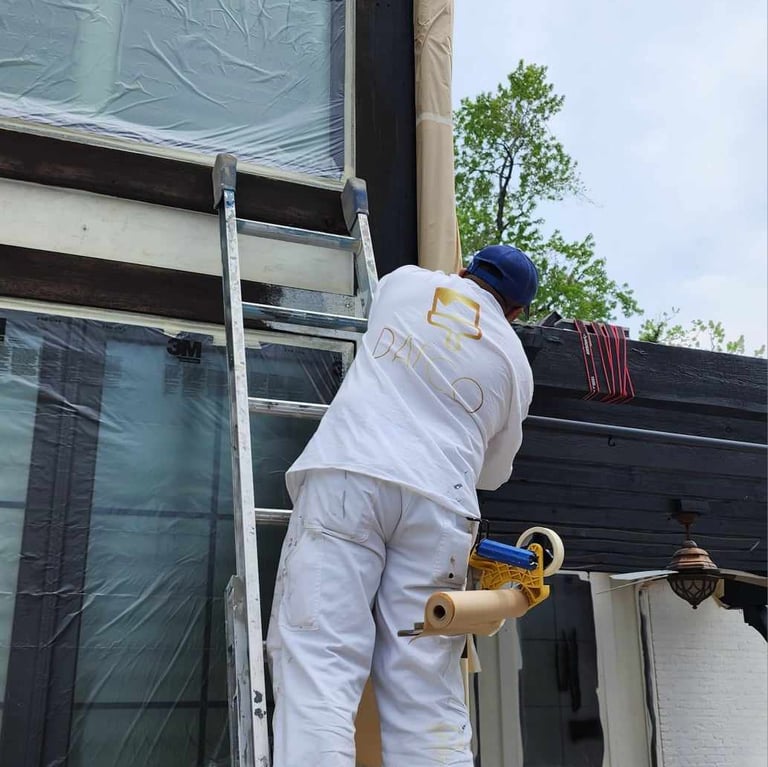
DAECO Painting — Denver & Boulder — Residential Painting Specialist Since 2003
In Washington Park and Capitol Hill, Denver's architecture earns its beauty through decades of character — and earns its punishment from one of North America's most demanding climates. At 5,280 feet, UV exposure runs approximately 25% higher than at sea level. Freeze-thaw cycles stress every painted surface through 300+ days of sunshine and sudden temperature swings. Choosing the right painting company is not a cosmetic decision. It is a preservation decision. DAECO Painting has served Denver homeowners since 2003, building a process engineered for Front Range conditions — not adapted from a national franchise playbook.
The DAECO Standard — What a Residential Paint Project Must Deliver
A legitimate residential painting engagement in Denver delivers four non-negotiable outcomes: thorough surface preparation that consumes 40% or more of total project time; a climate-appropriate coating system using 100% acrylic formulations with verified UV resistance; a fully documented scope specifying products, primer, timeline, and warranty; and a consistent crew with direct accountability — not rotating subcontractors.
Any proposal that cannot address all four in writing before work begins is not a premium offer. It is a risk transfer from the contractor to the homeowner.
Why This Matters in Denver Homes
Denver's residential stock spans Craftsman bungalows in Highlands, Victorian-era homes in Curtis Park, and mid-century architecture across Cherry Creek. Each carries material vulnerabilities that the Denver climate exploits with precision.
Altitude and UV load
High-altitude solar radiation degrades conventional exterior coatings far faster than manufacturers' general-use data suggests. A standard acrylic that performs for seven years at sea level may chalk and fade within three to four years on a south-facing Denver elevation.
Freeze-thaw cycling
Temperature differentials between Denver afternoons and pre-dawn mornings routinely exceed 30°F during shoulder seasons. Paint films applied at incorrect temperatures, or over inadequately cured surfaces, will fail at seams and caulk joints first — typically within 18 to 24 months.
Oil-to-latex transition
Denver's older historic homes almost universally carry oil-based primer layers from previous decades. Applying latex directly over oil without a bonding primer or proper sanding creates a delamination failure point that no top coat quality can prevent.
Key Insight: The Front Range climate is not simply "harsh." It is a specific combination of high UV, low humidity, and thermal cycling that requires coating systems designed for that triad — not generalized professional-grade products applied without local adaptation.
The Professional Process — Step by Step
Understanding what a rigorous Denver exterior or interior project requires helps homeowners evaluate proposals accurately before committing.
Site Assessment and Material Identification
Before pricing, a qualified contractor identifies existing coating type (oil vs. latex), substrate condition, presence of lead paint in pre-1978 construction, and moisture intrusion points. This assessment determines primer specification and surface repair scope.
"In Denver's historic districts, we don't just 'test' for lead — we assume its presence in all pre-1978 substrates and deploy full HEPA-shrouded tool chains from minute one. This isn't a surcharge. It's a safety standard."
Lead-Safe Protocols (Pre-1978 Homes)
EPA RRP-certified contractors follow federal guidelines for containment, wet sanding, HEPA vacuuming, and waste disposal. In Denver's historic neighborhoods — Curtis Park, Potter-Highlands, Whittier — this is legal requirement and occupant protection.
Surface Preparation
Power washing removes contaminants. Full scraping and sanding address failing coatings. Compromised wood is replaced with composite or cedar before any coating is applied. Caulk joints at trim, windows, and penetrations are removed and reapplied with flexible, paintable sealant rated for thermal movement.
Primer Application
Penetrating primer for bare wood; bonding primer for oil-over-latex transitions; alkali-resistant formulation for masonry. Primer selection is not decorative — it is the mechanical bond that determines whether the top coat lasts three years or fifteen.
Top Coat Application
Two-coat minimum with 100% acrylic exterior formulations — Sherwin-Williams Emerald Exterior or Benjamin Moore Aura Exterior are current Front Range standards. Dry film thickness is measured and documented to meet manufacturer minimums at altitude.
Documentation and Walkthrough
Written warranty, product data sheets, and a documented walkthrough confirm scope completion. A reputable Denver contractor provides CO license number, general liability certificate, and workers' compensation proof within 24 hours of request.
Cost and Value — The Real Comparison
To accurately evaluate a painting proposal in Denver, homeowners must look past the bottom-line number and examine the performance metrics that dictate long-term ROI. Below is the direct comparison between the standard low-bid/broker model and the
DAECO Standard.
Surface Preparation: The low-bid model typically allocates only 10–20% of project time to prep, focusing on speed. The DAECO Standard dedicates 35–45% of the total timeline to preparation, ensuring the substrate is ready to hold a bond for a decade or more.
Primer Specification: Generic or omitted primers are common in low-bid proposals to save on material costs. DAECO utilizes substrate and climate-specific formulations, ensuring the chemical bond is engineered for high-altitude UV and thermal cycling.
Lead-Safe Protocols: Most contractors treat lead safety as test-dependent or omit it entirely to move faster. DAECO operates on an assumption-based model, meaning we are active with lead-safe protocols from day one to ensure total occupant protection in historic neighborhoods.
Crew Structure: Broker models rely on rotating subcontractors who may have no long-term tie to the company. DAECO utilizes a consistent W-2 crew, ensuring the same skilled painters who start the project are there to finish it.
Warranty and Longevity: While a low bid may offer a verbal or 1-year "tailgate" warranty, DAECO provides a written 5–10 year warranty. This directly impacts the repaint cycle: a cheap job typically fails in 3–5 years, whereas the DAECO Standard is engineered to last 10–20 years.
The Bottom Line: Cost Per Year: When cycles are counted over a fifteen-year period, the low-bid model results in a significantly higher cost of ownership due to frequent failures. The DAECO Standard delivers a lower cost per year of performance, protecting both the home and the homeowner's capital.
Common Misconceptions — What the Low Bid Is Actually Selling
"More coats always means better quality."
Coat count without correct film build per coat is irrelevant. Three thin coats of an inferior product perform worse than two properly built coats of a climate-rated system. Ask for dry film thickness targets — not coat count.
"The paint brand is what matters most."
Premium paint applied over inadequate prep fails early. Preparation is the primary longevity driver, not brand. A correctly prepared surface with a mid-tier product outperforms an expensive coating over unprimed, chalked substrate.
"They can start immediately — must be in high demand."
In Denver's painting market, a contractor available immediately in peak spring or summer season most often signals low demand, not high efficiency. Reputable operations with consistent crews book 4 to 8 weeks out during high season.
"An itemized estimate is a scope of work."
A price list is not a scope. A legitimate proposal specifies primer product, topcoat product and coat count, caulk specification, surface repair allowance, warranty terms, and crew structure. Without those elements, you are comparing numbers — not projects.
Cause → Effect — How Paint Fails in Denver
Understanding specific failure modes helps Denver homeowners determine whether a contractor is addressing the root cause of a problem or simply applying a cosmetic "band-aid" that will fail within two seasons.
Peeling and Delamination Within 2 Years: The root cause is almost always an oil-to-latex transition without a bonding primer. In Denver’s older housing stock, applying modern latex directly over legacy oil layers creates a mechanical failure point. The professional solution requires a full strip or aggressive sanding followed by a climate-specific bonding primer system to ensure the new coating fuses to the substrate.
Chalking and Premature UV Fade :This occurs due to insufficient film build at altitude. Denver’s UV radiation is significantly more aggressive than at sea level, "burning" through thin layers of paint. DAECO solves this by applying high-build 100% acrylic formulations and verifying the dry film thickness to meet manufacturer specifications for high-altitude exposure.
Cracking and Separation at Trim Joints: The root cause is the use of rigid caulk over high-movement surfaces. Denver’s extreme freeze-thaw cycles cause wood to expand and contract rapidly. We utilize high-elongation flexible sealants specifically rated for Colorado’s thermal cycling, which move with the home rather than snapping under tension.
Bubbling or Blistering on South Elevations: This is typically caused by application in direct sun above 90°F, which causes the surface of the paint to skin over and trap solvent gases before they can evaporate. The professional solution is staged sequencing, where the crew follows the shade around the house to ensure coatings are applied to cool surfaces, allowing for a proper chemical cure.
Early Rust Bleed on Metal Features: When rust spots appear through new paint on railings or lintels, the cause is the omission of rust-inhibiting primers on ferrous surfaces. We perform a mechanical cleaning of all metal elements and spot prime with specialized ferrous-substrate primers before the topcoat is applied, arresting oxidation at the source.
Real Project Insight — A Curtis Park Victorian
Project Record — Curtis Park, Denver
Problem
A 1905 Victorian presented with severe peeling on north and west elevations, failed caulk at all window surrounds, and active wood rot in three sections of original crown molding — in a lead-paint-present pre-1978 structure.
Solution
Full EPA RRP containment deployed from day one — no test-and-wait protocol. Rotted crown sections replaced with primed composite profiles matched to existing. Bonding primer applied systemwide over existing oil layers. Benjamin Moore Aura Exterior in two coats with documented dry film thickness on all horizontal surfaces.
Outcome
10-year written warranty. Original trim profiles preserved. Total project cost recovered within the second repaint cycle that adjacent-property homeowners had already incurred.
The Preservation Principle
Historic homes are not candidates for speed-optimized production painting. The material decisions made during a paint project — what is replaced versus patched, what primer is specified, what caulk is used at thermal joints — determine whether the home's character survives the next two decades or accelerates toward deterioration that no future paint project can reverse.
Technical Insight — Coatings, Film Build, and Designer Considerations
Sheen and UV Stability
Flat and matte sheens on exterior surfaces accumulate UV damage at the surface layer, accelerating chalking that can transfer-stain adjacent materials. Semi-gloss and satin finishes on trim provide a UV-resistant surface layer while maintaining cleanability. For interior applications, a consistent sheen specification across a room prevents perceptible reflectance variation under Denver's high-contrast natural light.
Low-VOC Off-Gassing at Altitude
Low-VOC and zero-VOC interior formulations off-gas at a rate partially governed by air pressure. At 5,000+ feet, reduced atmospheric pressure accelerates initial off-gassing relative to sea-level manufacturer data. Occupied spaces reach safe air quality thresholds faster than coastal benchmarks suggest, but active ventilation during application remains essential — plan for 2 to 4 hours per room post-application.
A Note for Architects
When specifying interior finishes for Denver renovation projects, request confirmation that the product's colorimetric stability data was generated at altitude or validated by the contractor for Front Range natural light conditions. Color appearance under high-altitude daylight differs measurably from coastal specification data — particularly in northeast-facing rooms where the color temperature shift is most pronounced.
Micro-Intent — The Questions That Stop Homeowners From Booking
Homeowner friction questions — answered by DAECO
"How do you protect my original hardwood floors during spray application?"
DAECO uses a layered floor protection system: rosin paper as the primary layer (absorbs overspray, resists foot traffic without trapping moisture against wood), covered by heavy canvas drop cloths at all active working areas. No plastic sheeting is placed directly on hardwood — plastic traps humidity and can cause finish lifting on refinished floors. All protection is inspected and repositioned between rooms.
"What is the actual off-gassing timeline for low-VOC paints at Denver's altitude?"
At 5,280 feet, reduced atmospheric pressure accelerates initial off-gassing compared to manufacturer data gathered at sea level. For most low-VOC interior latex formulations, primary off-gassing is complete within 2 to 4 hours of application in a ventilated space. Full reoccupancy for sensitive individuals is recommended at 24 to 48 hours post-final coat. DAECO provides product data sheets with VOC content for every specified product before project start.
"Do you use the same crew from day one through project completion?"
Yes. DAECO operates with consistent W-2 crews — not rotating subcontractors. The same lead painter who conducts the pre-project walkthrough performs the work. This eliminates the accountability gap that occurs when an estimator sells a scope that a different, unvetted crew executes.
"What happens if I need to pause or reschedule mid-project?"
All DAECO contracts include a project pause protocol that specifies re-sequencing, staging area management, and a documented restart inspection. Denver's weather — particularly spring hail events and late-season temperature drops — occasionally requires mid-project holds. The plan for that scenario is written into the contract before work begins, not improvised when it occurs.
Frequently Asked Questions
What should I look for when comparing Denver painting company estimates?
Compare scope of work, not price. A legitimate estimate specifies the primer product, topcoat product and coat count, caulk specification, surface repair allowance, crew structure, and warranty terms in writing. Price alone cannot be evaluated without understanding what preparation and materials are included. Two estimates at different prices may represent entirely different projects.
Why do paint jobs fail faster in Denver than in other cities?
Denver's combination of high-altitude UV exposure, low ambient humidity, and significant freeze-thaw cycling creates coating stress that standard preparation methods and products cannot sustain. Paint failures in Denver are almost always preparation or product-specification failures — not top coat failures. The surface system determines the outcome, not the visible color layer.
How do I verify that a Denver painting contractor is legitimate?
Request the contractor's Colorado contractor registration number, current general liability insurance certificate (minimum $1M per occurrence), and workers' compensation coverage documentation. A reputable contractor provides all three within 24 hours of request. The absence of any single document is a disqualifying red flag — not a bureaucratic inconvenience.
Internal Cluster Reinforcement
→Exterior painting preparation in Denver — the full scraping, sanding, and caulking sequence specific to Front Range substrates and seasonal timing windows.
→Lead paint and pre-1978 home painting guide — EPA RRP assumption-based protocols for Denver's historic districts before any contractor begins surface work.
→Interior coating specification guide — sheen selection, colorimetric stability data, and low-VOC scheduling for architects and designers on Denver renovation projects.
DAECO Painting has operated in Denver since 2003 — not as a franchise location, not as a lead-generation model, but as a contractor whose reputation is built on the performance of its work across one of the most demanding painting climates in North America. Every project reflects the same preparation standards, the same coating specifications, and the same crew accountability that a homeowner's investment deserves. Denver's homes are worth protecting correctly — and the standard that achieves that is not a price point. It is a process.
Ready for Your Custom Quote?
As we hope you've learned, we take every aspect of your house into account when determining the cost of painting your home. Get in touch with us so we can provide you a detailed cost for painting your home.