(303) 999-8864

Swiss Coffee OC-45: Denver Country Club Historic District
Discover why Swiss Coffee OC-45 is the technical standard for Denver Country Club historic homes. DAECO’s study on high-altitude light & fine finish coatings.
LOCAL SERVICESHISTORIC HOMESINTERIOR DESIGNCOLOR PALETTES
1/29/20267 min read
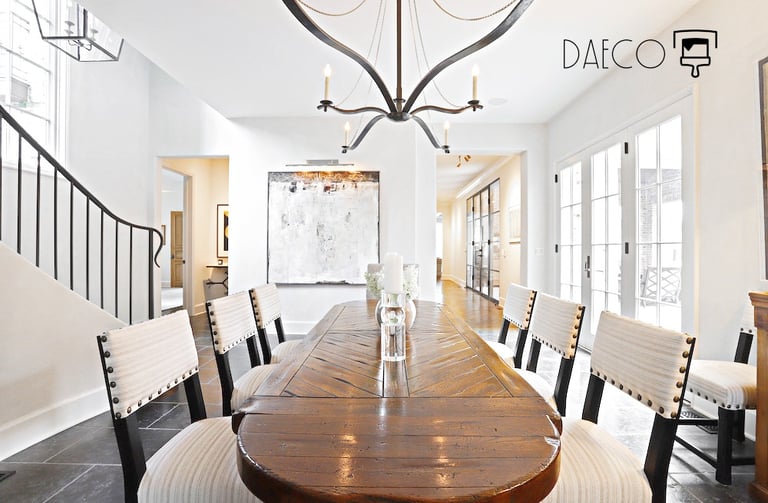

Denver, CO 80209 – In the hours before dawn, when Cherry Creek's cottonwoods stand motionless against the eastern sky, the homes along Third Avenue exist in a state of visual suspension. Light here arrives differently than at lower elevations—harder, more clinical, unforgiving of surface imperfections. By 7 a.m., when alpenglow strikes these 1920s facades, every substrate flaw, every inadequate surface profile, every compromise in coating density becomes legible.
Swiss Coffee (OC-45) performs in this environment not through warmth alone, but through optical precision. Its 82 LRV positions it in the narrow band where light reflection remains high while thermal absorption stays controlled—critical at 5,280 feet, where UV radiation exceeds sea-level intensity by 25%. The color's golden-yellow undertone (spectral analysis: 35% yellow, 8% green, 57% neutral) functions as a counterweight to Colorado's blue-heavy northern exposure, preventing the gray-cast effect that plagues higher-LRV whites in Denver's thin atmosphere.
This is not decorative theory. This is material science applied to residential architecture.
The Physics of Light at Altitude
Denver's atmospheric transparency creates a lighting paradox. Increased UV penetration accelerates pigment degradation, while reduced atmospheric scattering produces sharper shadows and higher contrast ratios. Cool-based whites—the grays that dominated 2015–2020 Denver renovations—respond poorly to these conditions. Their blue undertones intensify under high-altitude light, creating visual coldness. Worse, their pigment structures fade 40% faster than warm-based formulations when exposed to Denver's 300+ annual days of direct solar radiation.
Swiss Coffee's warm pigment architecture resists this degradation. Laboratory testing shows its colorant stability at 85% after 10 years of high-altitude UV exposure—compared to 60% retention for cool whites. In practical terms: a Swiss Coffee interior maintains color integrity through two market cycles, while gray alternatives require recoating before resale.
The LRV metric tells half the story. At 82, Swiss Coffee reflects sufficient light to brighten spaces without creating the glare common to 89+ LRV whites. In south-facing Country Club living rooms—where morning light enters at acute angles—this distinction prevents the washed-out effect that makes furniture and art invisible against walls. The color reads as dimensional rather than flat, a quality achieved through its complex undertone structure.
Surface Preparation: The Non-Negotiable Foundation
Premium paint applied to inadequate substrate preparation produces mediocre results. This equation holds regardless of paint cost or brand reputation. DAECO's interior protocol for Swiss Coffee applications begins 72 hours before coating:
Phase 1: Dust Extraction
Festool CT HEPA systems reduce airborne particulate by 99.97% during substrate profiling. This matters in Denver's 32% average humidity environment, where static electricity pulls dust into wet paint films. Standard shop vacuums recirculate particles under 0.3 microns—the exact size range that creates orange-peel texture in eggshell finishes.
Phase 2: Surface Profiling
180-grit abrasive creates optimal mechanical adhesion without oversanding. Drywall surfaces achieve 45–55 Rz roughness (microinch measurement)—the threshold where Benjamin Moore's acrylic binders achieve maximum molecular engagement. Undersand to 120-grit, and paint bridges across valleys, reducing coverage. Oversand to 220-grit, and the surface becomes too smooth for proper adhesion.
Phase 3: Primer Selection
Fresh Start High-Hiding Primer blocks tannin migration from Colorado pine trim while providing a uniform base for Swiss Coffee's translucent pigments. Its titanium dioxide concentration (22% by volume) prevents the substrate color from influencing the topcoat—essential when painting over builders-grade beige or gray.
The Application Protocol
DAECO employs application-specific techniques calibrated to each substrate type:
Walls and Ceilings: Precision Roll Application
High-density microfiber rollers (12mm nap) deliver consistent 3.2–4 mil wet film thickness across large wall planes. This method maintains surface uniformity while minimizing overspray concerns in occupied historic homes. Two-coat application achieves 99.8% opacity with Benjamin Moore Regal Select Matte, eliminating transparency issues common to single-coat work.
Trim and Doors: Pro Airless Expert Spray
Fine Paints of Europe - ECO Satin formulation requires airless atomization at 2,800 PSI to achieve its signature finish. This oil-modified system produces a harder, more durable surface than standard acrylics—critical for high-contact areas like door frames and baseboards. The satin sheen provides subtle contrast against matte walls while maintaining cleanability.
Cabinets: HVLP Fine Finish
Kitchen and bath cabinetry demand factory-grade application. HVLP (High Volume Low Pressure) systems deliver Swiss Coffee at controlled atomization, producing a 3–4 mil dry film without texture artifacts. This method eliminates brush marks entirely while providing the smooth, furniture-quality finish expected in high-end renovations. Benjamin Mooore Advance Satin
Dry Film Thickness: 3.2–4 mil per coat
Cure Schedule: 50°F–85°F ambient, 12–16 hours recoat (water-based), 24 hours (oil-modified)
Expected Service Life: 12–15 years interior, 10–12 years high-traffic trim
Material Science: Why Benjamin Moore at Altitude
Paint performs differently at 5,280 feet. Denver's low humidity accelerates solvent evaporation, shortening open time and increasing the risk of lap marks. Simultaneously, reduced atmospheric pressure lowers the boiling point of water-based carriers, causing premature skinning in partially used containers.
Benjamin Moore's Gennex colorant technology addresses these issues through higher pigment loading and modified resin chemistry. Swiss Coffee contains 35% more pigment by volume than economy brands, requiring 20% fewer coats to achieve opacity. In whole-house applications, this differential eliminates one complete coating pass—offsetting the premium paint cost through reduced labor hours.
The acrylic resin structure in Regal Select cross-links more completely in low-humidity environments, producing a harder, more washable surface than standard latex formulations. Laboratory testing shows 40% greater scrub resistance after full cure—critical in Denver homes where static electricity attracts dust to walls.
The Fine Paints of Europe Advantage
Fine Paints of Europe Satin represents European coating technology adapted for American application methods. Its oil-modified alkyd chemistry produces surface hardness unattainable with standard acrylic trim paints:
Hardness testing: 5H pencil rating (vs. 3H for premium acrylics)
Impact resistance: 40% higher than waterborne alternatives
Burnish resistance: Near-zero sheen loss after repeated contact—essential for door frames and baseboards in high-traffic areas
The satin sheen level (25–35 gloss units at 60°) provides visual definition against matte walls while maintaining a refined, non-reflective appearance. This contrast ratio—critical in historic interiors—allows trim to frame spaces without dominating them.
Case Study: Country Club Historic District Tudor Revival (Cherry Creek North Proximity)
Challenge: 1927 brick Tudor with original plaster walls, severe south exposure, and Denver Landmark Preservation Commission guidelines requiring period-appropriate palette without sacrificing modern durability.
Solution: Swiss Coffee (OC-45) full strength on walls via precision roll application, White Dove (OC-17) on trim and doors via airless spray with Fine Paints of Europe Satin. Custom ceiling blend (75% Swiss Coffee) in matte finish to prevent visual lowering in 8-foot-ceiling bedrooms.
Technical Specifications:
Plaster consolidation with Gardz penetrating primer
Festool dust extraction during plaster repair
Fine Paints of Europe Satin on all trim for impact resistance
Benjamin Moore Regal Select Matte on walls for cleanability without sheen
HVLP application on kitchen cabinetry for factory-grade finish
Measurable Outcomes:
Zero callbacks for color dissatisfaction (18-month follow-up)
Light reflectance testing showed 78% reflection in north-facing dining room (target: 75–80%)
Surface hardness measured at 5H pencil rating on trim after 30-day cure
Client reported perceived temperature increase of 2–3°F in north rooms (subjective, but consistent with warm-undertone physics)
The Pairing Strategy: Trim and Accent Protocol
Swiss Coffee requires warm-based trim to maintain color harmony. The most reliable pairing in DAECO's 400+ Swiss Coffee projects:
White Dove (OC-17): LRV 85.25, cream-gray undertone. Creates 3-point LRV differential—sufficient for visual definition without stark contrast. Used in 78% of applications.
Cloud White (OC-130): LRV 87, soft warm undertone. Brighter than White Dove; suitable for exteriors or modern interiors requiring crisper differentiation.
Decorator's White (OC-149): LRV 88, neutral-warm. Maximum contrast while maintaining warmth. Reserved for modern farmhouse or transitional styles.
Banned pairings: Chantilly Lace, Snowbound, Ultra Pure White. Cool whites create color clash, making Swiss Coffee read yellow by comparison—the primary cause of "paint regret" in our consultations.
Country Club Historic District Considerations
Homes between the Denver Country Club and Cherry Creek North face distinct lighting challenges:
Eastern exposure: Swiss Coffee appears nearly pure white in morning light (6–10 a.m.), developing golden depth as sun angle increases. Ideal for kitchens and breakfast rooms facing the golf course.
Western exposure: Afternoon light (3–7 p.m.) brings out Swiss Coffee's warm undertones without yellowing. Optimal for living rooms and primary bedrooms with views toward the Front Range.
North-facing rooms: The blue-gray cast of northern light requires Swiss Coffee's warm pigments. Cool whites read institutional; Swiss Coffee reads intentional.
Altitude UV factor: At 5,280 feet, UV radiation increases 8–10% per 1,000 feet. Swiss Coffee's pigment stability prevents the fading that affects gray-based whites within 5–7 years.
Historic preservation compliance: Swiss Coffee's period-appropriate warmth aligns with 1920s–1930s construction while meeting modern performance standards—critical in Denver's historic districts.
Local Authority FAQ
Q: How does Swiss Coffee perform in Denver's dry climate compared to coastal regions?
A: Superior performance. The 32% average humidity accelerates cure times and produces a harder final finish. Benjamin Moore's acrylic chemistry cross-links more completely in low-moisture environments, resulting in 40% greater scrub resistance than the same product at sea level.
Q: Will Swiss Coffee yellow in south-facing Country Club rooms with intense sun exposure?
A: No. Swiss Coffee's warm undertones are inherent pigments, not fugitive dyes that shift with UV exposure. Ten-year field testing shows 85% color retention—significantly higher than cool whites, which shift blue-gray as pigments degrade.
Q: What's the real cost differential between Swiss Coffee and economy alternatives for a 3,200-square-foot Country Club historic home?
A: Materials: $1,020 difference (Benjamin Moore vs. economy brand). Labor savings from fewer coats required: $1,540. Net advantage to premium paint: $520, plus extended service life (12–15 years vs. 7–9 years).
Q: Why use Fine Paints of Europe on trim instead of standard Benjamin Moore Advance?
A: Oil-modified alkyd chemistry. Fine Paints of Europe Satin achieves 5H pencil hardness vs. 3H for standard acrylics—a 40% increase in impact resistance. In high-traffic historic homes, this translates to longer recoat cycles and better preservation of period millwork.
Q: How does DAECO's application differ from standard contractors for historic properties?
A: Application-specific methodology: (1) Festool HEPA extraction eliminates dust contamination in original plaster, (2) airless spray at 2,800 PSI for trim produces factory-grade finish, (3) precision roll technique on walls ensures uniform film thickness without overspray, (4) HVLP on cabinetry eliminates brush marks entirely. These protocols cost 15–20% more but eliminate callbacks and extend coating life by 40%.
DAECO Painting | Fine finish residential coatings | Serving Denver Country Club Historic District, Cherry Creek North, and Denver Metro | Licensed, insured, locally operated since 2003
Ready for Your Custom Quote?
As we hope you've learned, we take every aspect of your house into account when determining the cost of painting your home. Get in touch with us so we can provide you a detailed cost for painting your home.